Digital Transformation
What Is Agentic AI? The Beginner’s Guide to AI That Takes Action for You
Explains agentic AI and its PRAL loop, how it differs from traditional and generative models, real-world uses, risks, and how to start safely.

What Is Agentic AI? The Beginner’s Guide to AI That Takes Action for You
Agentic AI refers to artificial intelligence systems that operate independently to complete tasks from start to finish. Unlike traditional or generative AI, which rely on human input or prompts, agentic AI uses a Perceive, Reason, Act, and Learn (PRAL) loop to make decisions, execute actions, and improve over time. These systems are designed to handle complex workflows with minimal human oversight.
Key Takeaways:
- Autonomous Execution: Agentic AI performs tasks without constant instructions, such as automating code updates or managing workflows.
- Goal-Oriented: It works backward from a defined objective, breaking it into smaller tasks and adjusting strategies in real time.
- Real Applications: Businesses use it for tasks like customer service, finance, healthcare, and logistics, cutting costs and saving time.
- Growth Potential: By 2028, 15% of routine work decisions are expected to be made by agentic AI, with the market projected to exceed $47 billion by 2030.
For beginners, starting with low-risk tasks and incorporating human oversight is a practical way to explore its potential while minimizing errors.
Agentic AI Explained So Anyone Can Get It!
sbb-itb-212c9ea
How Agentic AI Differs from Other AI Types
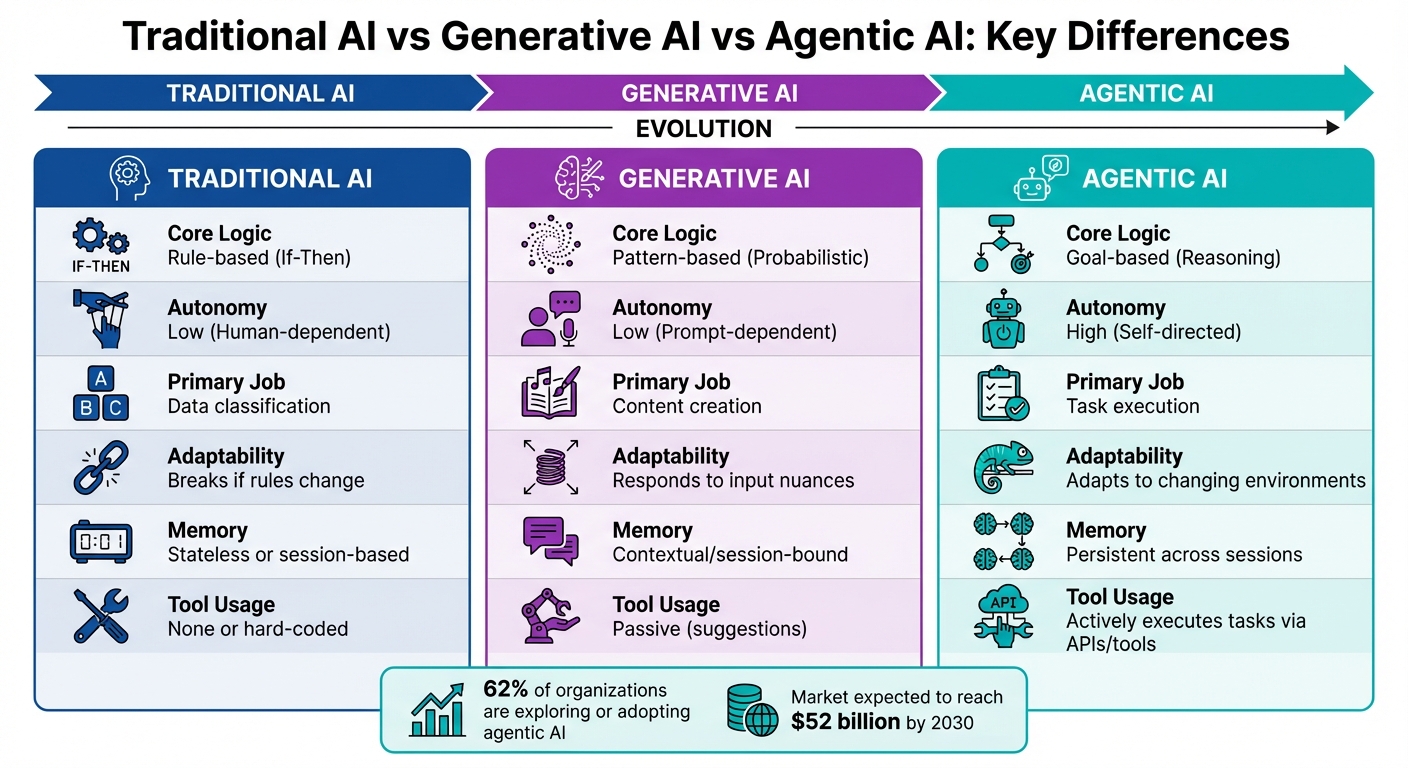
Comparison of Traditional AI vs Generative AI vs Agentic AI
Agentic AI vs. Traditional AI
Traditional AI operates on a straightforward "if-then" framework, relying heavily on predefined rules and human oversight. This structure often struggles to adapt when unexpected conditions arise.
Agentic AI, on the other hand, takes a goal-oriented approach. Rather than waiting for specific instructions, it begins with a clear objective - essentially working backward from "goal Z" to figure out the steps needed to achieve it. It breaks down the objective into smaller tasks, selects the right AI agent tools, and adjusts its strategy in real time based on feedback.
By 2026, experts predict that 40% of enterprise applications will incorporate task-specific AI agents, a sharp increase from under 5% in 2025. Companies already using these systems report productivity boosts ranging from 25% to 40%. The Identity Defined Security Alliance captures the essence of this shift:
"Unlike traditional machine learning systems that operate within narrow, predictable parameters, today's AI agents demonstrate dynamic tool use, adaptive reasoning, and the ability to navigate ambiguous situations with minimal guidance."
This evolution sets agentic AI apart from both traditional and generative systems, especially in how it handles tasks.
Agentic AI vs. Generative AI
Generative AI focuses on creating content based on input. It's reactive by design, producing results in response to prompts, and typically "forgets" the context once the session ends.
Agentic AI, however, goes beyond generating content - it takes action. It can perform tasks like calling APIs, updating databases, sending emails, and managing workflows across various tools. It also maintains persistent memory, allowing it to track and work toward long-term objectives across multiple sessions. As one expert from the Civic Team explains:
"If traditional AI helps you think, agentic AI helps you get things done."
The key differences between these AI types are summarized in the table below:
| Feature | Traditional AI | Generative AI | Agentic AI |
|---|---|---|---|
| Core Logic | Rule-based (If-Then) | Pattern-based (Probabilistic) | Goal-based (Reasoning) |
| Autonomy | Low (Human-dependent) | Low (Prompt-dependent) | High (Self-directed) |
| Primary Job | Data classification | Content creation | Task execution |
| Adaptability | Breaks if rules change | Responds to input nuances | Adapts to changing environments |
| Memory | Stateless or session-based | Contextual/session-bound | Persistent across sessions |
| Tool Usage | None or hard-coded | Passive (suggestions) | Actively executes tasks via APIs/tools |
These distinctions underscore why agentic AI is becoming essential for automating complex, real-world processes. While generative AI is widely used - nearly 80% of companies employ it - its passive nature often limits its impact on revenue. In contrast, agentic AI’s ability to handle end-to-end task execution has led 62% of organizations to explore or adopt it. The market for agentic AI is expected to grow significantly, reaching $52 billion by 2030.
This shift marks a move from reactive systems to autonomous agents capable of real-world action.
Core Features and How Agentic AI Works
Main Features of Agentic AI
Agentic AI stands out with five key traits: autonomy, goal-directed behavior, adaptability, memory, and tool use. Autonomy allows the system to operate on its own, making decisions based on user-defined goals rather than needing constant input. Its goal-directed behavior ensures the AI focuses on achieving specific outcomes - like "book a trip" or "process this invoice" - rather than simply reacting to individual prompts. Adaptability means the system can adjust its strategies in response to new data or unexpected challenges. Memory enables it to retain context across multiple sessions, which improves performance over time. Finally, tool use allows these agents to interact with external APIs, search the web, or use software interfaces to accomplish tasks.
As IBM explains:
"Without any human intervention, agentic AI can act independently, adapt to new situations, make decisions, and learn from experience."
These features elevate AI from being a passive assistant to an active, problem-solving partner. By bringing these capabilities together, Agentic AI mirrors how humans approach and execute tasks.
The Agentic AI Workflow
Agentic AI operates through a structured six-phase cycle designed to handle complex tasks. These phases - perception, goal setting, planning, action, evaluation, and learning - create a continuous loop that drives its functionality.
The process begins with perception and input, where the system gathers data from various sources, such as user commands, API streams, databases, or sensors. This is followed by goal setting and analysis, where the AI interprets the user’s objective and evaluates the current context to understand what needs to be achieved.
Next is planning and reasoning, where the AI breaks down the goal into smaller, manageable tasks. It often uses chain-of-thought reasoning to anticipate potential outcomes and map out the best course of action. In the action execution phase, the AI carries out the planned steps - whether it’s sending an email, updating a CRM like HubSpot, or running specific code.
After each action, the system enters the observation and evaluation phase, monitoring the results (such as API responses or task confirmations) to ensure success. The final phase, learning and feedback, involves assessing progress toward the overall goal. If a step fails, the AI adjusts its approach and stores the experience in memory, improving future decision-making.
This workflow has already delivered impressive results. In February 2026, the U.S. Internal Revenue Service (IRS) implemented Salesforce Agentforce within its Office of Chief Counsel and Taxpayer Advocate Services. The system automated 98% of manual tasks, cutting the time to open a tax court case from 10 days to just 30 minutes. Similar efficiencies are seen in private sectors, where AI tools for sales professionals automate lead management and outreach. This saved an estimated 500,000 minutes of work annually. Reflecting on the impact, Pidugu, a U.S. Department of Transportation official, remarked:
"It's mind-blowing what the number of actual days of work is that we can save by doing this"
Despite its efficiency, the system isn’t flawless. A five-step workflow with 95% accuracy per step results in an overall success rate of about 77%. This highlights the importance of safeguards like action allowlists, parameter validation, and human oversight.
Professor Ethan Mollick sums up the transformative potential of this technology:
"The real power of [AI] agents might be that they solve the organizational problem of how to integrate AI into existing workflows. For better or worse, they act much more like people that can independently execute tasks"
Where Agentic AI Is Used Today
Industry Applications of Agentic AI
Agentic AI is making waves across a variety of industries by handling complex tasks with minimal human intervention. In customer service, these AI agents can resolve issues from start to finish - processing refunds, troubleshooting technical problems via API calls, and prioritizing tickets based on customer history. In sales and marketing, teams use agents to qualify leads, personalize outreach, schedule meetings, and tweak campaign messaging based on real-time engagement metrics.
In finance and compliance, agentic AI systems monitor massive volumes of transactions to detect fraud, match payouts to ledgers, and resolve invoice exceptions by gathering missing documentation. Over in healthcare, these systems track patient data to flag emergencies, optimize scheduling according to clinical needs, and handle administrative tasks like verifying insurance.
Supply chain and logistics operations benefit from agents that monitor global disruptions - like weather or economic shifts - and autonomously reroute shipments or adjust delivery plans. This adaptability is crucial in an industry where profit margins can be tight. Meanwhile, human resources teams deploy agents to streamline onboarding processes, including setting up payroll, software, and benefits inquiries. In IT and software development, agents step in to manage DevOps rollbacks, monitoring health checks after failed deployments and reverting to stable versions automatically.
Adoption of agentic AI is growing fast. According to recent data, 67% of developers and product leaders report their teams are already building or deploying agentic workflows, and 69% of organizations are prioritizing speed and responsiveness over cost savings.
Agentic AI Task Examples
Agentic AI's ability to handle end-to-end tasks showcases its measurable impact. For instance, in October 2025, Easterseals, a U.S. non-profit health provider, implemented Thoughtful AI's agents to automate revenue cycle management. These agents streamlined processes like eligibility verification, coding, and appeals, cutting average accounts receivable days by 35 and reducing primary claim denials to under 2%.
Similarly, OI Infusion Services, a U.S. provider network, turned to agentic AI in October 2025 to manage specialty medication prior-authorizations. The agents automated insurance verification and payer communications, slashing approval times from 30 days to just three. In cybersecurity, the State of Oklahoma's Office of Management and Enterprise Services deployed Darktrace's Cyber AI Analyst in October 2025 to enhance network security. This system reduced daily alerts from 3,142 to 162 actionable incidents, identified 18 critical threats, and saved an estimated 2,561 analyst-hours - equivalent to adding 30 full-time analysts.
In the insurance sector, Zurich Insurance Group used agentic AI within its ZCAM subsidiary to power an internal CRM platform. By aggregating policyholder data and suggesting product recommendations autonomously, the system reduced customer service completion times by over 70%. In telecommunications, Telstra, an Australian company, deployed two AI agents in October 2025 to assist contact center staff. These agents retrieved information from knowledge bases and summarized customer histories, cutting follow-up calls by 20% and boosting agent effectiveness by 90%.
In finance, JPMorgan's COiN system processes over 12,000 commercial agreements in seconds - a task that previously consumed 360,000 manual hours. Elsewhere, a Toronto clinic utilized a Voiceflow-powered agent to manage after-hours inquiries, generating an extra $50,000 in revenue. Andrew Ng, Founder of DeepLearning.AI, highlighted the potential of agentic AI, stating:
"The transition to agent-driven workflows is likely to deliver greater short-term progress than even the next generation of basic models."
Despite these advancements, organizations remain cautious. Currently, only 4% of teams allow agents to operate without human oversight, opting for graduated trust models when dealing with high-risk tasks.
Finding Agentic AI Tools on AI Apps
How AI Apps Helps You Discover Agentic AI Tools
AI Apps makes finding agentic AI tools simple, offering a multilingual directory packed with over 1,900 tools and 557+ specialized agents. These tools are organized to help users automate repetitive tasks across countless industries. Whether you're looking for an AI agent builder or digital workers, the platform's advanced filters let you search by category or industry, making it easy to find the right match for your needs.
What sets AI Apps apart is its thorough quality checks. Tools are tested in simulated real-world scenarios, with metrics like task completion rates, error handling, and actual costs per session clearly presented. This transparency is especially important for high-volume tasks, where costs can add up quickly - for example, some models may charge $0.12 per screenshot. To make your decision even easier, side-by-side comparison tables let you weigh options based on category, price, and user ratings. Once you've found the right tool, you can move on to integrating it seamlessly into your workflow.
Getting Started with Agentic AI on AI Apps
If you're new to agentic AI, start by using AI Apps' search and filter features to find no-code tools. These options are perfect for beginners, as they often include prompt assistants to refine your instructions and ensure the agent performs as expected.
For a quick introduction, try using pre-made templates designed for common tasks like lead generation, meeting management, or expense tracking. These templates help you understand how the tools work before you dive into customization. Once you've selected a tool, connect it to your existing systems - such as Slack or your CRM - to make it a part of your daily workflow.
Start small with low-risk tasks, like summarizing a document, and include "pause for approval" steps for more sensitive processes. Regularly review dashboards to adjust and improve the agent's performance as you gain confidence.
Conclusion
Agentic AI is changing the game by turning reactive tools into proactive digital teammates capable of autonomously executing workflows. These systems go beyond simply generating content - they can perceive, reason, act through APIs, and continuously learn from feedback. This "delegate and done" concept elevates AI from being a mere assistant to a powerful productivity enhancer.
The results speak for themselves. Gartner estimates that by 2026, over 40% of enterprise automation projects will incorporate agentic AI. Businesses using these tools have reported significant reductions in process times. On top of that, organizations see an average return of $3.70 for every dollar spent on AI automation, with leading companies achieving up to 10× ROI.
For those just starting, it's smart to focus on low-risk, repetitive tasks - like sorting emails or summarizing meetings - where mistakes have minimal consequences. As you gain confidence, you can scale up. However, always maintain human oversight for critical actions involving finances, data deletion, or external communications. This balanced approach demonstrates how agentic AI can transition from basic assistance to managing complex workflows.
If you're ready to explore these possibilities, AI Apps simplifies the process with a directory of over 1,900 AI tools. The platform provides clear metrics on task success rates, error handling, and costs per session, making it easier to find the right fit. Whether you're aiming to automate customer support - cutting costs from $15–$25 per interaction to just $2–$4 - or optimize internal processes, their filters and comparison tools help you make informed decisions.
FAQs
What tasks should I start with for agentic AI?
Start by targeting tasks that involve automating multi-step workflows and decision-making processes. For instance, you could handle employee requests like password resets, streamline customer support ticket management, or take care of routine operations such as updating billing systems or consolidating data. Prioritize narrow, clearly defined tasks to ensure the AI functions safely and efficiently while demonstrating its ability to operate independently.
How do I keep an AI agent from making risky mistakes?
When working with agentic AI, avoiding risky mistakes requires sticking to responsible governance practices and established safety frameworks. This means prioritizing thorough testing, maintaining transparency, implementing robust security protocols, and ensuring proper oversight to keep operations safe.
Equally important is gaining a clear understanding of the AI's architecture and its potential failure modes. Regular monitoring and validation processes are essential, along with integrating fail-safes or manual overrides. These measures help manage risks effectively and ensure that humans retain control over the AI's autonomous decision-making.
What do I need to connect agentic AI to my tools and data?
To link agentic AI to your tools and data, you’ll need to provide access through APIs or similar interfaces. This connection allows the AI to interpret its surroundings, make informed decisions, and operate independently. Be sure to carefully plan for security and transparency during the integration process, as the AI will handle workflows, activate tools, and complete tasks without requiring continuous human oversight.