Financial Technology
AI Budgeting vs. Traditional Methods
Compare AI-powered budgeting and manual spreadsheets: automation, accuracy, cost, and when to choose each for personal or business finances.
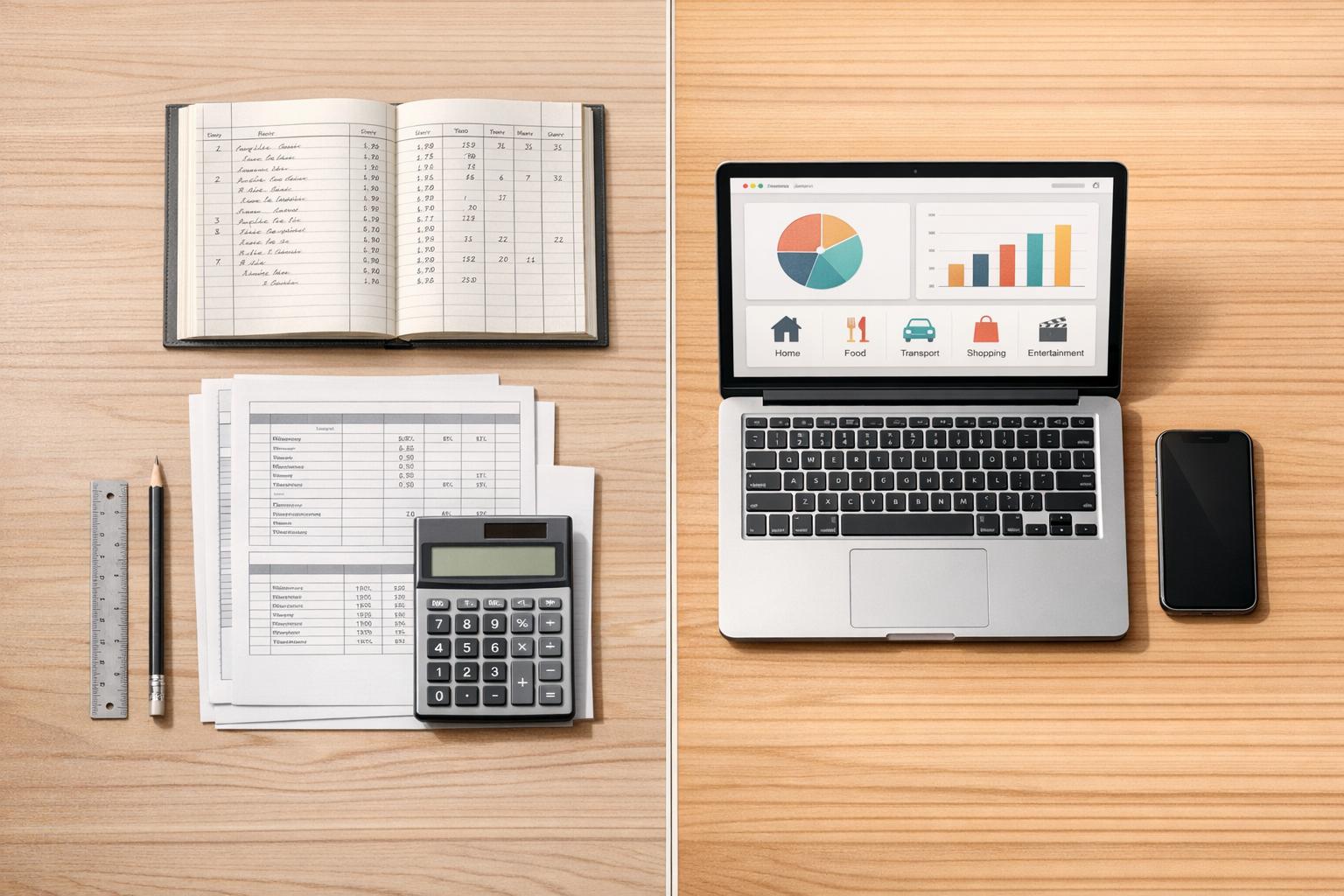
AI Budgeting vs. Traditional Methods
Budgeting is essential for managing your finances, but the method you choose can make a big difference. AI-powered budgeting tools automate tasks, predict expenses, and analyze spending patterns, saving time and improving accuracy. In contrast, manual methods like spreadsheets offer customization and zero cost but require significant effort and are prone to errors.
Key Takeaways:
- AI Budgeting: Automates tracking, categorizes transactions with 85–90% accuracy, predicts future expenses, and costs $4–$15/month. Users report cutting expenses by up to 20% and increasing savings by 30%.
- Manual Budgeting: Free and customizable but demands 5–10 hours/month of manual work. Focuses on past spending without predictive insights.
| Feature | AI Budgeting | Manual Budgeting |
|---|---|---|
| Time Efficiency | Automated, minimal effort | 5–10 hours/month, manual effort |
| Cost | $4–$15/month | Free |
| Accuracy | High, algorithm-driven | Prone to human error |
| Forecasting | Predictive insights | Limited to past trends |
Choose AI if you want automation and insights. Stick with manual methods if cost and simplicity matter most.
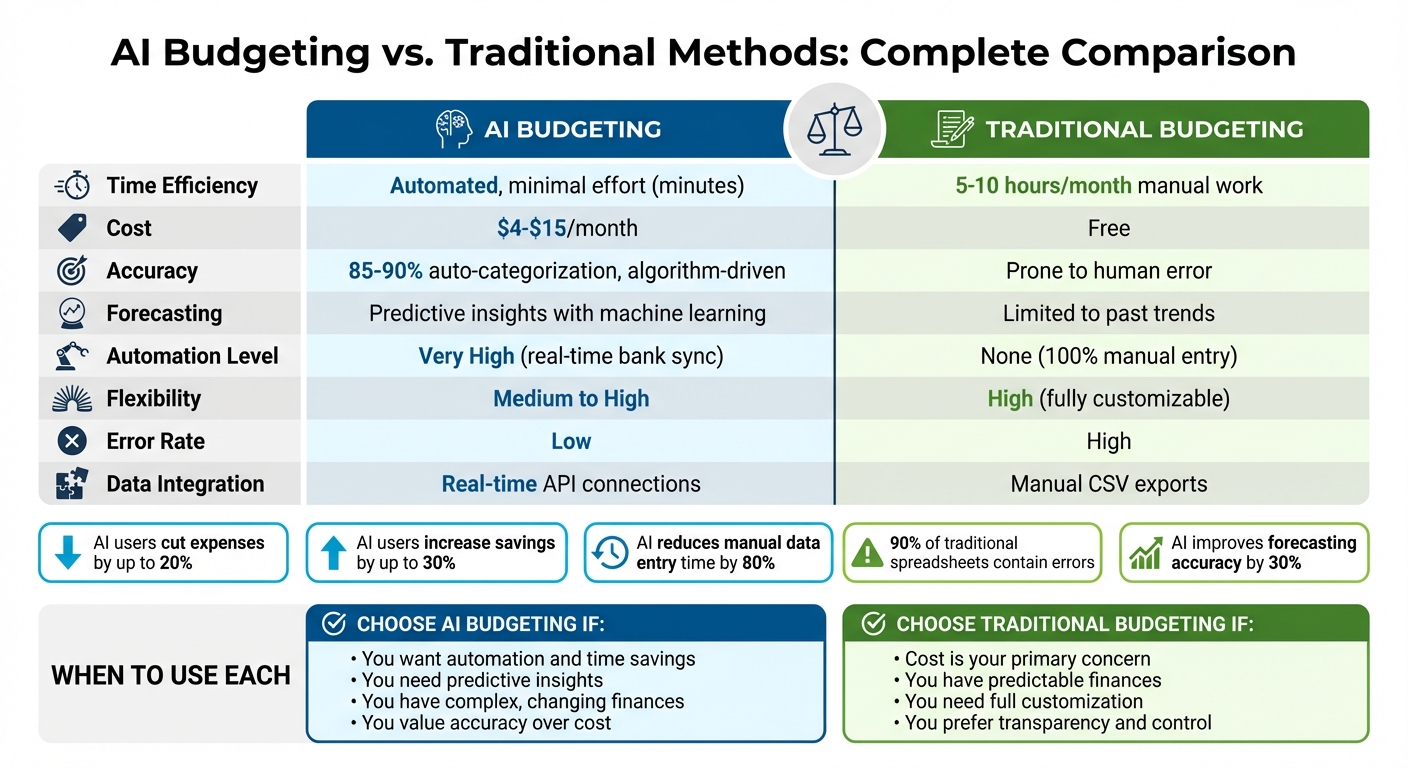
AI vs Traditional Budgeting: Feature Comparison Chart
You’re Wasting Money by Not Using AI to Budget (2025 Update)
sbb-itb-212c9ea
Comparing Efficiency, Accuracy, and Cost
This section dives deeper into how AI and traditional budgeting stack up when it comes to time, accuracy, and cost.
When choosing between AI-powered tools and traditional budgeting methods, three key factors often drive the decision: time investment, accuracy of financial tracking, and costs - both upfront and ongoing. Traditional methods, such as using spreadsheets, are free and allow for full customization. However, they demand significant manual effort. On the other hand, AI tools automate the bulk of the work, with top platforms categorizing 85–90% of transactions automatically.
Accuracy is a game-changer for AI. These systems rely on algorithms to process data, minimizing human errors and identifying overlooked patterns like forgotten subscriptions or upcoming bills. Unlike traditional methods, which focus on past spending, AI budgeting tools provide a forward-looking view, helping you anticipate where your money is headed.
When it comes to cost, the difference becomes even clearer. Traditional tools, such as Google Sheets or EveryDollar, are free to use, with no setup costs. AI budgeting apps, however, come with a monthly subscription fee, typically ranging from $4 to $15 per month. For instance, Rocket Money costs $4–$12/month, PocketGuard is priced at $7.99/month, and Monarch Money charges $9.99/month. While these apps require a financial commitment, many users report cutting their expenses by up to 20% and increasing their savings by up to 30%. In many cases, the savings generated by these tools offset their cost within just a few months, leading to long-term financial benefits.
These comparisons underscore the advantages of AI tools in terms of efficiency, predictive accuracy, and overall financial impact.
Comparison Table: AI vs. Traditional Budgeting
| Feature | Traditional Budgeting | AI Budgeting |
|---|---|---|
| Time Efficiency | 5–10 hours/month of manual work | Minutes (automated sync & categorization) |
| Forecast Accuracy | Low (relies on historical data, prone to errors) | High (predictive machine learning, 85–90% auto-categorization) |
| Flexibility | High (fully customizable spreadsheets) | Medium to High (varies by app features) |
| Automation Level | None (100% manual entry) | Very High (real-time bank sync via Plaid/MX) |
| Implementation Cost | $0 (free tools like spreadsheets) | $4–$15/month |
| Data Integration | Manual CSV exports or entry | Real-time API connections to thousands of banks |
| Error Rate | High (manual entry mistakes) | Low (algorithm-driven processing) |
This breakdown shows that while traditional methods offer complete control over customization, AI budgeting tools excel at reducing manual effort and minimizing errors, making them a strong choice for those seeking efficiency and accuracy.
Benefits of AI Budgeting
Real-Time Data Integration
AI budgeting tools connect directly with systems like bank accounts, ERP platforms, CRM software, and payroll tools, providing live financial data and eliminating the need for tedious manual reconciliation.
This real-time access changes the game when it comes to responding to market shifts. Whether it’s a sudden currency fluctuation or an unexpected surge in demand, AI tools can calculate the profit-and-loss and cash flow impact within minutes rather than weeks. Considering that nearly 90% of traditional spreadsheets contain errors, AI's ability to pull data from unified sources ensures you’re working with a single, accurate dataset. For businesses, this means spotting cash flow risks earlier and making decisions at "board speed" rather than waiting for monthly reports to flag issues too late.
Automation and Less Manual Work
AI budgeting tools take over repetitive tasks, like entering transactions or transferring data between systems. These tools automatically sync, categorize, and reconcile financial data, cutting manual data entry time by as much as 80%. This allows finance teams to focus on strategic planning instead of getting bogged down in spreadsheet maintenance.
The time savings are impressive. For instance, Caterpillar Inc. reduced its quarterly forecasting process from three weeks to just 30 minutes. Similarly, XYZ Corporation saved over 300 hours of manual work monthly while cutting errors by 40%. By automating these processes, businesses not only save time but also achieve more precise and reliable forecasts.
Better Forecasting and Accuracy
AI doesn’t just analyze past spending - it predicts the future. Using machine learning models that continuously improve, these tools assess historical trends alongside external factors like macroeconomic data, commodity prices, supply chain disruptions, and even weather patterns. This approach boosts forecasting accuracy by nearly 30%, with some tools achieving validated accuracy rates as high as 94.4%.
Benefits of Traditional Budgeting
While AI tools bring automation and advanced analytics to the table, traditional budgeting methods still hold their ground, especially when cost and simplicity are top priorities.
Low Initial Costs and Accessibility
One of the standout advantages of traditional budgeting is how affordable and accessible it is. Tools like Excel, Google Sheets, Mint, and EveryDollar are either free or included with existing software packages. Unlike AI systems, which often require subscriptions or significant upfront investments, these tools can be used without breaking the bank. This makes them particularly useful for households or businesses operating on tight budgets. If a simple spreadsheet gets the job done, spending thousands on AI software might seem unnecessary.
Ideal for Predictable Environments
Traditional budgeting methods shine in scenarios where revenues and expenses are stable and predictable. If your financial situation doesn't involve frequent fluctuations, the complexity and cost of AI-driven tools may not justify their use.
Industries like healthcare, education, and government have long favored traditional budgeting for its structured, straightforward approach. These sectors often require clear accountability and detailed line-item tracking. As Adams Smith Williams from Obafemi Awolowo University explains:
Traditional methods, while less agile, offer a level of familiarity and transparency that many organizations still value, particularly in industries with stable environments or heavy regulatory oversight.
The fact that nearly half (49%) of companies still rely on spreadsheets for budgeting underscores the continued relevance of this approach. In settings where financial patterns are steady, traditional tools remain a practical choice.
Built on Historical Data
Traditional budgeting relies heavily on past performance, offering a level of transparency and accountability that AI systems sometimes lack. Unlike AI tools, which can feel like a "black box", traditional methods allow users to see exactly how numbers are calculated. With spreadsheets, for example, you can trace every formula and document assumptions directly in the file.
This emphasis on historical data not only enforces spending limits but also ensures clear, audit-friendly records. For entrepreneurs starting new businesses or projects where historical data is unavailable, traditional methods often outperform AI. Since AI models depend on past data to make predictions, they struggle in situations without it. In these cases, human judgment and manual tracking become indispensable. When starting from scratch, traditional budgeting provides the clarity and control that automated systems can't replicate.
When to Use AI Budgeting vs. Traditional Methods
Deciding between AI-driven budgeting tools and traditional approaches depends heavily on your financial situation and specific needs. Factors like the complexity of your data, the speed at which you need results, and the resources at your disposal play a big role in making the right choice.
When AI Budgeting Works Best
AI budgeting shines in environments where financial conditions change rapidly. If your business operates with unpredictable revenues or intricate supply chains, AI tools can provide real-time insights and handle multiple "what-if" scenarios that go beyond the capabilities of spreadsheets. Large-scale enterprises, in particular, benefit from AI's ability to process thousands of files - like PDFs, images, and spreadsheets - at once.
Take Caterpillar Inc., for example. In 2024, the company slashed its quarterly forecasting time from three weeks to just 30 minutes using machine learning, according to Kyle Epley, Senior VP of Finance. Similarly, Salesforce CFO Amy Weaver leveraged predictive AI to improve expense forecasting accuracy across their operations. Even freelancers with irregular income can rely on AI to automatically identify work-related expenses and adapt to fluctuating cash flows that mix personal and business finances.
Rachel, an AI researcher at UC Berkeley, highlights this transformation:
The 'Department of No' has become the 'Department of How' thanks to AI tools that simulate thousands of 'what-if' scenarios in seconds.
When Traditional Methods Work Best
For smaller operations with steady financial patterns, traditional methods often make more sense. If your income and expenses are predictable month-to-month, the added cost and complexity of AI tools may not be worth it. Tools like Google Sheets or Excel can handle these needs without the burden of subscription fees.
Budget constraints also favor traditional methods. When margins are tight, paying $4 to $12 per month for consumer AI apps - or investing in costly enterprise solutions - might not deliver enough value to justify the expense. Additionally, businesses that need clear, traceable processes for compliance often stick to manual methods. Spreadsheets allow for full transparency, making it easier to audit formulas and document assumptions - something AI’s "black box" nature can’t always provide.
By weighing these considerations, you can choose a solution that aligns with your financial priorities.
Finding AI Budgeting Solutions
If AI budgeting seems like the right fit, navigating the crowded marketplace can feel daunting. Consumer apps like Cleo ($5.99/month) and YNAB ($14.99/month) offer affordable options, while enterprise solutions typically require custom pricing. The trick is to pinpoint tools that meet your specific needs, whether that’s real-time bank integration, scenario modeling, or team collaboration features.
Platforms like AI Apps (aiapps.com) provide a curated directory of budgeting tools tailored to various business sizes and industries. With features like advanced filtering, you can easily compare pricing, functionality, and user reviews - helping you find the perfect AI budgeting solution with minimal hassle.
Conclusion: Picking the Right Budgeting Method
Deciding between AI-driven and traditional budgeting methods comes down to your specific circumstances and priorities. There’s no universal winner here - your ideal choice depends on factors like your financial environment, the quality of your data, and the resources you have available. For businesses with steady cash flows and predictable financial patterns, traditional methods like spreadsheets offer simplicity and affordability. On the other hand, if you’re dealing with fast-changing markets where conditions shift rapidly, AI-powered tools can handle the unpredictability far better than static annual budgets.
Many organizations are finding success by combining traditional human judgment for strategic decisions with AI analytics for routine data processing. This hybrid approach allows you to benefit from both human expertise and automation. A practical way to test this balance is by running a three-month pilot program, comparing AI-generated forecasts with your historical cash flow data.
Looking ahead, Gartner estimates that by 2028, half of all organizations will use AI to replace labor-intensive, bottom-up forecasting methods. However, both AI and traditional approaches fulfill different needs and will likely continue to coexist.
If you decide that AI budgeting is the right fit for your goals, finding the right tool is easier than ever. Platforms like AI Apps (aiapps.com) provide curated directories where you can explore AI tools for financial analysts and budgeting software based on pricing, functionality, and user reviews. Whether you’re seeking a $5.99/month app for personal use or a tailored enterprise solution, these resources simplify the search and help you make quicker, more informed decisions.
Ultimately, the key is to align your budgeting method with your operational needs. Consider factors like efficiency, accuracy, and cost-effectiveness, and choose the approach that best supports your goals.
FAQs
Is AI budgeting safe to connect to my bank accounts?
AI budgeting tools can be a secure option for linking to your bank accounts, provided they adhere to strong security practices. Trusted apps often implement encryption, secure authentication methods, and rely on third-party services like Plaid to keep your data protected. To stay safe, stick to well-known tools, confirm they use industry-standard security measures, and carefully review their privacy policies. Additionally, keeping your device's software up to date is key to protecting your financial details.
How long does it take for AI budgeting to become accurate for my spending?
AI-based budgeting tools usually start showing reliable accuracy within a few months. Many experts agree that it takes around 3 to 6 months of consistent use for these systems to significantly improve their forecasting abilities. During this time, the AI learns and adjusts to your specific spending habits and patterns, making its predictions more precise.
Can I use AI budgeting and spreadsheets together?
Yes, AI budgeting tools can seamlessly integrate with spreadsheets like Excel or Google Sheets. They simplify budgeting by automating data entry, generating real-time reports, and offering predictive insights. This combination not only saves time but also reduces errors and enhances financial analysis. Features like cash flow forecasting and tracking spending patterns become more accessible, all while working within the familiar spreadsheet interface. It's a smart solution for managing finances, whether for personal use or business needs.