AI Agents
ChatGPT Work Data Agent: From Company Data to Dashboards and Action
OpenAI's Data Agent can query business systems, build analysis, and take approved actions. Governance determines whether that is useful or dangerous.

The promise is analysis without the handoff chain
Business questions often pass through several people before an answer appears. A leader asks an analyst, the analyst requests access, data engineers clarify definitions, and the final spreadsheet arrives after the decision window has moved. OpenAI's ChatGPT Work Data Agent is designed to shorten that chain by connecting analysis directly to company systems, semantic layers, documents, and approved actions.
OpenAI lists integrations with data platforms including Redshift, BigQuery, ClickHouse, Databricks, MongoDB, and Snowflake, as well as document sources such as Google Drive and SharePoint. The agent can investigate a question, produce analysis or dashboards, and move into an action when the organization permits it. Existing permissions are intended to carry through. The attractive demo is speed, but the real product question is whether the answer preserves business definitions and access controls.
Semantic context matters more than SQL fluency
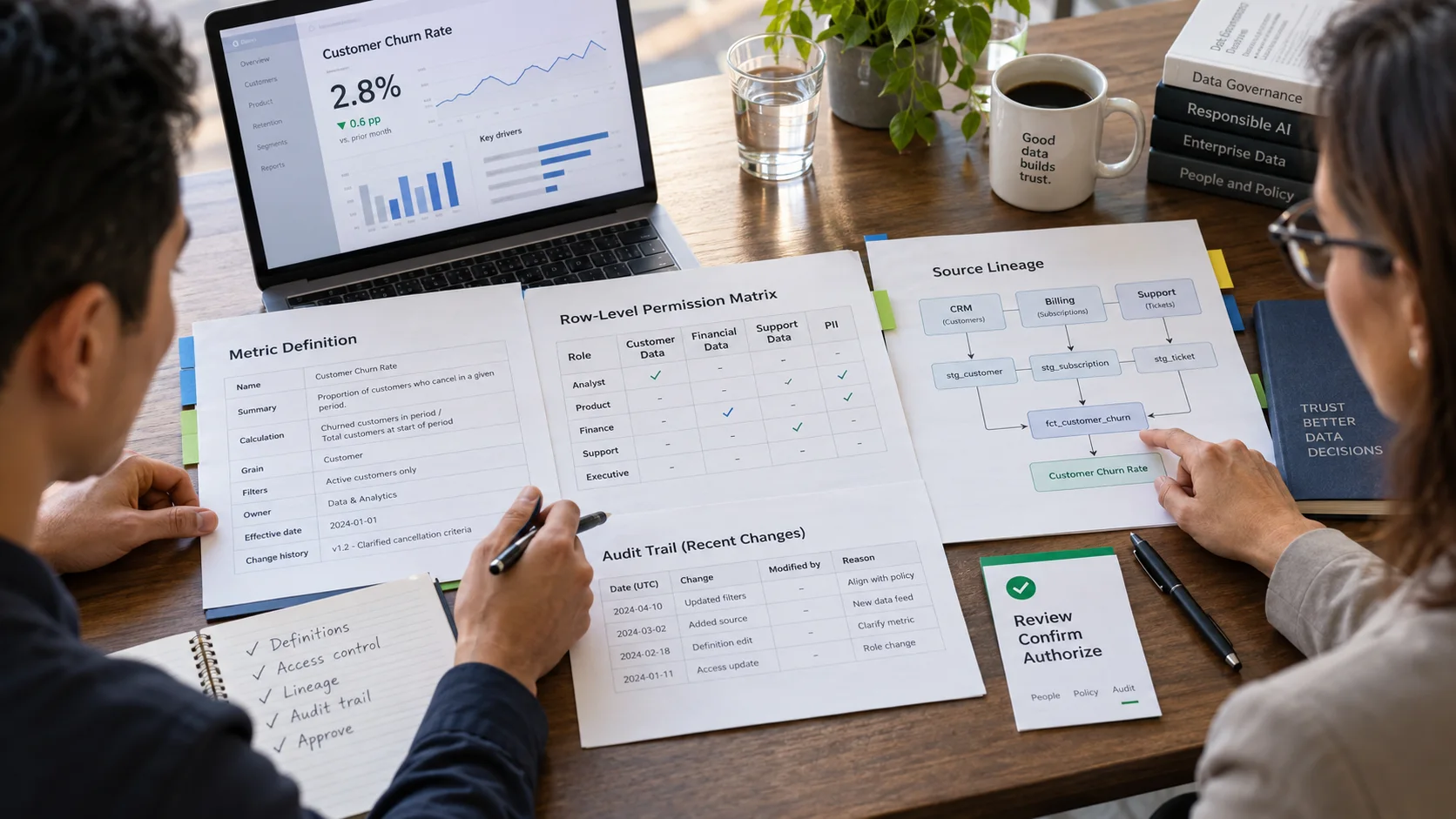
A model can write syntactically correct SQL and still answer the wrong question. Revenue may mean booked, billed, recognized, collected, or adjusted revenue. Active customer definitions can differ by team. Time zones, refunds, internal accounts, and late-arriving data can change a chart. A semantic layer gives the agent governed measures and relationships instead of asking it to infer company logic from table names.
Organizations without a reliable metric layer should not expect an agent to repair years of inconsistent definitions. The agent may make those conflicts more visible, which is useful, but it can also produce polished contradictions faster. Start by documenting high-value metrics, ownership, refresh times, and known limitations. Require the answer to state the definition and data period it used.
Permissions must be enforced below the conversation
A user should not gain access to payroll, customer records, or executive documents because they can phrase a clever request. The connector and data platform must enforce row, column, and source-level permissions independently of the model. Generated queries should run with the requesting user's scoped identity or a tightly controlled service role. Sensitive values should be masked before they enter model context when the task does not require them.
Data leakage can also occur through derived answers. A dashboard may reveal the value of a restricted segment even if individual rows remain hidden. Governance needs rules for aggregation, minimum cohort sizes, export, retention, and sharing. Audit logs should connect the user request, sources queried, transformations applied, result shown, and any later action. That lineage turns a convenient answer into something an organization can review.
Action is where the risk changes
Analysis can inform a decision. An action can alter a campaign, notify customers, change a forecast, or update an operational system. The Data Agent supports approved actions, but approval should be granular. A person may be allowed to draft a segment without launching it, prepare a refund list without issuing refunds, or build a dashboard without sharing it outside a team.
Product interfaces should show the proposed change, affected records, assumptions, and rollback path before execution. High-consequence actions need separation of duties. The person who requests the analysis may not be the person authorized to approve the action. After execution, the system should verify the resulting state instead of treating a successful API response as proof that the intended business outcome occurred.
A responsible rollout starts narrow
Choose a domain with clean metrics and low-risk outputs, such as internal product usage analysis. Run the agent alongside the existing analyst process and compare answers, source selection, query cost, and time saved. Include deliberately ambiguous questions to see whether it asks for clarification. Test permission boundaries with users from different roles. Track hallucinated fields, stale data, and charts whose labels overstate what the query proves.
Only add write actions after the read path is dependable. Keep a catalog of approved actions, each with its own validation and confirmation requirements. Data agents can make analysis available to more people and reduce repetitive requests, but they do not eliminate data engineering or governance. They raise the value of both. The organizations that benefit most will be those that already know what their data means and can prove who is allowed to do what with it.
Measure trust, not only query speed
Track how often users verify an answer, correct a metric, abandon a result, or ask an analyst to redo the work. Fast generation with low trust does not remove the handoff chain, it adds another step to it. A successful deployment should reduce time to a defensible decision while preserving analyst oversight for novel questions. Publish known limitations inside the product and make source inspection easy. Trust grows when the system shows its work and responds predictably when it does not know.