Financial Technology
How AI Predicts Crypto Price Changes
How AI uses market, on-chain, and sentiment data with LSTM/CNN models to send real-time crypto alerts and improve trading decisions.
How AI Predicts Crypto Price Changes
AI is transforming how traders approach cryptocurrency markets. It processes massive amounts of data - like price trends, social media sentiment, and blockchain activity - to predict price movements faster than any human could. By using advanced models such as LSTMs and sentiment analysis tools, AI identifies potential trading opportunities, monitors markets 24/7, and sends real-time alerts. This approach has been shown to outperform basic trading strategies, with some AI systems achieving returns over 1,600% compared to 223% from buy-and-hold methods.
Key points:
- AI analyzes market data, on-chain activity, and sentiment from platforms like Twitter and Reddit.
- Models like LSTMs and CNNs predict trends with up to 91% accuracy.
- Real-time alerts help traders act quickly on high-confidence signals.
- Challenges include handling unpredictable events and avoiding overfitting.
AI tools are powerful but work best when combined with human judgment and risk management strategies.
Cryptocurrency Price Prediction Using AI
sbb-itb-212c9ea
How AI Analyzes Crypto Market Data
AI dives deep into multiple data layers - technical, sentiment, and fundamental - to build a comprehensive view of the crypto market. It processes everything from price trends and trading volumes to blockchain metrics and developer activity.
What sets AI apart is its ability to integrate all this data. While you might be checking Bitcoin's price on your phone, AI systems are busy analyzing around 50,000 crypto-related tweets every hour. They also track whale activity and exchange flows, uncovering patterns that might otherwise go unnoticed. This multi-layered analysis forms the foundation for the prediction models discussed below.
Data Sources AI Uses for Predictions
AI taps into several critical data categories to make price predictions. These include:
- Market data: Historical prices, trading volumes, and correlations between assets, like Bitcoin's influence on altcoins.
- On-chain data: Insights into "smart money" movements, such as whale wallet activity, exchange inflows and outflows, staking trends, and network hash rates.
- Sentiment data: Natural Language Processing (NLP) tools scan platforms like Twitter (X), Reddit, Discord, and Telegram, as well as news headlines, to measure emotions like fear, greed, and FOMO.
As crypto analyst Zachary James Lowrance puts it:
"By the time you see a price movement, the emotion that caused it has already swept through social media, Discord channels, and Reddit threads hours or even days earlier."
AI systems also incorporate macroeconomic indicators, such as interest rates, inflation, GDP data, and correlations with traditional markets like the S&P 500 and the Dollar Index (DXY). The data itself comes from tools like Glassnode, IntoTheBlock, Nansen, CoinGecko, OKX, and sentiment platforms like LunarCrush and Google Trends.
AI Models and Analysis Techniques
With this rich data mix, AI uses advanced models to predict price movements. Machine learning models like Long Short-Term Memory (LSTM) networks and Gated Recurrent Units (GRU) are particularly effective for time-series forecasting. They analyze historical price and volume data to identify recurring patterns, often using sliding windows (e.g., the past 60 days) to predict the next day's trends.
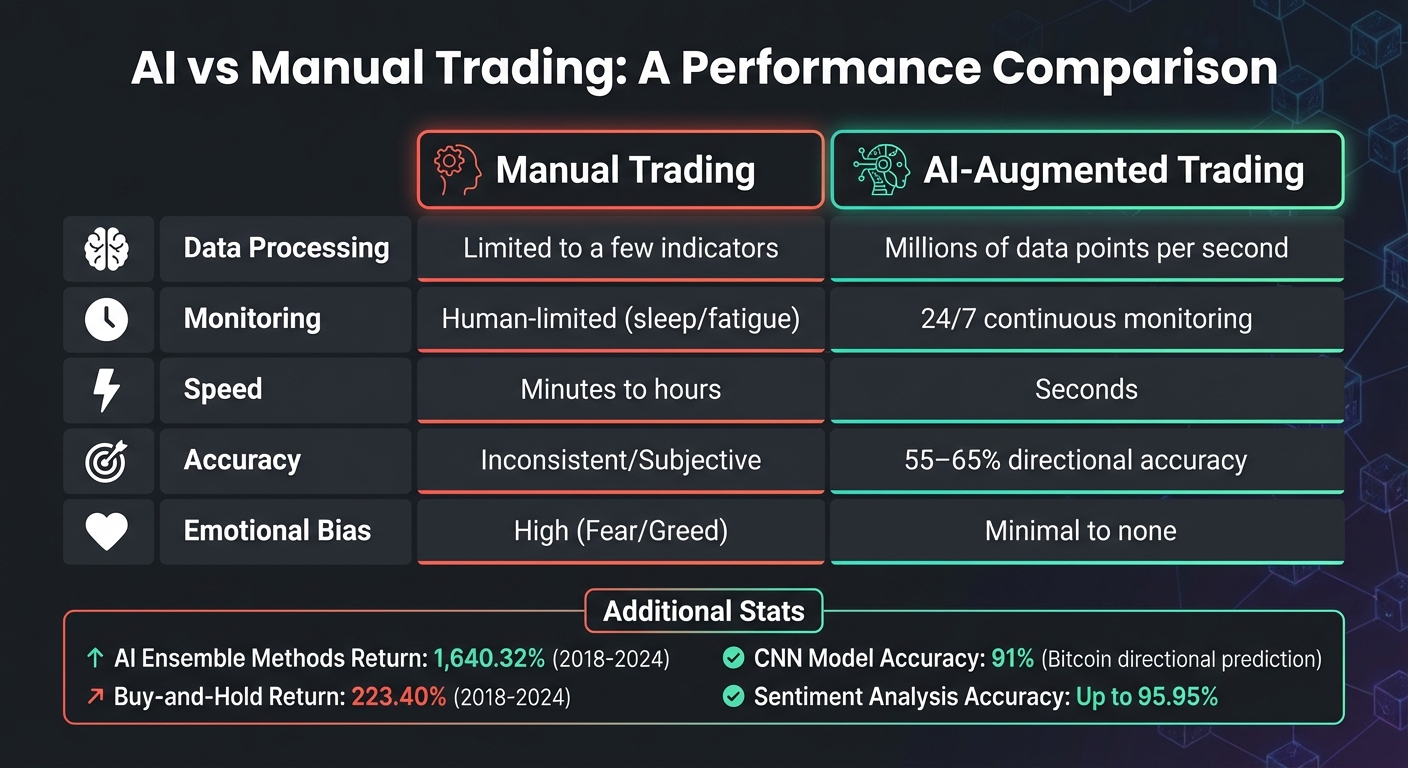
A 2025 study highlighted the power of such models: a Convolutional Neural Network (CNN) achieved 91% accuracy in predicting Bitcoin's directional movement. Even more striking, ensemble methods combining Gradient Boosting and XGBoost delivered a total return of 1,640.32% over six years (2018–2024), compared to just 223.40% from standard buy-and-hold strategies.
AI has also revolutionized sentiment analysis. Instead of simply counting keywords, modern systems use Transformer-based models like FinBERT and GPT-4. These tools can understand crypto-specific slang like "HODL" and "WAGMI" and even pick up on sarcasm. Advanced LSTM models have achieved sentiment classification accuracy as high as 95.95%, outperforming older Recurrent Neural Networks that capped at 80.59%. AI now goes a step further, analyzing "sentiment velocity" (how quickly emotions spread) and "sentiment divergence" (when sentiment and price trends clash) to predict market shifts 24–72 hours ahead.
The game-changer? Validation. AI cross-references social sentiment with blockchain data, checking if positive social media chatter aligns with whale accumulation or if negative sentiment matches rising exchange inflows. This approach has enabled AI to predict Bitcoin's next-day price direction with about 63% accuracy. This level of precision allows for timely alerts and real-time market monitoring, giving traders a crucial edge.
Real-Time Monitoring and Alerts
Once prediction models are in place, AI's real advantage lies in its ability to perform round-the-clock market surveillance. These systems continuously monitor thousands of cryptocurrencies across various exchanges, processing live data through WebSocket connections. This ensures that every analysis reflects the most recent price changes and volume shifts .
This constant monitoring provides a speed edge that can be measured in seconds, not hours. While you might manually check a handful of coins on your phone, AI platforms are simultaneously analyzing hundreds or even thousands of trading pairs. They integrate technical indicators, sentiment data, and on-chain metrics into actionable insights .
How AI Detects Critical Market Movements
AI systems use a combination of hard signals and soft signals to identify important market trends. Hard signals include technical indicators like RSI (Relative Strength Index), MACD (Moving Average Convergence Divergence), and moving average crossovers. Soft signals, on the other hand, rely on sentiment analysis, which involves scanning platforms like Twitter, Reddit, and news outlets for shifts in public emotion.
The secret to accuracy is confluence - aligning signals across multiple timeframes. For example, a bullish pattern observed on both a 15-minute chart and a daily chart is more reliable. This approach helps reduce false positives, especially during volatile market periods .
Some platforms utilize multi-agent architecture, where different AI agents specialize in tracking specific data streams. One agent may monitor breaking news, another focuses on technical indicators, while a third keeps an eye on regulatory updates. When multiple agents detect the same directional trend, the system assigns a confidence score (ranging from 0 to 1). In the case of highly liquid assets like Bitcoin and Ethereum, confidence scores above 0.75 have historically aligned with actual market movements 68% to 73% of the time.
AI also examines derivatives data, such as funding rates, open interest, and liquidation levels, to predict volatility spikes before they affect spot markets. Combined with on-chain tracking of whale wallet activity and exchange flows, these systems can uncover institutional-level moves that retail traders often overlook .
Once these critical market changes are identified, the next step is setting up alerts to act on these insights effectively.
Setting Up Personalized Alerts
Creating AI-driven alerts is straightforward: register, configure your trigger parameters, and select a notification method such as Telegram, Discord, email, or mobile push notifications .
You can design alerts ranging from simple price targets - like "notify me when Bitcoin reaches $75,000" - to more complex conditions, such as "alert me when RSI drops below 30 and MACD shows a bullish crossover." Advanced tools, covering over 9,000 cryptocurrencies across 11 major exchanges, offer more than 100 real-time indicators like Bollinger Bands, Fibonacci Retracement, and Ichimoku Clouds.
For model selection, many platforms provide three main options:
- Technical: Focuses on price patterns and indicators.
- Sentiment: Prioritizes social media and news data.
- Hybrid: Combines both, often weighting technical data at 60% and sentiment at 40%.
Hybrid models are particularly useful for balancing extremes, offering more measured forecasts . You can also choose prediction timeframes, ranging from as short as 30 minutes to as long as 60 days .
Confidence thresholds are another crucial feature. By setting the system to notify you only when confidence levels exceed a certain point - typically 0.75 or higher - you can minimize unnecessary alerts and focus on high-probability opportunities .
For those just starting out, it’s best to stick with basic price alerts before experimenting with more advanced technical triggers. As Crypto Shahar, an AI researcher and trader, explains:
"Traders want to know why an AI predicted something. Transparency builds trust."
Before fully relying on any alert system, review its "forecast history" to evaluate how previous predictions matched actual market trends. Enabling push notifications in your settings ensures you won’t miss critical entry points .
Benefits and Challenges of AI for Crypto Predictions
AI vs Manual Trading in Cryptocurrency: Performance Comparison
AI plays an increasingly prominent role in crypto trading, offering powerful tools for real-time market analysis. However, it’s essential to weigh its strengths against the challenges it presents.
Advantages of AI in Crypto Trading
One of AI's biggest strengths is its ability to process data at incredible speed and scale. Unlike manual trading, where an individual might track a limited number of coins, AI systems analyze millions of data points every second. These points come from diverse sources like price trends, wallet activity, social media sentiment, and even macroeconomic factors. This constant monitoring is crucial in the crypto market, which never sleeps.
Research by Gil Cohen and Avishay Aiche highlights how AI-driven strategies can outperform traditional buy-and-hold methods, delivering superior returns.
AI also helps traders avoid emotional pitfalls. Human decisions are often swayed by fear or greed, leading to impulsive actions. In contrast, AI platforms focus purely on data. Many top forecasting tools achieve directional accuracy rates of 55–65%, with some advanced models performing even better. For instance, word-embedding sentiment analysis systems have achieved up to 89.13% accuracy, while convolutional neural networks have reached as high as 91% in predicting market direction [4, 10].
| Feature | Manual Trading | AI-Augmented Trading |
|---|---|---|
| Data Processing | Limited to a few indicators | Millions of data points per second |
| Monitoring | Human-limited (sleep/fatigue) | 24/7 continuous monitoring |
| Speed | Minutes to hours | Seconds |
| Accuracy | Inconsistent/Subjective | 55–65% directional accuracy |
| Emotional Bias | High (Fear/Greed) | Minimal to none |
Challenges and Limitations
While AI offers substantial benefits, it’s not without flaws. One major limitation is its struggle to navigate black swan events - unpredictable situations like exchange failures (e.g., FTX), sudden regulatory actions, or even a single influential tweet. These events often lack historical data, making it difficult for AI models to respond effectively.
Another issue is overfitting. AI models can sometimes "memorize" historical patterns, which may not hold true in live markets. This can result in impressive backtesting results but disappointing real-world performance. Additionally, crypto markets demand constant updates to AI models to prevent them from becoming outdated. The noisy nature of crypto data - caused by wash trading, spoofing, and inconsistent order-book information - can further reduce accuracy.
The complexity of advanced AI systems also poses a challenge. Often described as "black boxes", these systems make it difficult for traders to understand the reasoning behind specific predictions. This lack of transparency can lead to misinterpretations. For example, a probabilistic statement like "70% chance of an increase" might be wrongly seen as a guarantee, prompting risky decisions like over-leveraged trades. As Paul Bennett, a B2B Specialist and Web3 Copywriter, aptly puts it:
"AI - a fantastic tool. But a terrible trader."
The key is to treat AI as a tool that supports decision-making rather than fully replacing human judgment. Traders should validate AI signals with traditional methods like technical analysis, test performance through paper trading, and use dynamic risk management strategies. This "human-in-the-loop" approach ensures traders can harness AI's computational power while still accounting for qualitative factors like breaking news or regulatory changes. By blending AI insights with human expertise, traders can navigate the complexities of crypto markets more effectively.
Find AI Tools for Crypto Predictions on AI Apps
After diving into the mechanics of AI prediction models, the next logical step is choosing the right tool to put these insights into action.
Why Use the AI Apps Directory
With so many options available, finding the perfect AI tool for cryptocurrency predictions can feel overwhelming. That’s where AI Apps comes in. This directory features over 1,900 AI tools, including specialized platforms for crypto analysis. Tools are grouped into categories like automated trading bots, on-chain analytics, sentiment analysis platforms, and real-time alert systems, making it simple to find the right match for your trading strategy.
Whether you're after LSTM models for short-term trends, Transformer-based systems for long-term patterns, or tools that analyze social media sentiment from platforms like Twitter and Reddit, AI Apps lets you compare options side by side. You can review features, pricing, and user ratings all in one place - saving you the hassle of testing multiple platforms individually.
These specialized tools are essential for effective market analysis, and the directory makes it easy to explore them.
AI Tools Available on AI Apps
The directory caters to both retail and professional traders. For retail users, platforms like Token Metrics and IntoTheBlock stand out with intuitive interfaces and features like filtered "Alpha" signals and market summaries. For instance, Token Metrics Daily Pulse, trusted by over 100,000 investors, aggregates data from 41+ editorial sources and 14+ market feeds for actionable insights.
For professional traders, tools like Glassnode deliver institutional-grade analytics, including whale activity tracking and in-depth on-chain data.
In the fast-paced crypto market, real-time alert systems are a game-changer. Crypto Analysis AI monitors over 9,000 cryptocurrencies and evaluates more than 100 technical indicators across 11 major exchanges. It offers smart alerts based on price targets, indicator crossovers, and custom multi-parameter conditions. Similarly, Strykr tracks over 5,000 assets across 50+ exchanges with a 99.9% uptime guarantee. It provides AI-driven volatility alerts and real-time signals. As Strykr explains:
"Our AI surfaces what matters, so you can act faster."
Many tools in the directory offer free tiers or trial periods, giving you the chance to test their reliability before committing. For example, Strykr provides a free tier with no credit card required, while Crypto Analysis AI offers free samples of its high-confidence signals.
Conclusion
AI has reshaped how traders navigate cryptocurrency markets. By blending technical indicators, market sentiment, and on-chain metrics into actionable insights, these tools offer a level of precision that manual analysis struggles to achieve. In many cases, AI-powered strategies have outperformed traditional buy-and-hold approaches.
That said, AI isn't perfect. Its accuracy, while impressive, still requires human oversight. AI systems excel at processing massive datasets in real time, revealing patterns and predicting price movements with a speed that's beyond human capability. But these systems are tools, not standalone solutions, and work best when combined with informed trading strategies.
Choosing the right AI tool is key. Whether you're looking for sentiment analysis for trending altcoins or on-chain data tracking for institutional assets, platforms like AI Apps can simplify the search. With over 1,900 categorized tools, you can easily compare features, pricing, and reliability. Many tools also offer free tiers, allowing you to test them before committing.
As the crypto AI market is expected to grow from $5.1 billion in 2025 to $55.2 billion by 2035, integrating these tools into your trading strategy could be a game-changer. Use real-time alerts and advanced data analysis to complement your decision-making. Start with demo accounts, choose transparent systems that clearly explain their logic, and always stick to sound risk management practices. The synergy between AI's data-driven insights and human strategic thinking is the best way to tackle the volatility of crypto markets.
FAQs
How accurate are AI crypto predictions in live markets?
AI-driven crypto predictions in live markets tend to have a directional accuracy of around 55-65%. In other words, they correctly anticipate price trends a bit more often than a coin flip. However, given the inherently unpredictable nature of cryptocurrency markets, adopting strong risk management strategies is critical when using these forecasts.
What data should an AI crypto tool track to work well?
An effective AI crypto tool needs to process a wide range of data to deliver meaningful insights. This includes price and volume metrics like OHLC (open, high, low, close) and trading volume, as well as on-chain data such as market capitalization and gas fees. Additionally, it should incorporate sentiment indicators, drawing from sources like social media trends and updates from developers.
By leveraging advanced techniques such as pattern recognition and neural networks, these tools can improve accuracy. Combining these diverse data sources allows for a more thorough market analysis, helping users manage risks effectively and receive timely alerts.
How do I set safe alert thresholds and manage risk?
AI-based tools for cryptocurrency trading can help you stay ahead of market fluctuations by analyzing historical data, technical indicators, and market sentiment. Many platforms allow you to set custom alerts based on specific price levels or percentage changes. These alerts ensure that you're notified of key market movements, enabling quick responses when needed.
Another powerful feature is AI-driven dynamic stop-loss strategies. These tools can automatically adjust your exit points in real time, minimizing potential losses while keeping your risk management aligned with ever-changing market conditions. This combination of proactive alerts and adaptive strategies makes managing risk more efficient and responsive.