Digital Transformation
Beyond the Search Bar: How Perplexity AI is Killing the Traditional Google Search.
AI answer engines are replacing link-heavy search by delivering fast, ad-free, citation-backed answers for complex research.
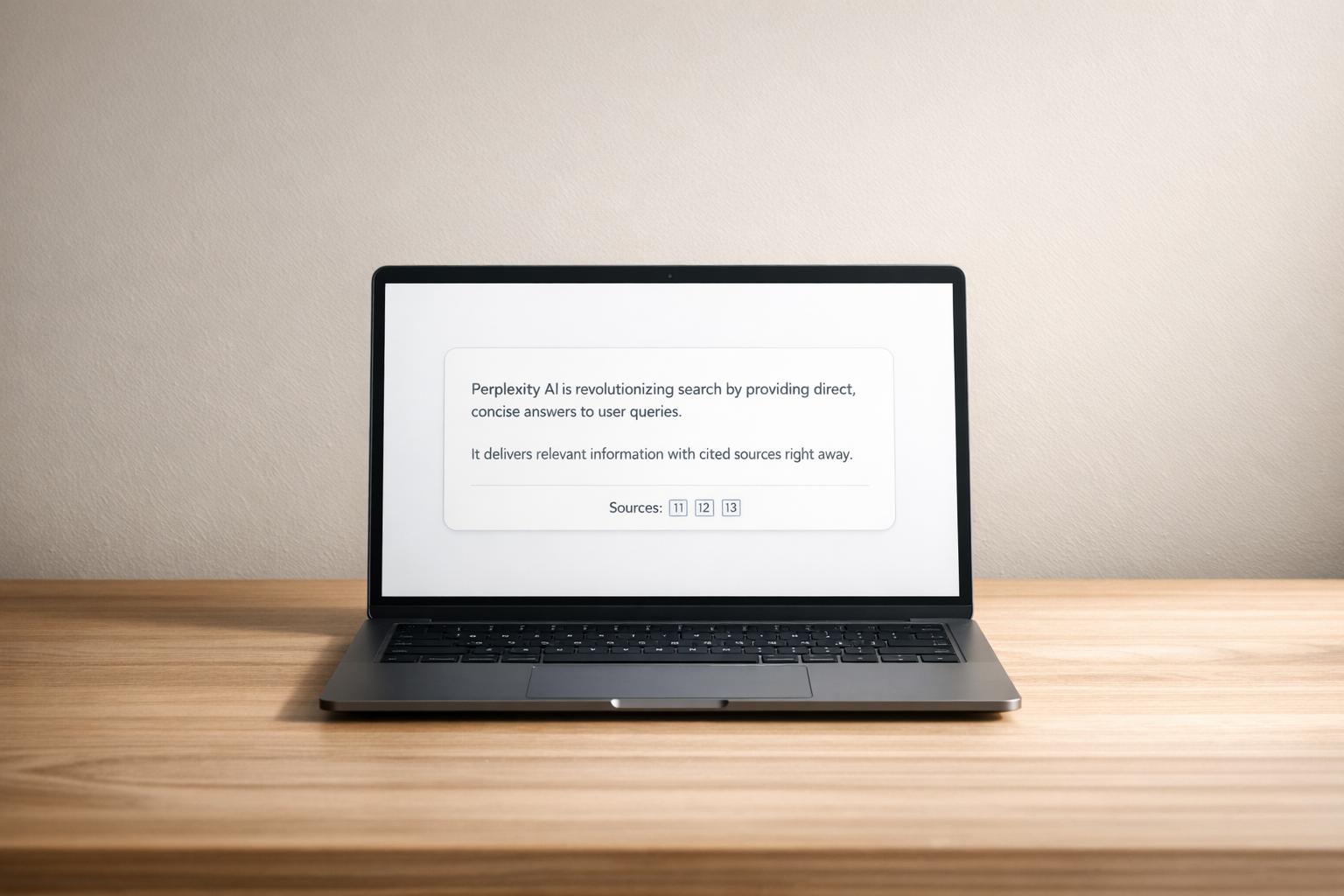
Beyond the Search Bar: How Perplexity AI is Killing the Traditional Google Search.
Google's dominance in search is being challenged. Perplexity AI offers a faster, ad-free, and more efficient way to find answers, especially for research and multi-step queries. While Google excels at local searches, shopping, and navigation, its search results are often cluttered with ads and SEO-driven content that forces users to sift through multiple tabs.
Perplexity AI flips this model by delivering concise, citation-backed answers directly, saving users time and effort. Its Pro Search and Deep Research tools simplify complex queries and provide structured reports, making it ideal for professionals and researchers. With features like conversational context retention and inline citations, Perplexity AI is reshaping how we access information online.
Key Differences:
- Google Search: Link-based, ad-heavy, great for local info and shopping.
- Perplexity AI: Synthesized answers, no ads, excels in research and technical queries.
Quick Comparison:
| Feature | Google Search | Perplexity AI |
|---|---|---|
| Ads Presence | Heavy | None |
| Output Style | Links | Synthesized answers |
| Research Speed | Slower | Faster |
| Best For | Local info, shopping | Research, technical queries |
Perplexity AI isn’t just another search engine - it’s a reimagined way to get answers. For those tired of endless tabs and ad-filled pages, it’s a game-changer.
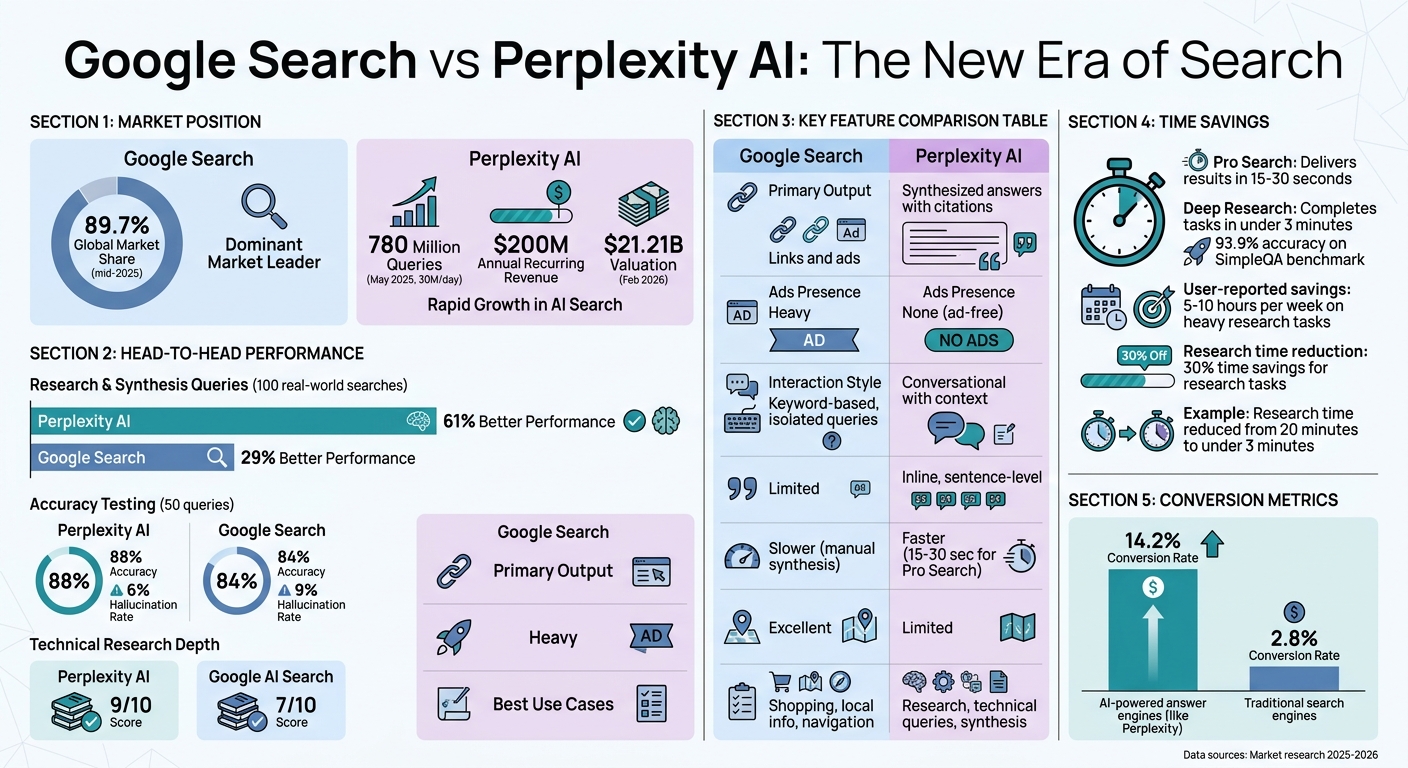
Google Search vs Perplexity AI: Feature Comparison and Performance Metrics
Perplexity AI vs Google: The Future of Search
sbb-itb-212c9ea
How Perplexity AI Differs from Google Search
The key difference between Google Search and Perplexity AI lies in how they deliver answers. Google provides a list of links for users to explore, while Perplexity offers a concise, synthesized response. Let's break down these differences in terms of speed, context retention, citation accuracy, and overall user experience.
Google Search: Fast and Familiar
Google is the go-to platform for quick and straightforward searches, especially for tasks like finding a restaurant's hours or checking store details. Its seamless integration with tools like Maps, Shopping, and real-time business information makes it ideal for transactional queries. With a commanding 89.7% share of the global search market as of mid-2025, Google remains the default choice for accessing specific websites and detailed local data.
Perplexity AI: Conversational Search with Context
Perplexity offers a more interactive experience by retaining conversational context across search threads. For instance, if you ask about quantum computing and then follow up with "how is this used in cryptography?", Perplexity understands the connection without needing you to restate the topic. Acting more like an "Answer Engine" than a traditional search engine, it synthesizes information from multiple sources and provides a unified response, complete with inline, sentence-level citations. This approach is especially useful for multi-step research, catering to users who value efficiency and depth. In a test of 100 real-world searches, Perplexity outperformed Google in delivering faster, more useful answers for 61% of research and synthesis queries, compared to Google's 29%. Claire, an AI tool researcher, summed it up perfectly:
"Perplexity isn't replacing Google - it's replacing the most tedious part of Google: the part where you click through five tabs and piece together an answer yourself."
Feature Comparison: Google Search vs Perplexity AI
The contrasting approaches of Google and Perplexity lead to distinct feature sets, as shown in the table below:
| Feature | Google Search | Perplexity AI |
|---|---|---|
| Primary Output | Links and ads | Synthesized answer with citations |
| Interaction | Keyword-based, isolated queries | Conversational with thread context |
| Citations | Limited (in AI Overviews) | Inline, sentence-level citations |
| Ads | Heavy presence in results | Ad-free (subscription-focused) |
| Local/Maps | Excellent integration | Basic/Limited |
| Research Speed | Slower (manual synthesis required) | Faster (automated synthesis) |
| Best For | Shopping, local info, navigation | Research, technical deep-dives, synthesis |
What Perplexity AI Can Do
Perplexity AI reimagines how we search for information by addressing the limits of traditional methods. With two standout features - Pro Search and Deep Research - it simplifies and accelerates the process of finding and synthesizing information. These tools handle tasks that would otherwise take hours of manual effort.
Pro Search: Solving Complex Queries
Pro Search uses sequential reasoning to break down tough questions into manageable steps. Instead of requiring multiple Google searches, it conducts follow-up queries and delivers detailed, well-structured answers. By integrating the Wolfram|Alpha engine, it handles calculations and computational tasks with precision. What’s more, this all happens in just 15 to 30 seconds, saving users from the time-consuming task of navigating multiple tabs and piecing together information manually.
Deep Research: Advanced Information Gathering
Deep Research acts as an autonomous research assistant, performing multiple searches and refining its understanding through iterative loops. It doesn’t just gather information - it verifies consistency, flags conflicting data, and assigns confidence ratings (high, medium, or uncertain) to its sources. Most tasks are wrapped up in under 3 minutes, a process that could take a human expert hours to complete. As the Perplexity team puts it:
"Deep Research takes question answering to the next level by spending 2-4 minutes doing the work it would take a human expert many hours to perform."
On the SimpleQA benchmark for factuality, Deep Research achieves an impressive 93.9% accuracy. This makes it a reliable tool for professionals working on tasks like market analysis, literature reviews, or comparative research. Beyond saving time, it elevates the quality of the research process.
How These Features Benefit Users
Pro Search and Deep Research transform how users approach information retrieval by cutting out the need for tedious manual synthesis. Instead of juggling multiple tabs and compiling data yourself, you’re presented with a structured, cited report that’s ready to use. This streamlined ask-get-verify workflow has been a game changer, with users reporting time savings of 5 to 10 hours per week on heavy research tasks.
For professionals like journalists, analysts, and corporate researchers, Perplexity functions more like a digital research analyst than a chatbot. As Data Studios notes, it’s "methodical, documented, and audit-ready". By delivering answers first, it allows users to focus less on searching and more on applying the insights they gain.
When to Use Each Platform
Deciding between Google and Perplexity depends on what you need at the moment - whether it's quick answers or detailed analysis. Each platform has its strengths, and knowing when to use one over the other can save you both time and effort.
Quick Searches and Local Information: Google's Strength
Google is still the go-to choice for "near me" searches and anything tied to your location. Looking for a pizza place that's open now? With its live Maps integration and real-time updates, Google provides instant answers about business hours, directions, and current status - features that Perplexity doesn't support. The same applies to checking flight statuses, train schedules, or movie showtimes - Google's formatting makes this information easy to access, while Perplexity often falls short in these areas.
For navigational queries like "Netflix login" or "IRS tax forms", Google takes you straight to the official site. In comparison, Perplexity might only offer a summary about the site. Google also excels in shopping and product discovery, offering tools like price comparisons and retailer reviews. Its dominance in search is clear: as of March 2026, Google holds an 89.85% share of the global search market, with mobile usage reaching 93.58%.
When it comes to subjective reviews - like a film critic's opinion or Reddit discussions - Google's link-based setup lets you access real human voices and opinions instead of AI-generated summaries. As Mike Lyngaas, Product Manager at Gusto, aptly puts it:
"Google is the hungry junior analyst. Their research is incredibly exhaustive, leaving no stone unturned".
However, for more in-depth research and analysis, Perplexity offers a different approach.
Research and Analysis: Where Perplexity AI Excels
Perplexity stands out when you need to synthesize multiple perspectives or handle complex, multi-step queries. Instead of juggling multiple tabs, it reads through sources and presents a structured response with inline citations. In a test of 50 queries, Perplexity achieved 88% accuracy compared to Google's 84%, while also maintaining a lower hallucination rate - 6% versus Google's 9%.
For academic and technical research, Perplexity's "Focus" modes allow you to directly search databases like arXiv or Nature. It even provides summaries of peer-reviewed papers along with links to the full PDFs. In technical research testing, Perplexity scored 9/10 for depth, while Google AI Search scored 7/10. Its conversational capabilities also make follow-up questions seamless, which is particularly helpful for exploring interconnected topics.
Whether you're debugging code, comparing economic policies, or conducting market analysis, Perplexity acts more like a digital research assistant. Instead of forcing you to piece together an answer from multiple sources, it delivers structured, cited reports that are ready to use. The table below highlights the strengths of each platform for various tasks.
Use Case Comparison Table
| Query Type | Google Search | Perplexity AI |
|---|---|---|
| Local Business/Maps | Excellent; live data with Maps integration | Poor; often lacks live hours or precise locations |
| Shopping | Excellent; broad directory and price comparisons | Limited; no e-commerce integration |
| Technical Research | Moderate; requires opening multiple tabs | Excellent; synthesizes multiple papers into one report |
| Navigational (e.g., "Netflix login") | Excellent; top result is always the site | Moderate; may provide a summary about the site instead |
| Breaking News | Excellent; fastest indexing | Good; chronological summaries |
| Complex Comparisons | Limited; single perspective | Excellent; balanced, multi-perspective summaries |
Why Perplexity AI is Changing Search
Perplexity AI is transforming the way we search by delivering complete, fact-checked answers in an instant.
Clear Sources and Verified Information
Every response from Perplexity AI includes inline, numbered citations, along with its Model Council feature, which cross-checks outputs from advanced language models side-by-side. This approach ensures transparency, allowing users to verify facts without relying on unclear summaries. Alan Bradley from PCMag highlights this advantage perfectly:
"Google remains the map of the web, but for me, Perplexity is fast becoming its smart guide."
This emphasis on clear and accessible sourcing creates a more trustworthy and user-friendly search experience.
No Ads for a Better Experience
In February 2026, Perplexity made a bold move by dropping its advertising model in favor of a subscription-first approach, eliminating advertiser influence from its answers. This shift ensures users receive objective and unbiased information. Gerry Pallor from Byte Sized Tech Tips captures the essence of this change:
"The constraint is not technical. It is structural. The revenue model and the better product are in direct conflict."
By removing ads, Perplexity focuses on delivering concise, synthesized answers. Research even shows that users save up to 30% of their time when using its direct, cited responses for research tasks.
Rapid Growth and User Trust
With its transparent sourcing and ad-free model, Perplexity AI has quickly built trust and gained traction. The numbers speak for themselves: in May 2025, it processed 780 million queries - an average of 30 million per day. By February 2026, it reached $200 million in annual recurring revenue and achieved a valuation of $21.21 billion. Strategic partnerships have only fueled this growth further. For example, a distribution deal with Bharti Airtel in July 2025 brought Perplexity to 360 million subscribers in India, leading to a 600% increase in downloads and a 640% boost in monthly active users.
Additionally, referral traffic from AI-powered answer engines like Perplexity has a 14.2% conversion rate, far surpassing the 2.8% seen with traditional search engines. Instead of piecing together scattered information, users now get synthesized, citation-backed answers - marking a clear shift in how we retrieve and trust information.
Conclusion
Perplexity AI is changing the way we retrieve information online. Instead of wading through endless links, it provides clear, citation-backed answers that save both time and effort. In a comparison of 100 real-world searches, Perplexity outperformed in 61% of queries involving research and synthesis, showcasing its effectiveness for knowledge-focused tasks.
Features like conversational threading and inline citations simplify research by eliminating the need for juggling multiple tabs and questioning the credibility of sources. For example, in April 2026, project manager Jessica Lin reported cutting her research time from 20 minutes to under three, thanks to Perplexity's ability to synthesize information with verifiable sources.
With 30 million daily queries and $200 million in annual recurring revenue as of February 2026, Perplexity has proven its value by delivering straightforward, ad-free answers without compromising user experience for profit.
For those tackling complex research or fact-checking, Perplexity offers real productivity gains. Its free tier includes unlimited standard searches and five Pro searches daily, making it easy to explore whether this tool fits into your workflow. Whether you're a student, researcher, or professional, Perplexity's answer engine can simplify how you find and verify information.
FAQs
How accurate are Perplexity’s citations?
Perplexity provides citations that are typically transparent and linked directly to their sources. However, independent tests have raised concerns about its accuracy. For example, studies have revealed a 37% error rate in its answers, with some sessions showing that none of the provided citations were accurate. It's important for users to double-check the information, especially when precision is essential.
When should I use Perplexity instead of Google?
Use Perplexity AI when you're looking for in-depth, research-oriented answers that are well-organized and properly cited. It's perfect for tackling complex questions, synthesizing data, and following up with context-aware, conversational responses. On the other hand, if you need quick access to local information, maps, images, or shopping options, Google is the better choice. Opt for Perplexity AI when your focus is on efficient research with clear, structured, and sourced results.
What do Pro Search and Deep Research actually do?
Pro Search and Deep Research are standout features of Perplexity AI, built to refine how users search and gather information.
Pro Search combines several advanced reasoning engines to deliver detailed and precise answers to even the most complex questions. Meanwhile, Deep Research pulls in real-time web data, complete with citations, to offer thorough, source-supported insights.
By working together, these tools make research more accurate and efficient, blending cutting-edge language models with up-to-the-minute information.