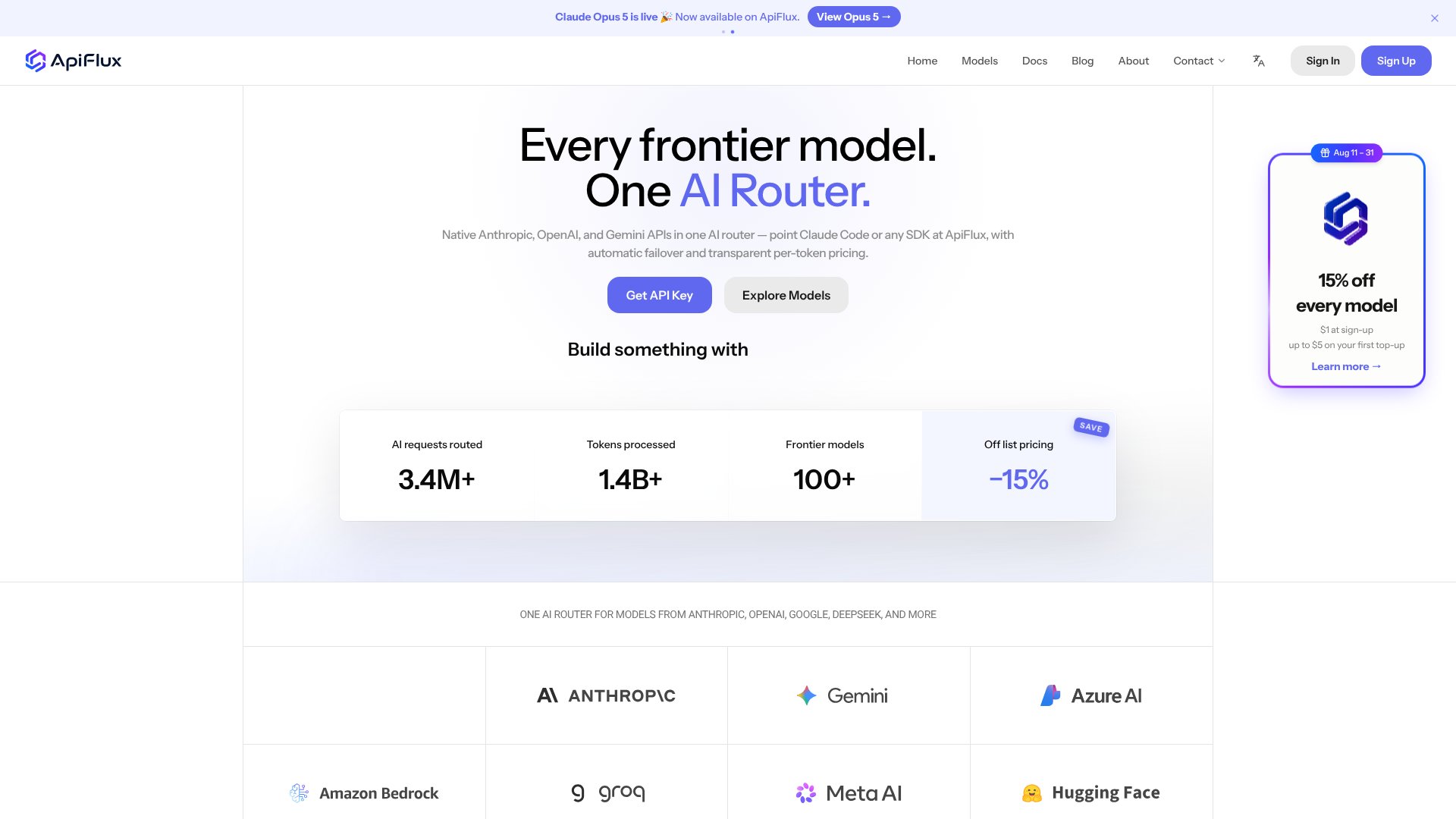
ApiFlux is an AI Code tool. Multi-protocol AI router providing unified access to Claude, GPT, Gemini, and 100+ frontier models at 15% below list price with automatic failover. Best for developers, ai coding tools and saas.
About ApiFlux
ApiFlux addresses a core friction point for developers working across multiple AI providers: the need to maintain separate API keys, SDKs, and integrations for Claude, GPT, Gemini, DeepSeek, and other frontier models. Instead of juggling five provider accounts and learning each vendor's SDK quirks, you get one OpenAI-compatible API key that routes to 100+ models.
The features that matter
- Single API key across 100+ models — Route requests to Claude, GPT, Gemini, DeepSeek, Kimi, Qwen, and more without switching authentication or rewriting integration code.
- OpenAI-compatible SDK — Works with any OpenAI client by changing one base URL. No code rewrite required; integrates with Claude Code, Codex CLI, OpenCode, and standard SDKs.
- Transparent per-token pricing at 85% of list — Every request shows exact token cost and pricing tier. No hidden fees or subscriptions; you top up once and pay as you go.
- Automatic failover — If an upstream provider degrades, the platform reroutes requests to healthy alternatives before your users notice downtime.
- Live usage dashboard — Track token consumption, latency, costs, and errors per request in real time. No instrumentation needed.
- Team billing controls — Set per-key limits and audit usage logs by team member, model, and timestamp for cost allocation.
Where it pays off
ApiFlux works best when you're already calling multiple AI providers or want to avoid being locked into a single vendor. Teams running AI coding tools (Claude Code, Codex CLI, OpenCode) see immediate token savings from the 15% discount. For production chatbots, copilots, and agent pipelines, the automatic failover means less scrambling during provider outages. Developers evaluating models side-by-side can test Claude, GPT, Gemini, and DeepSeek on the same prompt without creating separate accounts.
What to know before signing up
The platform's strength is in consolidation and cost, not in adding new capabilities beyond what each individual model offers. You're still bound by the latency and rate limits of the upstream providers—ApiFlux routes to them, it doesn't cache or pre-process responses. Setup is genuinely quick (create a key, change a base URL), but you'll need to be comfortable with the OpenAI SDK pattern; non-compatible clients require additional work. For teams on a single provider with no failover concerns, the routing overhead may not justify the operational change.
Key Features
Route across 100+ frontier models with one API key
Transparent per-token pricing at 85% of list price
Automatic failover when upstream providers degrade
OpenAI-compatible SDK integration with no code rewrite
Live usage dashboard tracking tokens, latency, and costs
Per-key limits and usage logs for team billing
Frequently Asked Questions
An AI router consolidates multiple AI model providers into one unified endpoint. ApiFlux lets you create a single API key and route requests across Claude, GPT, Gemini, and 100+ other models without changing your code.
Yes. ApiFlux provides an OpenAI-compatible API, so you can integrate it with any OpenAI SDK by simply changing the base URL. No code rewrite needed.
ApiFlux bills every model at 85% of the maker's list price with transparent per-token pricing. There is no subscription fee, and you only pay for what you use.
ApiFlux automatically fails over to healthy provider routes before users notice. Live usage dashboards show token usage, latency, costs, and errors for every request.