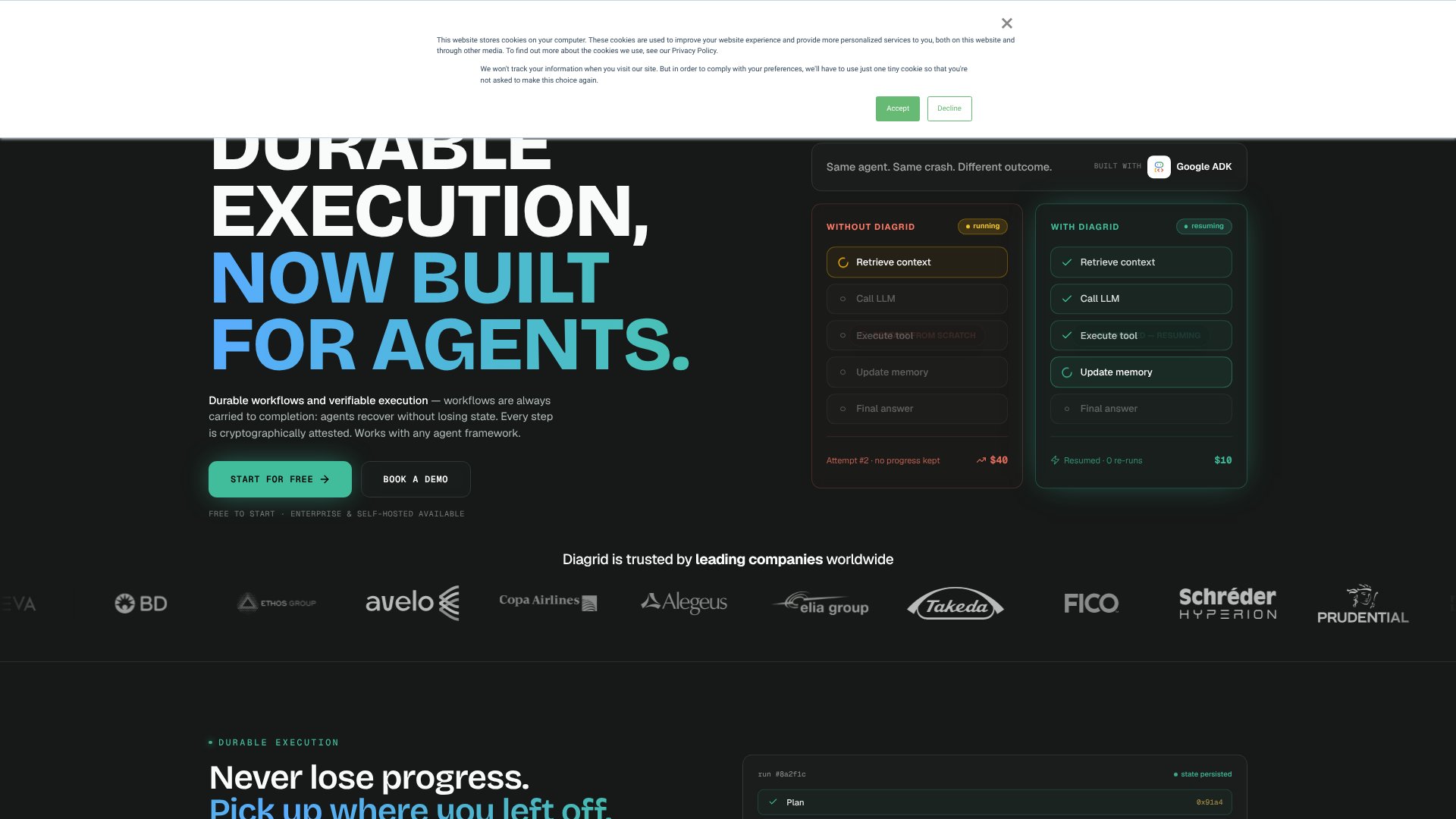
Diagrid Catalyst is an Automation tool. Platform enabling autonomous agents to recover from failures without losing state, with cryptographic verification of execution. Best for developers and enterprise.
About Diagrid Catalyst
Diagrid Catalyst addresses a fundamental reliability problem in production AI systems: agents that crash, encounter infrastructure outages, or face network failures often restart from scratch, wasting time and money on duplicate work. This platform preserves execution state as agents work, so they recover automatically without losing progress or re-running expensive LLM calls.
The features that matter
- Automatic crash & outage recovery — Agents resume from the last completed step after crashes, infrastructure failures, or deploys. No manual intervention, no state loss.
- Exactly-once execution — Duplicate LLM calls are prevented, protecting you from unnecessary costs when workflows are retried or resumed.
- Cryptographically signed audit logs — Every agent step is signed into a tamper-proof record, so you can prove exactly what an autonomous agent executed, when, and by whom.
- Framework-agnostic — Works with LangGraph, CrewAI, Google ADK, Strands, OpenAI Agents, and others. No rewrite required.
- Zero-trust access control — Control connections between agents, apps, and tools at the execution layer. Deny by default, then explicitly allow each integration.
- Long-running workflows — Supports work lasting from seconds to indefinite duration with durable state across restarts and scale events.
How it stands out
Most agent frameworks offer no built-in durability. If an agent crashes mid-execution, you restart it and hope idempotency saves you—but you're often re-running tool calls and re-querying LLMs. Diagrid Catalyst bakes durability into the execution layer itself, capturing state after each step so recovery is automatic and cost-free. The cryptographic audit log is equally rare: it proves what actually ran, signed and tamper-proof, which matters for compliance, debugging, and accountability in production systems.
What to know before adopting
Diagrid Catalyst requires integrating the platform into your workflow runner—it's not a log-after-the-fact solution. If your agents are already deeply embedded in your application logic without a clear orchestration boundary, adding durability may require some refactoring. The platform is free to start, but production and self-hosted options require licensing. Also, durability only covers the agent execution itself; your underlying tools and APIs still need to be idempotent for the guarantee to hold end-to-end.
Key Features
Automatic recovery from crashes and infrastructure outages without state loss
Cryptographically signed audit log proving what agents executed
Exactly-once execution preventing duplicate LLM calls and costs
Works with any agent framework including LangGraph and CrewAI
Zero-trust access control between agents, apps, and tools
Long-running workflows from seconds to indefinite duration
Frequently Asked Questions
Yes, Diagrid works with any agent framework including LangGraph, CrewAI, Google ADK, Strands, OpenAI Agents, Deep Agents, and Microsoft Agent Framework. No framework migration required.
Diagrid preserves execution state as work progresses. When the agent restarts, it resumes from the last completed step with zero work lost and zero duplicate LLM calls.
Diagrid cryptographically signs every step an agent takes, creating a tamper-proof record. This proves exactly what an autonomous agent did and detects if any record has been altered.
Diagrid is built on open-source software at its core, constructed by the creators of KEDA and Dapr, two graduated CNCF projects trusted by thousands of organizations.