
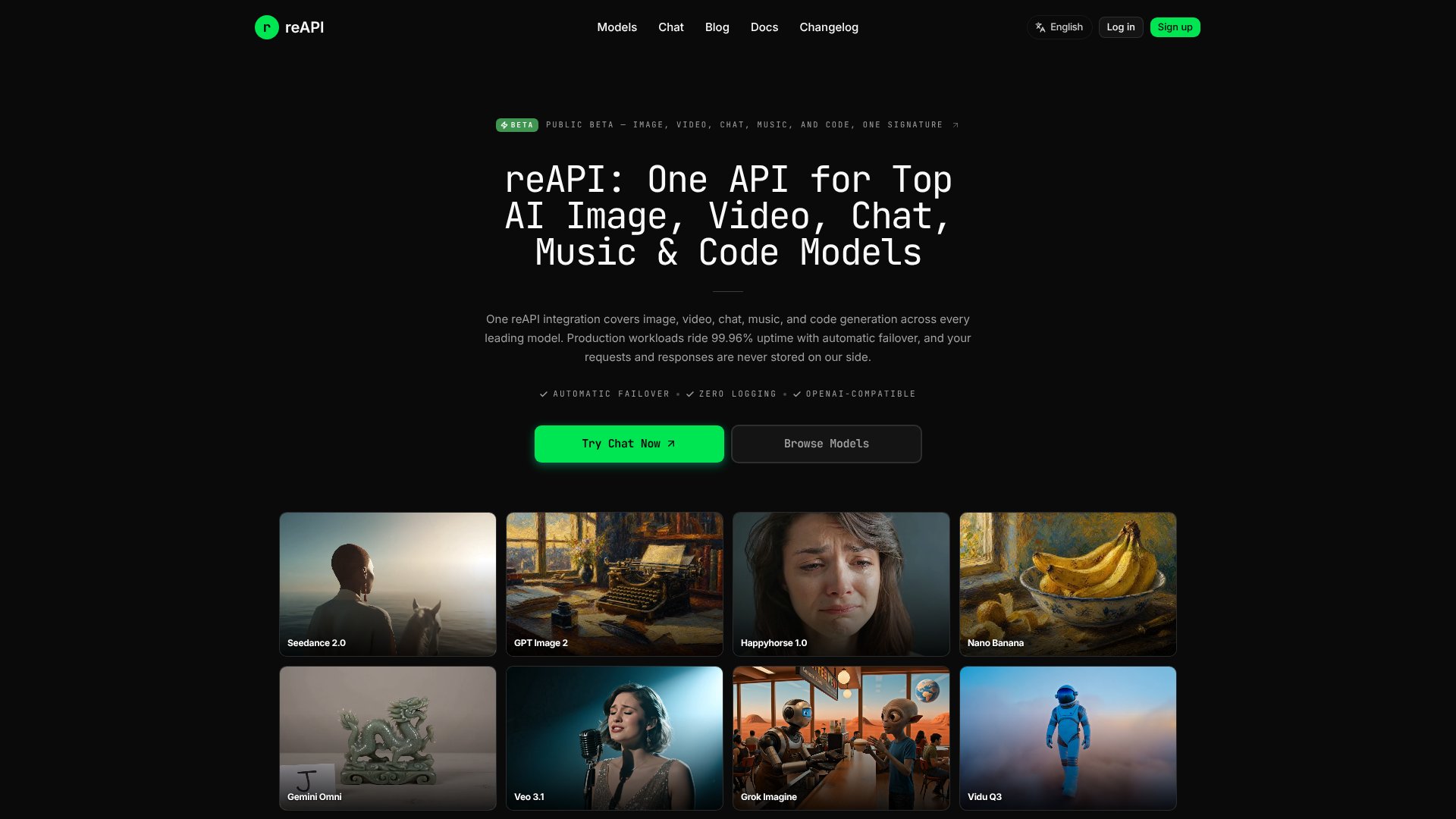
reAPI is a Misc AI tool. API aggregator providing unified access to leading image, video, chat, music, and code generation models with 99.96% uptime and automatic failover. Best for developers, saas and enterprise.
About reAPI
reAPI consolidates access to dozens of leading AI models—from GPT-5.5 and Claude to Veo, Seedance, Flux, and Suno—through a single OpenAI-compatible endpoint. The practical problem it solves: without it, you'd need separate API keys, different authentication schemes, and vendor-specific code paths for each model type. reAPI collapses that friction into one integration.
How it works
You mint a single reAPI key, point your existing OpenAI client at https://reapi.ai/v1, and start calling models by name. Change the model parameter from GPT-5.5 to Claude 4.7 Sonnet or Veo 3.1 without touching the rest of your code. The platform handles vendor selection, routing, and failover behind that one endpoint.
Where it pays off
- Automatic failover: When a model or vendor degrades, the next call routes to a backup vendor automatically. You get 99.96% uptime without writing retry logic.
- Zero request logging: reAPI never stores your requests or responses on its servers. Billing & security events log; your content does not.
- Spend control: Set per-key daily caps and team-level ceilings. A runaway worker hits the wall, not your credit card.
- Compliance features: Region pinning keeps EU traffic in EU, US in US, APAC in APAC—useful when data residency matters.
- Idempotent retries: Send the same request twice with an idempotency key; reAPI deduplicates so you never pay twice for a flaky network.
- One dashboard: Image, video, chat, music, and code models live in a single console. No separate portals per vendor.
What to know before signing up
The platform is in public beta. While the models themselves are production-ready and the uptime claim is specific (99.96%, not "enterprise-grade"), you're adopting a routing layer that's younger than the underlying vendors. You still need API keys from reAPI—this is not a free proxy. Streaming, tool calling, structured outputs, and multimodal inputs all pass through unchanged, but reAPI does add a hop in the request chain, so latency-sensitive applications should test live traffic before committing.
Key Features
Single endpoint for image, video, chat, music, and code models
Automatic failover across multiple vendors with 99.96% uptime
Zero request logging—responses never stored on reAPI servers
OpenAI-compatible API with no code changes required
Per-key spend caps and region pinning for compliance
Idempotent retries to prevent duplicate charges
Frequently Asked Questions
reAPI routes your request to the selected model, handles vendor selection and automatic failover if one degrades, and returns the response without storing it. Your code stays unchanged when switching models.
No. Requests and model outputs are never stored on reAPI servers. Only billing and security events are logged. Your content remains absent by design—there is no second copy on reAPI's side.
No. Point your existing OpenAI, Anthropic, or Google SDK client at reAPI's base URL and change one line. The rest of your code remains exactly the same across all models.
reAPI supports GPT-5.5, Claude 4.7, Gemini 2.5 Pro, Veo 3.1, Seedance 2.0, Flux, Suno, and many others for chat, image, video, music, and code generation—all accessible through one API key.