Digital Transformation
27 AI Chatbot Trends Dominating Customer Service in 2026
How AI chatbots cut support costs, improve satisfaction, and automate workflows with personalization, sentiment detection, RAG, and ethical controls in 2026.

27 AI Chatbot Trends Dominating Customer Service in 2026
AI chatbots are transforming customer service in 2026, handling 95% of interactions and reducing costs dramatically. Businesses are seeing 20–30% improvements in customer satisfaction and operational efficiency by leveraging advanced AI capabilities. Here’s what’s driving this shift:
- Cost Efficiency: AI-powered interactions cost $0.50–$2, compared to $8–$12 for human-only support.
- Personalization: Chatbots now understand text, voice, images, and videos, offering tailored solutions and remembering past interactions.
- Autonomy: AI handles multi-step tasks like refunds and scheduling, reducing human involvement in repetitive queries.
- Real-Time Sentiment Analysis: Chatbots adjust responses based on customer emotions, escalating to humans when needed.
- Proactive Support: AI predicts and resolves issues before they arise, improving customer experiences.
- Ethical AI Practices: Transparency, bias monitoring, and mandatory disclosures are building trust.
Companies are using AI strategically to cut costs, improve service, and free human agents for complex tasks. With features like smart routing, voice AI, and retrieval-augmented generation, chatbots are reshaping customer support into a scalable, efficient system. The challenge now is deploying these tools effectively to stay competitive.
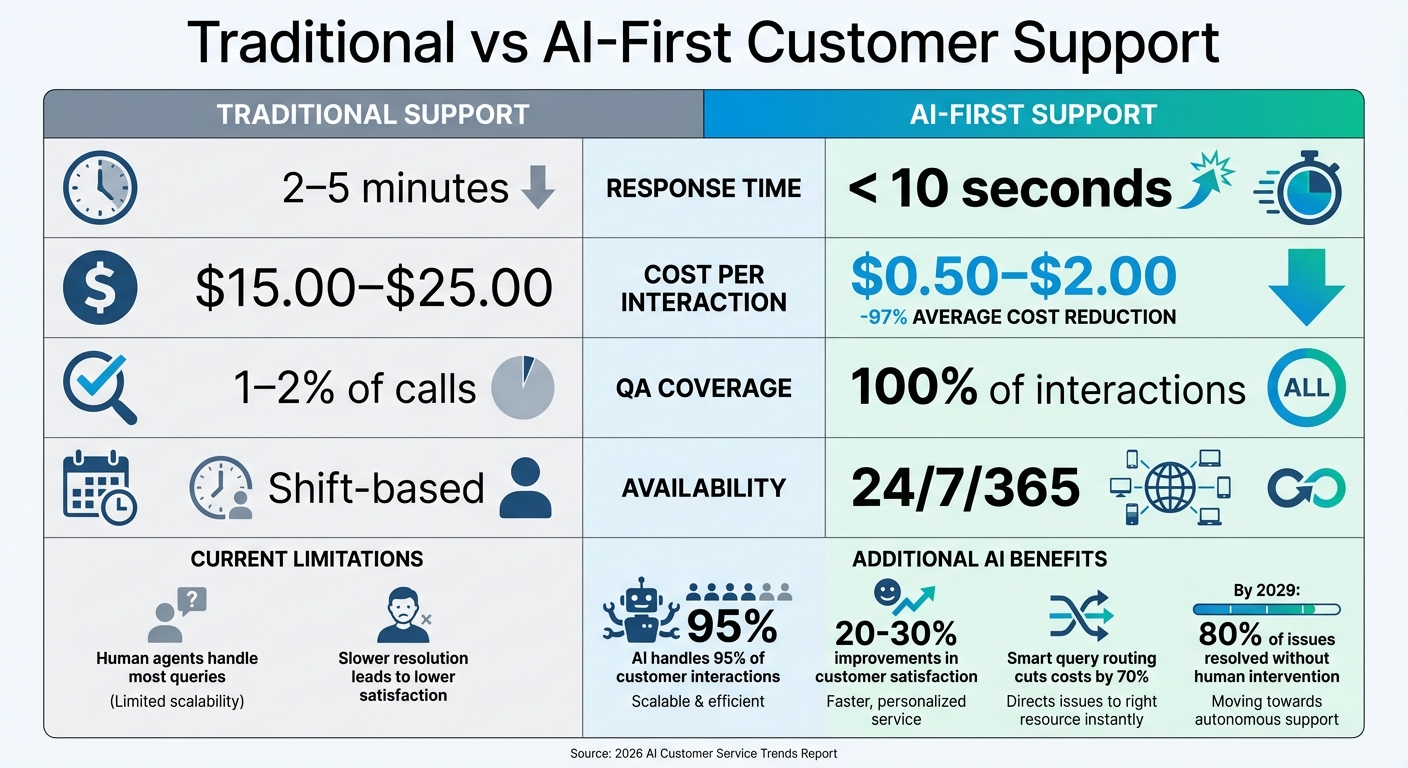
AI-First vs Traditional Customer Support: Cost, Speed, and Efficiency Comparison 2026
Beyond Just Chatbots: How to Use AI in Customer Service the Right Way | ClickUp
1. Personalization & Customer Experience
Multimodal Understanding Across All Input Types
AI chatbots have reached a new level of versatility, seamlessly handling text, voice, image, and video inputs within a single interaction. This eliminates the hassle of switching between channels. For instance, a customer can describe an issue via text, share a screenshot of an error message, and receive a solution - all without starting over. It's no wonder 76% of consumers prefer companies that offer integrated communication across these formats. Plus, the system’s memory keeps improving with each interaction, ensuring a smoother, more personalized experience every time.
Continuous Memory That Never Forgets
AI systems now employ a three-tier memory structure - session, user, and organizational - allowing them to retain context across interactions. This is a big deal because 81% of consumers expect AI to pick up right where a previous conversation ended, and 74% feel frustrated when they have to repeat themselves. By remembering past interactions, these systems make customer support feel less robotic and more human.
Chain-of-Thought Reasoning for Complex Recommendations
When it comes to making recommendations, modern AI goes beyond surface-level suggestions. It uses chain-of-thought reasoning to juggle factors like budget, team size, technical needs, and even past preferences - all in real time. For example, instead of offering generic product comparisons, the AI provides tailored guidance that aligns with the customer’s specific needs. This method captures the full context, making recommendations more relevant and actionable.
Real-Time Sentiment Analysis and Adaptive Responses
Customer expectations are constantly changing, and AI keeps up by analyzing tone and word choice in real time. This allows it to detect emotions like frustration or confusion and adjust its response accordingly. In cases where the situation escalates, the system can instantly involve a human agent. With 92% of companies already leveraging AI for tasks like sentiment analysis and proactive issue resolution, this capability has become a standard tool for delivering empathetic and effective support.
Proactive Service Before Problems Arise
AI doesn’t just react - it anticipates. By monitoring usage patterns and system logs, it can identify potential issues before they disrupt the customer experience. For example, if the system notices declining usage or recurring errors, it can proactively reach out with solutions or preventive guidance. This approach resonates with 67% of customers, who respond positively to proactive service interventions, and aligns with the belief of 72% of CX leaders that AI will drive proactive customer interactions in the future.
AI-Backed Satisfaction Scoring for Every Interaction
Traditional customer satisfaction surveys only capture about 3% of interactions, but AI changes the game. By analyzing 100% of customer interactions - using emotional cues and resolution outcomes - AI-backed CSAT systems provide a much fuller picture of customer sentiment. This eliminates the bias of voluntary surveys, which often skew toward extreme experiences, and ensures every interaction is accounted for.
Personalized Routing Based on Customer Value and Context
AI routing systems are now smarter and more cost-efficient. For straightforward queries, they use lightweight models like GPT-5.2 nano, while reserving advanced reasoning models like GPT-5.2 Pro for complex, high-value cases. This dual approach can slash operational costs by up to 70%, all while ensuring customers receive responses tailored to their specific needs and context. It’s a win-win for businesses and customers alike.
2. AI Capabilities & Technology
Reasoning Models That Think Before They Speak
AI models like GPT-5.2 Pro and Claude Opus 4.5 take a thoughtful approach to problem-solving. Instead of offering instant responses, these models use techniques like chain-of-thought reasoning and additional cues to ensure their answers align with business guidelines. This approach goes beyond basic pattern recognition, allowing them to offer more nuanced and accurate responses. On top of that, these advanced systems can handle complex, multi-step tasks, making them far more capable than earlier AI versions.
Agentic AI That Takes Action, Not Just Answers
AI chatbots are no longer limited to answering questions - they're now capable of performing tasks autonomously. These "agentic" systems can handle multi-step processes such as issuing refunds, rebooking flights, or updating CRM records. According to Gartner, by 2029, AI is expected to resolve 80% of common customer service issues without human intervention. As Kumar Krishnasami, CEO of Desk365, explains:
"The most impactful benefit we've seen is AI-driven ticket deflection: let AI handle L1 queries end-to-end, while human experts focus on L2 issues that require judgment and nuance".
Retrieval-Augmented Generation for Hyper-Personalized Answers
Modern chatbots are using Retrieval-Augmented Generation (RAG) to deliver highly personalized responses. By searching a company's knowledge base and first-party data in real time, these systems can provide answers tailored to each customer's specific needs instead of relying on generic responses. Whether it's pulling information from help documents, product specs, or past interactions, RAG ensures that the solutions offered are both context-aware and relevant.
Industry-Tuned Small Language Models
In specialized fields like finance, healthcare, and SaaS, small language models (SLMs) trained on domain-specific data are proving to be game-changers. These models deliver higher accuracy, faster response times, and come with built-in compliance features. For industries where precision is critical, SLMs are outperforming general-purpose AI models.
Edge AI for Lightning-Fast, Private Interactions
Edge AI is transforming how data is processed by running AI directly on user devices instead of in the cloud. This approach reduces response times to under 500 milliseconds and ensures that sensitive customer data stays on the device. This is particularly important in sectors like healthcare and fintech, where privacy and speed are non-negotiable.
Vibe Coding for Rapid Bot Development
Creating conversational AI no longer requires advanced technical skills. With vibe coding, non-technical teams can design detailed conversational flows using natural language. This method significantly reduces development time, making it easier to iterate and refine bots based on user feedback.
Voice AI with Natural Turn-Taking
Voice AI has become the go-to solution for handling urgent, high-priority inquiries. These systems can interpret emotion, tone, and speech patterns to maintain a fluid, natural conversation. With response times under 500 milliseconds, they ensure seamless interactions. Companies using conversational Voice AI in their contact centers have seen a 23.5% drop in cost per contact and a 4% boost in annual revenue.
sbb-itb-212c9ea
3. Operational Efficiency & Scalability
Operational efficiency is becoming a cornerstone for cost savings and scaling up, thanks to advancements in personalization and technology.
Smart Query Routing Cuts Costs by 70%
Companies are adopting tiered routing systems to handle queries more efficiently. Basic questions are directed to lightweight "nano" models, costing just $0.05 per million input tokens, while more complex tasks are routed to premium models like GPT-5.2 Pro, priced at $15.00 per million tokens. This approach slashes operational costs by as much as 70%, compared to relying on flagship models for every interaction.
Autonomous Agents Manage End-to-End Workflows
AI chatbots are now equipped to complete entire workflows without human intervention. These systems can process refunds, rebook flights, update CRM records, and schedule appointments via direct API integrations. This automation reduces interaction costs from $15.00–$25.00 to just $0.50–$2.00.
AI Optimizes Workforce Management
Modern AI tools predict ticket volumes and adjust agent schedules automatically to align with demand. By analyzing historical data, these systems forecast the types of queries expected and assign agents with the appropriate skills, reducing average handle times and improving overall efficiency. This predictive capability also enables automated quality controls to function seamlessly.
Real-Time Quality Assurance for Every Interaction
AI-driven quality assurance now reviews 100% of customer interactions in real time, replacing the traditional method of manually sampling just 1–2% of conversations. These systems evaluate compliance, empathy, and brand tone across all channels, ensuring consistent service quality at scale.
Proactive Issue Prevention
Predictive AI systems monitor user behavior, error logs, and billing cycles to identify potential problems before they arise. For example, if the system detects a drop in usage or other warning signs, it triggers proactive outreach, such as sending billing reminders or cart recovery messages.
Cross-Channel Context Switching Simplifies Support
AI systems now maintain user and session memory across multiple communication channels. This means a customer can start a conversation in chat, continue it on the phone, and follow up via email without needing to repeat their details. This continuity reduces redundant data entry and speeds up resolution times.
| Efficiency Metric | Traditional Support | AI-First Support |
|---|---|---|
| Response Time | 2–5 minutes | < 10 seconds |
| Cost per Interaction | $15.00–$25.00 | $0.50–$2.00 |
| QA Coverage | 1–2% of calls | 100% of interactions |
| Availability | Shift-based | 24/7/365 |
4. Trust & Ethical AI
Ethical and transparent AI isn't just a nice-to-have - it’s essential for building long-term customer trust. With 95% of consumers wanting clear explanations of AI decisions and 74% of CX leaders emphasizing transparency, it's clear that both customers and regulators expect more clarity. This push for transparency has led to technical advancements that make AI decisions easier to understand and verify. As Tom Eggemeier, CEO of Zendesk, aptly says:
"AI is not the differentiator anymore. How intelligently you apply it is".
AI Reasoning Controls: Making Logic Clear
AI systems are becoming increasingly adept at explaining their decisions. These systems now provide insights into the reasoning behind their recommendations, helping users understand why they received a specific answer. Impressively, 98% of high-maturity organizations have implemented or plan to implement these reasoning controls.
Knowledge Grounding: Avoiding Misinformation
To combat misinformation, AI chatbots are now tethered to verified sources. They rely on approved materials like official knowledge bases and release notes. When providing answers, the chatbot cites the exact document or article it used, enabling customers to double-check the information. Regular audits - conducted weekly - review unresolved issues and ensure the content remains accurate and relevant.
Mandatory AI Disclosures
Starting January 27, 2026, the FCC will require outbound AI communications to include a clear disclosure. This transparency measure is designed to build trust, and it aligns with the 86% of consumers who favor openness about AI usage.
Human Escalation for Complex Scenarios
For sensitive or complex cases, ethical AI systems ensure smooth handoffs to human agents. These escalations are triggered automatically when the system detects customer frustration through sentiment analysis or when the AI’s confidence level drops below a certain threshold. This approach prevents customers from feeling stuck in endless automated loops, providing them with the human touch when it matters most.
Tackling Bias Through Monitoring and Audits
To address concerns about bias, companies are running stress tests and monitoring AI for inaccuracies before they reach customers. By the end of 2026, 70% of organizations are expected to adopt formal AI ethics guidelines, reducing risks to both reputation and compliance. Regular audits also ensure that AI models treat all groups fairly, particularly in multilingual settings.
| Trust Factor | Customer Expectation | Implementation Rate |
|---|---|---|
| AI Usage Transparency | 86% demand openness | Required by FCC (Jan 2026) |
| Reasoning Visibility | 95% expect explanations | 98% of mature orgs adopting |
| Human Agent Access | Available for complex cases | Standard practice |
| Fair Treatment | 63% concerned about bias | 70% implementing guidelines |
Conclusion
In 2026, the question isn’t whether to integrate AI but how to do it effectively. Declan Ivory, VP of Customer Support at Intercom, captures this challenge perfectly:
"Launching AI is easy, but transforming with it is not... when you invest in the system, the returns compound".
The gap between superficial adoption and strategic deployment is growing, with only a small percentage of businesses achieving full integration. Those that succeed unlock major advantages, particularly in operations and customer service.
Leading companies in 2026 view AI as a core part of their infrastructure, not just an add-on. They’re leveraging tools like smart query routing - which can reduce costs by as much as 70% - deploying autonomous agents to manage entire workflows, and embracing voice-first interfaces for high-intent customer interactions. These mature adopters are turning customer support from a cost center into a driver of growth. By 2029, it’s estimated that up to 80% of customer issues will be resolved without human involvement. To prepare for this shift, businesses should begin with a 90-day action plan: review their current systems, focus on quick wins (like addressing the top three repetitive queries), and set up governance to ensure ethical AI use.
The future of customer support lies in a balanced approach. AI excels at handling routine tasks, while humans focus on complex, high-value interactions. Kenji Hayward, Senior Director of Customer Support at Front, sums it up well:
"AI should handle the common path. Humans should own the moments that matter".
The ideal model is AI-first, human-supported. AI provides the speed and scale needed for everyday queries, allowing teams to dedicate their time to scenarios that require empathy and critical thinking. Customers now expect chatbots with advanced reasoning, comparable to GPT-5.2-level capabilities. The challenge isn’t just adopting AI - it’s implementing it quickly and effectively. Start your 90-day plan today and use these trends to transform your customer support strategy.
FAQs
How do AI chatbots enhance customer satisfaction and streamline operations?
AI chatbots are reshaping how businesses deliver customer support by focusing on faster responses and deeper understanding. By 2026, these bots are expected to interpret customer intent more accurately, tackle intricate problems step-by-step, and provide highly tailored solutions. This means shorter wait times, higher resolution rates on the first try, and an overall sense that customers are genuinely valued.
From an operational perspective, AI chatbots excel at managing repetitive questions, which lightens the load for human agents and significantly reduces costs. While a chatbot interaction costs between $0.50 and $2, human-assisted support can range from $6 to $12 per interaction. These cost savings, combined with improved efficiency, contribute to a smoother and more satisfying customer experience.
What ethical concerns should businesses consider when using AI in customer service?
Businesses face several ethical challenges when integrating AI into customer service, and addressing these is crucial for maintaining trust and integrity. One of the biggest concerns is bias and fairness. AI systems need to be carefully designed to avoid perpetuating stereotypes or unfairly treating specific customer groups. This requires ongoing monitoring and adjustments to ensure equitable outcomes for everyone.
Transparency is another key issue. Customers should always know when they’re interacting with an AI rather than a human. Clear communication about this builds trust and helps manage expectations during interactions.
Data privacy is also a major factor. AI often processes large amounts of personal data, so companies must handle this information responsibly. This means securing data, obtaining proper consent, and adhering to relevant regulations to protect customer information.
Lastly, there’s the question of how AI impacts jobs. While AI can streamline processes, it should complement human agents rather than replace them. Maintaining a balance ensures that customer interactions remain personal and empathetic while minimizing concerns about job loss.
By focusing on fairness, transparency, privacy, and thoughtful implementation, businesses can use AI responsibly and strengthen their connections with customers.
What are the best strategies for businesses to implement AI chatbots and stay competitive?
Businesses aiming to stay ahead should prioritize using advanced AI technologies while keeping customer needs front and center. For starters, reasoning models can help chatbots understand customer intent and tackle complex issues. This not only improves the quality of interactions but also builds trust with users. While these models can demand significant resources, finding the right balance between innovation and operational costs is crucial.
Another smart move is implementing a hybrid support model. In this setup, AI takes care of routine tasks, freeing up human agents to handle more complicated problems. This approach boosts efficiency and ensures quicker, more accurate service, aligning with customer expectations. On top of that, proactive AI systems - designed to predict customer needs - can elevate service quality and strengthen customer loyalty.
Lastly, consider investing in scalable AI solutions that can evolve alongside customer demands. Training support teams to work seamlessly with AI tools is equally important. By blending advanced technology with thoughtful planning, businesses can not only prepare for the future but also deliver standout customer experiences.