Digital Transformation
Why the New Claude Fable 5 is Different From Older Models
Generational jump in long-horizon AI: Fable 5 adds self-correction, task delegation and a 1M-token context, but costs more and stores data 30 days.

Why the New Claude Fable 5 is Different From Older Models
Claude Fable 5 is Anthropic's latest AI model, designed for complex, long-term tasks. Unlike its predecessor, Claude Opus 4.8, which excelled at shorter, iterative workflows, Fable 5 introduces advanced features like self-correction, task delegation, and a 1-million-token context window. It also supports persistent memory and enhanced vision capabilities, making it suitable for handling intricate projects like large-scale coding or data analysis.
However, these advancements come at a price - Fable 5 costs $10 per million input tokens and $50 per million output tokens, double the cost of Opus 4.8. It also mandates a 30-day data retention policy, which may raise privacy concerns for some users. For simpler, budget-conscious tasks, Opus 4.8 remains a strong option.
Here’s a quick comparison:
| Feature | Claude Fable 5 | Claude Opus 4.8 |
|---|---|---|
| Coding Performance | 80.3% (SWE-Bench) | 69.2% |
| Vision Accuracy | 29.8% (GDP.pdf) | 22.5% |
| Context Window | 1M tokens | 200K–1M tokens |
| Input/Output Cost | $10/$50 per 1M tokens | $5/$25 per 1M tokens |
| Long-Term Task Handling | Yes | Limited |
| Safety Mechanisms | Fallback to Opus 4.8 | Standard filters |
Fable 5 is ideal for businesses needing autonomous, high-level AI operations, while Opus 4.8 remains a cost-effective choice for shorter, straightforward tasks.
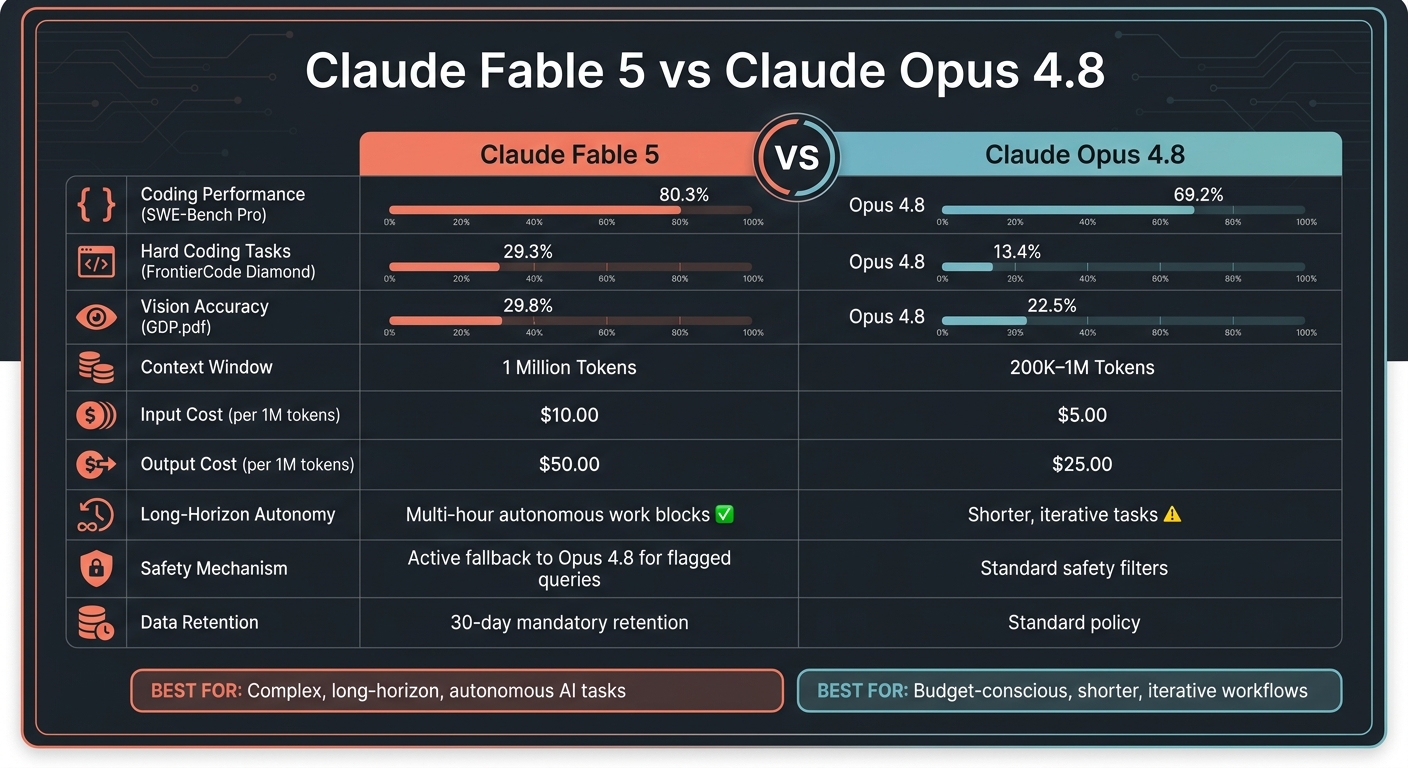
Claude Fable 5 vs Claude Opus 4.8: Full Feature & Performance Comparison
Claude Fable 5: Better Than Opus 4.8?
sbb-itb-212c9ea
1. Claude Fable 5
Claude Fable 5 is the first widely available model in Anthropic's Mythos-class tier. It stands out by processing entire work blocks through planning, self-correction, and delegating tasks to sub-agents.
Technical Advancements
Fable 5's design is built around two standout features. The first is Adaptive Thinking, which is always active. Users can control the depth of its reasoning by adjusting an "effort" parameter, which also impacts the cost. The second is its 1-million-token context window, with support for up to 128,000 output tokens per request. This makes it particularly useful for handling large-scale text, code, or data tasks.
Another highlight is its persistent file-based memory, which enables it to reference its own historical notes spanning millions of tokens. Its advanced vision capabilities allow it to extract data from scientific figures and even reconstruct web app source code directly from screenshots. Anthropic showcased Fable 5's capabilities by using it to complete Pokémon FireRed using only raw screenshots as input.
These features collectively deliver notable performance improvements, as detailed below.
Performance Benchmarks
Fable 5's performance metrics showcase its advancements. For instance, it achieves 80.3% on SWE-Bench Pro, compared to 69.2% for Opus 4.8. On the FrontierCode "Diamond" split, it scores 29.3%, more than doubling Opus 4.8's 13.4%. In document and chart reasoning, it leads the GDP.pdf vision evaluation with 29.8% versus 22.5% for Opus 4.8.
In June 2026, Stripe leveraged Fable 5 to migrate a 50-million-line Ruby codebase in just one day - a task that would have taken over two months manually. Michael Truell, CEO of Cursor, commented:
"Claude Fable 5 is the state of the art model on CursorBench. It's opened up a class of long-horizon problems that were out of reach for earlier models."
In addition to its performance, Fable 5 places a strong emphasis on safety and reliability.
Safety and Guardrails
Fable 5 employs dedicated AI classifiers to monitor requests involving sensitive topics like cybersecurity, biology, chemistry, and model distillation. Instead of outright rejecting flagged requests, it reroutes them to Claude Opus 4.8 as a safety fallback. This mechanism is triggered in fewer than 5% of sessions.
Anthropic also conducted over 1,000 hours of external bug bounty testing, which found no universal jailbreaks. A new policy now mandates a 30-day data retention period for all Mythos-class usage, even for enterprise customers who previously had zero-retention agreements. This ensures thorough safety monitoring.
Pricing and Cost Efficiency
Fable 5's pricing is approximately double that of Opus 4.8. However, it offers cost-saving features like 90% discounts on cached input tokens and no charges for requests rerouted to Opus 4.8 by safety classifiers before generating output. For businesses handling complex, long-term projects, this pricing aligns with its enhanced capabilities. A Rakuten team noted:
"At the highest effort, Claude Fable 5 reflects on and validates its own work. For us, that's what makes highly autonomous operations possible - the extra thinking pays for itself."
2. Older Claude Models
Before the release of Fable 5, Anthropic's leading model was Claude Opus 4.8, the standout model in the Opus series. It was primarily built for standard reasoning tasks, relying on workflows that required continuous user input to function effectively. Developers often managed these models through platforms like OpenRouter to streamline integration.
Technical Advancements
Older models like Opus 4.8 lacked the ability to handle long-term tasks independently. While it supported an impressive 1-million-token context, it faced challenges with intricate visual tasks that needed additional tools for consistent performance. For instance, models like Opus 4.8 couldn’t independently play a game such as Pokémon FireRed without a specialized helper harness, as its raw vision capabilities were insufficient for the task. Multi-step tasks often required frequent corrections, limiting its overall efficiency.
These technical gaps were reflected in its benchmark results, especially when compared to newer models.
Performance Benchmarks
Opus 4.8 delivered respectable results on several benchmarks, including 69.2% on SWE-Bench Pro, 22.5% on GDP.pdf vision, and 49.8% on Humanity's Last Exam. However, its performance on the FrontierCode Diamond split, where it scored 13.4%, revealed its limitations with intricate coding challenges. Despite these constraints, it held the top position on the Appwrite Arena leaderboard as of June 2026.
Safety and Guardrails
Safety mechanisms in older models were noticeably different. Claude Opus 4.8 employed strict safety measures, using hard refusals to decline flagged unsafe queries and terminate interactions. Earlier versions, such as Opus 4.6, lacked even basic cybersecurity protections. Later updates introduced features like bioweapon classifiers to enhance safety protocols.
Pricing and Cost Efficiency
Claude Opus 4.8 was priced at $5 per million input tokens and $25 per million output tokens, making it significantly more affordable than Fable 5. By contrast, the earlier Claude Mythos Preview, launched in April 2026, came with a much steeper price tag of $25 per million input tokens and $125 per million output tokens. This pricing difference highlights the evolving cost structure of Anthropic's models over time.
Pros and Cons
Deciding between the Claude Fable 5 and the older Claude Opus 4.8 depends largely on your specific needs and priorities. The table below provides a quick comparison of their features, followed by a breakdown of how these differences play out in real-world scenarios.
| Criteria | Claude Fable 5 | Claude Opus 4.8 |
|---|---|---|
| Coding Performance (SWE-Bench Pro) | 80.3% | 69.2% |
| Hard Coding Tasks (FrontierCode Diamond) | 29.3% | 13.4% |
| Vision Accuracy (GDP.pdf, no tools) | 29.8% | 22.5% |
| Long-Horizon Autonomy | Built for multi-hour work blocks | Optimized for shorter, iterative tasks |
| Context Window | 1 million tokens | 200,000–1 million tokens |
| Input Price (per 1M tokens) | $10.00 | $5.00 |
| Output Price (per 1M tokens) | $50.00 | $25.00 |
| Safety Mechanism | Active fallback to Opus 4.8 for flagged queries | Standard safety filters |
| Data Retention | 30-day mandatory retention | Standard policy |
When it comes to performance, the Fable 5 makes major strides over the Opus 4.8. For instance, in coding tasks, it achieves a notable 80.3% on the SWE-Bench Pro benchmark, compared to Opus 4.8’s 69.2%. This advantage becomes even more pronounced with complex coding challenges, where Fable 5 more than doubles Opus 4.8’s score on the FrontierCode Diamond test (29.3% vs. 13.4%). Its ability to handle extended work sessions and larger context windows also makes it a better choice for demanding, long-term projects.
"Fable 5 is the model for tasks where Opus 4.8 produces reliable but imperfect results... the cases where you'd need Opus and more context than Opus can hold." - Will Tygart, Tygart Media
However, these benefits come at a cost. Fable 5’s pricing is significantly higher, with input and output costs per 1M tokens at $10.00 and $50.00, respectively, compared to Opus 4.8’s $5.00 and $25.00. Additionally, its mandatory 30-day data retention policy may raise concerns for organizations prioritizing data privacy. Another drawback is its safety fallback mechanism, which sometimes routes legitimate queries - especially in fields like software security or biotech - back to Opus 4.8, causing delays.
Looking ahead, it’s worth noting that as of June 23, 2026, Fable 5 will no longer be part of the standard Pro, Max, or Team plans. Users will need to purchase separate usage credits, adding another layer of cost for those relying on this model.
Conclusion
Claude Fable 5 stands out as a significant improvement over its predecessors, boasting Mythos-class intelligence, a 1-million-token context window, and the ability to manage complex workflows. Benchmarks consistently highlight its performance advantages.
That said, Fable 5 is best suited for tasks requiring high-level delegation and processing. For simpler tasks, quick exchanges, or projects with tighter budgets, Opus 4.8 remains a dependable and budget-friendly alternative, costing about half as much.
For U.S. users in regulated industries, two features are particularly noteworthy: the US-only inference option, which ensures data remains on domestic infrastructure at just 1.1× the standard pricing, and blind review evaluations that confirm Fable 5 excels in legal applications, often surpassing its predecessors.
FAQs
When is Fable 5 worth the higher price?
Claude Fable 5 justifies its higher price tag when tackling complex, long-term tasks that require advanced reasoning and the ability to maintain context for extended periods. It's particularly suited for high-pressure projects like codebase migrations, multi-system integrations, or in-depth strategic research. These scenarios demand precision, and Claude Fable 5 excels at minimizing costly mistakes. While its cost per token is double that of Opus 4.8, the enhanced reliability and superior performance it offers for intricate and well-defined workflows make it a worthwhile investment.
How does the “effort” setting change results and cost?
The effort setting determines how deeply the model reasons through a task. When set higher, the AI takes extra steps to validate its work, making it better suited for handling complex challenges. Pricing starts at $10 per million input tokens and $50 per million output tokens, but increasing the effort level leads to higher token usage. Depending on the task's complexity, this can push the total cost to 3–5 times the base price.
What does the 30-day data retention mean for my privacy?
Anthropic’s 30-day data retention policy means that any inputs and outputs are stored for a month. This temporary storage helps detect and prevent multi-request attacks and allows for identifying false positives in the model's safety mechanisms. Importantly, while your data is stored during this period, Anthropic has made it clear that this information will not be used for model training, prioritizing your privacy.