Writing Tools
Claude Opus 5 vs ChatGPT 5.6 Sol: Which Is Better? Full Review August 2026
One model delivers cleaner long-form writing and deep analysis; the other combines image, voice, and terminal workflows in one platform.

Claude Opus 5 vs ChatGPT 5.6 Sol: Which Is Better? Full Review August 2026
If you want the short answer: I’d pick Claude Opus 5 for writing, long documents, and careful analysis, and I’d pick ChatGPT 5.6 Sol for images, voice, terminal work, and Microsoft-heavy teams. Both start at $20/month, both launched in July 2026, and both offer about a 1M-token context window.
Here’s the fast breakdown:
-
Pick Claude Opus 5 if you care most about:
- cleaner long-form drafts
- better handling of long source material
- lower API output cost at $25 per 1M tokens
- chat privacy that is off by default for training
-
Pick ChatGPT 5.6 Sol if you care most about:
- native image generation
- voice and video workflows
- terminal and DevOps use
- a lower entry plan at $8/month in the U.S.
What stood out to me is simple: Claude tends to need less cleanup, while ChatGPT covers more types of work in one place. So this choice is less about who “wins” overall and more about how you work each day.
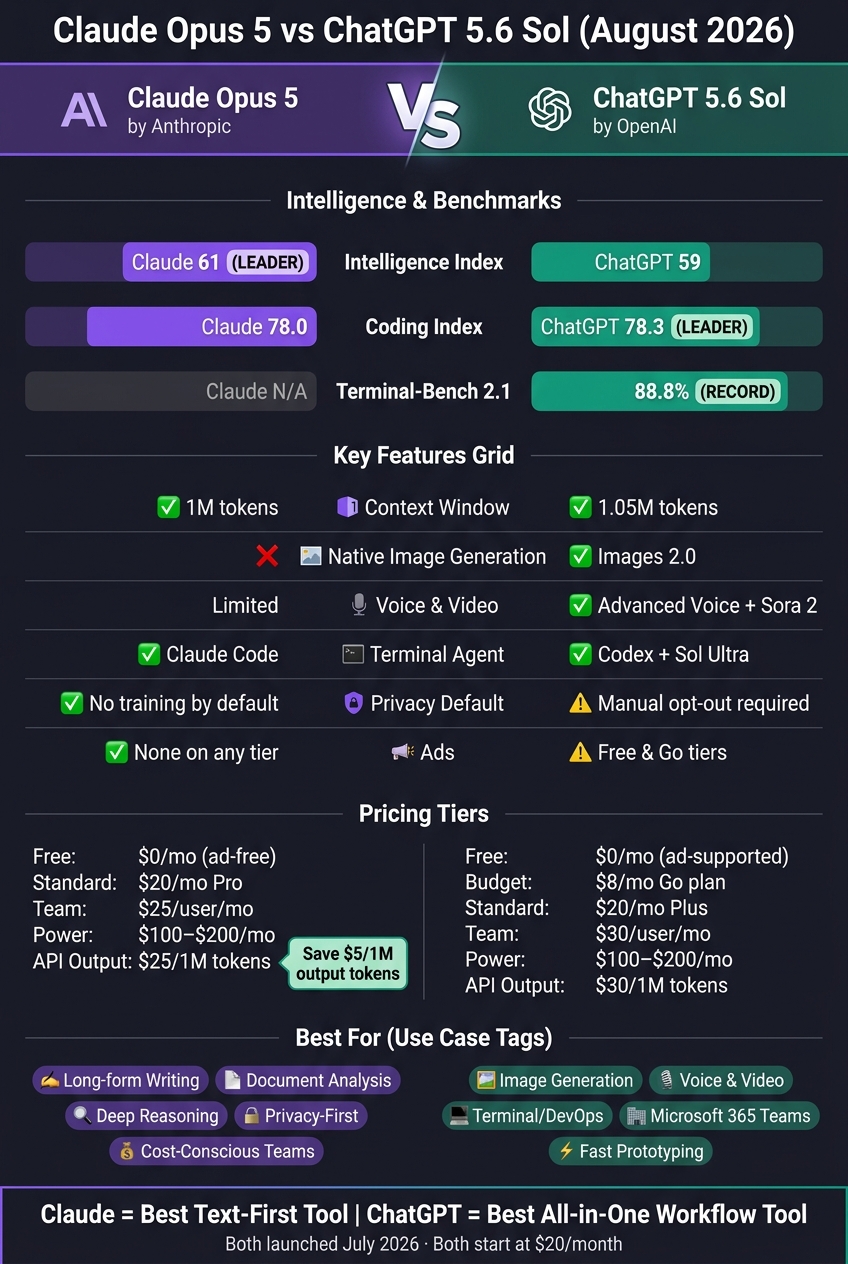
Claude Opus 5 vs ChatGPT 5.6 Sol: Full Feature & Pricing Comparison (2026)
Claude Opus 5 Vs GPT 5.6 Sol - The ULTIMATE comparison test
sbb-itb-212c9ea
Quick Comparison
| Criteria | Claude Opus 5 | ChatGPT 5.6 Sol |
|---|---|---|
| Best use | Writing, deep analysis, long docs | Multimodal work, terminal tasks, team workflows |
| Launch date | July 24, 2026 | July 9, 2026 |
| Standard plan | $20/month | $20/month |
| Context window | 1M tokens | 1.05M tokens via OpenRouter |
| Writing | Stronger final polish | Faster first drafts |
| Coding | Good for repo review and multi-step work | Slight edge on coding benchmarks |
| Terminal work | Claude Code | Strong lead, 88.8% on Terminal-Bench 2.1 |
| Image generation | No | Yes |
| Voice/video | Limited | Yes |
| API output cost | $25 per 1M tokens | $30 per 1M tokens |
| Privacy default | No training on chats by default | Manual opt-out for Free and Plus |
If you want one clean takeaway, it’s this: Claude is the better text-first tool, and ChatGPT is the better all-in-one workflow tool.
Claude Opus 5 and ChatGPT 5.6 Sol at a glance
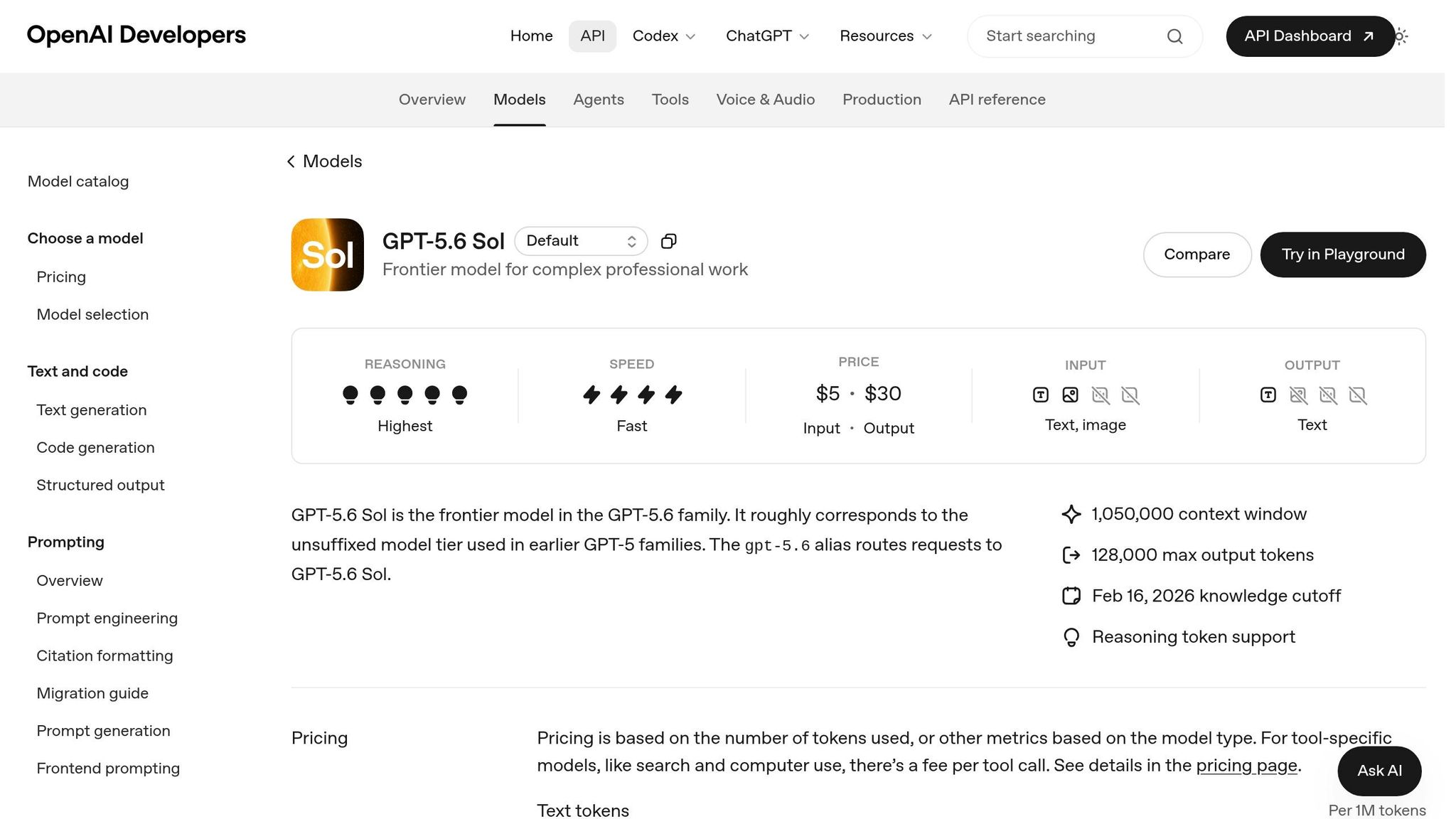
Claude Opus 5
Claude Opus 5 is Anthropic's top model. It leads the Artificial Analysis Intelligence Index with a score of 61.
It's best suited for long-form writing, deep reasoning, and long-context document analysis. One of its biggest selling points is the confirmed 1 million-token context window across all paid tiers, including the $20/month Claude Pro plan. On the API side, pricing is $5 per 1 million input tokens and $25 per 1 million output tokens.
Claude Pro also includes Claude Code, a terminal-based agent that can read repositories, run commands, and edit files locally. On privacy, Claude has a clear edge: it does not train on chats by default on any tier.
ChatGPT 5.6 Sol
ChatGPT 5.6 Sol is OpenAI's flagship reasoning model. It scores 59 on the Artificial Analysis Intelligence Index and leads the Artificial Analysis Coding Index with 78.3, just ahead of Claude Opus 5 at 78.0.
Its main strengths are multimodal features and terminal-based agent workflows. It comes with native image generation through ChatGPT Images 2.0, advanced voice mode, and a confirmed 1.05M-token API context window. It also posted a record 88.8% on Terminal-Bench 2.1.
API pricing matches Claude on input at $5 per 1 million tokens, but output is higher at $30 per 1 million tokens. OpenAI has not published the Plus limit.
The table below focuses on the differences that matter most before getting into the task-by-task review.
Side-by-side comparison table
| Feature | Claude Opus 5 | ChatGPT 5.6 Sol |
|---|---|---|
| Intelligence Index | 61 (leader) | 59 |
| Coding Index | 78.0 | 78.3 (leader) |
| Context window | 1M tokens on paid tiers | 1.05M tokens (API confirmed) |
| Image generation | No native image generation | Yes - ChatGPT Images 2.0 |
| Agentic coding tool | Claude Code | Codex + Sol Ultra |
| Standard plan | $20/month (Claude Pro) | $20/month (ChatGPT Plus) |
| Budget option | None | $8/month Go plan with ads |
| API output cost | $25 per 1M tokens | $30 per 1M tokens |
| Privacy default | No training on data by default | Free and Plus users must opt out manually |
| Ads | None on any tier | Yes - Free and Go tiers |
Next, the review tests both models on writing, reasoning, coding, and workflow speed.
Task-by-task performance review
The gap between these models shows up best when you put them on actual work.
Writing quality
Claude Opus 5 turns out cleaner final drafts. Its rhythm is better, the tone stays steady, and it uses fewer filler lines. ChatGPT 5.6 Sol is fast, but its long-form writing can feel a bit patterned, with stock transitions that show up too often.
Put simply: Claude sounds more like a person. ChatGPT sounds more like a system built for output speed.
For marketing copy and support replies, Claude has a clear lead in polish and tone control. ChatGPT is still very useful when you need to brainstorm fast or spin up several angles in a short time. But the last pass often gets better once Claude tightens it up. A practical setup is simple: use ChatGPT to generate options fast, then move the best one into Claude for the final version. If the goal is human-sounding writing, Claude Opus 5 is the default pick.
The same split shows up in reasoning too. Claude goes deeper. ChatGPT moves faster.
Reasoning, research, and coding
Both models perform well on reasoning, but they shine in different ways. Claude Opus 5 leads the Artificial Analysis Intelligence Index at 61 vs. 59, which makes it a better match for complex, multi-step logic and long-document analysis. Its 1M-token context window means it can handle about 555,000 words in a single session.
Claude does better with synthesis and pulling signal from long documents. ChatGPT does better with live web research and factual lookup.
ChatGPT 5.6 Sol moves ahead on coding benchmarks and stands out on terminal-heavy work, with an 88.8% score on Terminal-Bench 2.1. If you're doing deep debugging or refactoring architecture across a large codebase, Claude is usually the better choice. If you need fast prototypes, boilerplate, or DevOps command-line help, ChatGPT has the lead.
| Task | Stronger Model | Why |
|---|---|---|
| Terminal/DevOps tasks | ChatGPT 5.6 Sol | 88.8% on Terminal-Bench 2.1 |
| Rapid prototyping | ChatGPT 5.6 Sol | Fast boilerplate and quick iteration |
| Multi-step agent loops | Claude Opus 5 | More reliable in long, multi-turn workflows |
There’s also a small but important behavior difference. Claude is more likely to push back on vague or conflicting prompts. ChatGPT usually fills in the blanks and moves forward. That can make ChatGPT feel faster on messy prompts, but Claude’s caution can stop small issues from snowballing.
Speed and multimodal features shape the day-to-day experience from there.
Speed, multimodal use, and workflow speed
In daily use, raw speed matters less than how long it takes to get to a usable final result. ChatGPT is a bit faster per token, and that helps on high-volume work. But Claude often needs fewer follow-up fixes, which can make up for the speed difference on harder tasks.
The bigger separation is multimodal use. ChatGPT 5.6 Sol comes with native image generation through ChatGPT Images 2.0, video through Sora 2, and Advanced Voice Mode for live conversation. Claude can review uploaded images and documents, but it can't generate images or video. So if your workflow includes visual assets or voice, ChatGPT wins outright.
Tooling also matters. Claude leans on Artifacts and Projects. ChatGPT leans on Custom GPTs and Operator. And if your team lives in Microsoft Office, ChatGPT fits that setup in a way Claude still doesn't fully match.
Pricing and business fit
Plans, API costs, and availability
Once the feature set is clear, pricing and deployment usually make the final call. The biggest split shows up below and above the standard plan.
| Plan | Claude Opus 5 | ChatGPT 5.6 Sol |
|---|---|---|
| Free | $0.00 (ad-free) | $0.00 (ad-supported in the U.S.) |
| Budget | N/A | $8.00/mo (Go, ad-supported in the U.S.) |
| Standard | $20.00/mo (Pro) | $20.00/mo (Plus) |
| Team | $25.00/user/mo | $30.00/user/mo |
| Power User | $100.00 (5x usage) or $200.00 (20x) | $100.00/mo or $200.00/mo (Pro) |
| API Input | $5.00 per 1M tokens | $5.00 per 1M tokens |
| API Output | $25.00 per 1M tokens | $30.00 per 1M tokens |
Claude costs less for teams and for API output. For a 10-person team, that works out to $600.00 less per year on the team plan. And the $5.00 gap per 1M output tokens can add up fast if you're running high-volume jobs or customer-facing flows all day.
ChatGPT does have one thing Claude doesn't: an $8.00/month Go plan in the U.S. Claude has no low-cost tier like that, though it stays ad-free across every plan. OpenAI started showing ads on ChatGPT Free and Go in the U.S. on February 9, 2026. So this part of the decision isn't just about price. It's also about team size, usage pattern, and whether ads are a deal-breaker.
Best fit by user type
Those pricing gaps point to different best-fit users.
- Solo content creators: Pick Claude for writing-heavy work where cleaner drafts can cut editing time. Pick ChatGPT if you need native image generation in the same workflow.
- Developers: Pick Claude for long-context repo review. Pick ChatGPT for terminal automation.
- Support teams and researchers: Pick Claude. Its 1M-token context window can handle large documents in one session without running into a published cap.
- Cost-conscious startups: Claude makes more sense here. Lower seat pricing and lower output costs stack up fast.
- Microsoft-heavy teams: ChatGPT fits better if you want closer Copilot and app integration.
Final verdict by use case
Both models are good. But they shine in different kinds of work.
That’s the main point here: this comes down to fit, not just who looks smarter on paper.
After testing writing, reasoning, coding, and day-to-day workflows, the split is pretty easy to see.
Choose Claude Opus 5 if
Claude makes more sense when your work leans heavily on text.
Its writing feels more natural, and its code edits tend to be more exact. That gives Claude an edge for long drafts, close reading, and messy source material that needs care. It also works well for sensitive tasks, since Anthropic does not train on chats by default.
Choose ChatGPT 5.6 Sol if
ChatGPT is the better pick if you want one tool that can handle text, images, voice, and terminal work in the same place.
It stands out on autonomous terminal tasks, with an 88.8% score on Terminal-Bench 2.1. Copilot integration also matters if your team already works inside Microsoft 365. And at $8/month, the Go tier gives budget-conscious users a lower-cost way in.
So if your workflow is more visual or voice-heavy, ChatGPT is the stronger fit.
Key takeaways
| Claude Opus 5 | ChatGPT 5.6 Sol | |
|---|---|---|
| Best for | Writing, deep reasoning, long documents | Multimodal work, terminal coding, Microsoft workflows |
| Intelligence Index | 61 | 59 |
| Coding edge | More precise code edits, multi-file fixes | Agentic terminal loops, 88.8% on Terminal-Bench 2.1 |
| Multimodal | No native image/video | Yes: Images 2.0, Sora 2, advanced voice |
| Best first pick | Claude free tier (ad-free, strong reasoning) | ChatGPT Go ($8/month, ad-supported) |
FAQs
Which model is better for long PDFs?
Claude Opus 5 is the better pick for long PDFs. Both models support a 1 million-token context window, but Claude tends to stay more steady and coherent with long documents.
It’s less likely to skim, does a better job holding onto details across big files, and is more dependable for deep research synthesis, policy review, or pulling information from sprawling reports.
Is the cheaper plan enough for daily work?
Yes. For most people, the $20/month plan is enough for day-to-day professional work, including writing, coding, and document analysis.
That said, it comes down to how you work. ChatGPT’s $8 Go plan can be fine for casual use. But if you run heavy agentic loops or push through lots of API-style tasks, the standard $20 limits can start to feel tight.
Which is better for coding and terminal tasks?
It depends on how you work.
ChatGPT 5.6 Sol is the stronger pick if you want more terminal autonomy from an agent and better cost-efficiency. It leads on the Artificial Analysis Coding Index at 78.3 and on Terminal-Bench 2.1 at 88.8%.
Claude Opus 5 is the better fit for precise work and hard engineering tasks, especially when you're dealing with long-context refactoring or reasoning across many files. Claude Pro also includes Claude Code, a terminal-based agent with direct git and environment integration.