Digital Transformation
The Content Strategy We Used to Outrank AI Search in 2026
How we made web pages AI can quote: unblock AI crawlers, add schema, lead with short answers, and build comparison and category pages.

The Content Strategy We Used to Outrank AI Search in 2026
Search changed fast: nearly half of Google searches now show AI answers, and about 65% end with no click. So I didn’t treat this like a ranking problem. I treated it like a citation problem.
Here’s the short version: I got better results by building pages AI systems could quote, not just pages that could rank. That meant fixing crawler access, adding schema, writing direct answers near the top of each page, and publishing more category, comparison, tool, and how-to content based on prompt intent.
If you want the core playbook upfront, it looked like this:
- Fix access first: unblock
GPTBot,PerplexityBot, andGoogle-Extended - Add structure: use schema and clear internal links
- Match page type to prompt type: category, tool detail, comparison, and deep guide pages
- Lead with the answer: put a short, direct response in the first part of each page
- Write in quote-ready blocks: short sections with clear claims
- Refresh pages on a set schedule: because AI citations change fast
A few numbers shaped the plan:
- AI citation share started at 2.1%
- Prompt coverage was 12% across tracked prompts
- 63% of LLM citations came from Top-N list pages
- 44.2% of AI citations came from the first 30% of a page
- Comparison pages were cited 5.8x more often than standard product pages
- AI-referral session share grew from 0.4% to 4%–9%
The big lesson was simple: rank alone wasn’t enough anymore. I had to make pages easy to retrieve, easy to parse, and easy to cite.
That shift shaped the whole content system in the article below.
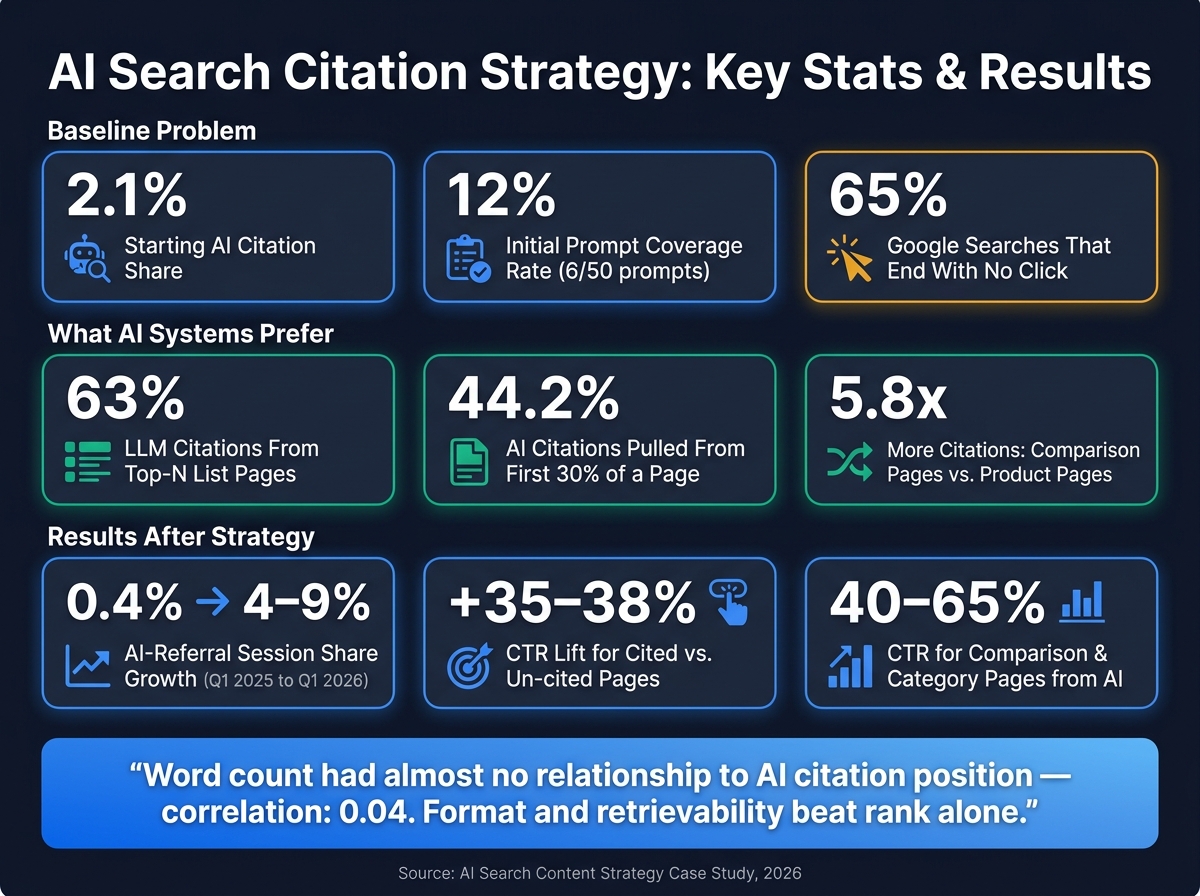
AI Search Citation Strategy: Key Stats & Results at a Glance
How to Optimize Your Content for LLM Citations and AI Search in 2026
sbb-itb-212c9ea
Search Visibility Audit
Before the team wrote new pages, they checked how visible the site was in AI answers. The numbers were pretty stark. AI citation share sat at 2.1%, and AI Apps showed up in 6 out of 50 tracked prompts, which works out to a 12% prompt coverage rate.
That told us something important right away: the issue wasn’t content volume. The bigger problem was page format and crawler access.
Baseline Queries, Mentions, and Page Gaps
The audit showed a clear format mismatch. Users had moved toward conversational prompts, but AI engines leaned toward pages with clear, self-contained claims they could quote, along with list-style pages. The site didn’t have much of that.
That mattered because comparison queries had a 40–65% click probability. On top of that, 63% of LLM citations across commercial and informational queries come from "Top-N" list pages. So the pattern was hard to miss: the pages AI systems liked most were also the ones this site mostly lacked.
Crawlability, Internal Links, and Structured Data Checks
The technical review uncovered crawl and schema issues that hurt citation eligibility. Several AI-focused crawlers, including GPTBot, PerplexityBot, and Google-Extended, were blocked by robots.txt rules.
The site also didn’t have an llms.txt file. That makes it harder for AI agents to map a site and figure out which pages matter most.
Schema was another weak spot. Pages were missing FAQPage, HowTo, and Organization JSON-LD markup, which weakened entity and authorship signals. At the same time, key category pages sat too deep in the site structure, and many internal links used generic anchor text that gave crawlers almost no topic clue.
In plain English: crawlability and structure shaped whether pages could even be picked for AI answers, not just whether they could rank.
| Technical Issue | Impact | Fix Applied |
|---|---|---|
| AI crawlers blocked | Invisible to GPTBot, PerplexityBot | Updated robots.txt with explicit Allow rules |
No llms.txt |
No content map for LLM agents | Created Markdown-based priority URL file |
| Missing schema | Weak extraction signals | Added JSON-LD markup across key pages |
| Generic anchors | Poor topical authority signals | Rewrote anchors to be descriptive and claim-shaped |
Those gaps set the direction for the page formats, internal links, and content templates built next.
Content Framework
The audit showed a simple problem: the issue was format, not volume. So we built pages in the order AI systems were most likely to cite them. Every page type had one job, and each one was picked to fix the prompt, crawl, and citation gaps the audit surfaced.
The Page Types We Built First
The team built a four-page system: Category/Pillar pages for broad citations, Tool Detail pages for high-intent discovery, Comparison/Versus pages for decision-stage clicks, and Deep Blog Guides for procedural queries. Each tier did something different.
| Page Type | Target Intent | Citation Role |
|---|---|---|
| Category / Pillar Pages | Definitional ("What is...") | Earns citations |
| Tool Detail Pages | Transactional / Action-driven | Captures high-intent clicks |
| Comparison / Versus Pages | Decision-stage ("X vs Y") | Converts decision-stage visits |
| Deep Blog Guides | Procedural / How-to | Wins procedural queries |
Comparison pages moved to the front of the line because AI engines cite them 5.8x more often than standard product-feature pages. That made them hard to ignore. From that point on, these page types became the structure behind every draft.
Our Keyword and Intent Model
The team stopped chasing raw search volume and started mapping topics to actual user prompts, intents, and entities. That shift mattered. AI search runs on prompts, so we mapped full queries instead of just head terms.
The model worked in a straight line: prompts → intents → page types.
Four intent groups shaped every content call: definitional queries, commercial queries, procedural queries, and diagnostic queries. Each one mapped to a specific page format. That kept the team from publishing the wrong page for the wrong query, which happens more often than people think.
Content Elements That Won Citations and Clicks
Page format choices made a measurable difference. 44.2% of all AI citations are pulled from the first 30% of a page, so every page started with a direct one- or two-sentence answer before moving into more detail. Sections were also written as citable units: short, self-contained blocks that could make sense on their own without the rest of the page around them.
On commercial-intent pages, comparison tables in Markdown showed up every time. They made structured answers easier for AI systems to synthesize. Update dates were changed only after material changes. Descriptive anchor text helped reinforce topical depth across the site.
Information gain tied the whole system together: original data, proprietary frameworks, and firsthand experience. Those points became the working checklist for briefs, drafts, and updates.
Publishing Workflow
Once the page types were set, the next step was turning them into a system the team could run again and again. The goal wasn't just to get pages live. It was to make them citable by AI systems.
Research, Briefing, and Draft Production
The workflow runs in four steps. It starts with keyword data from SE Ranking or DataForSEO. That data gets filtered for informational intent, search volume above 100, and then grouped into definitional, comparison, and how-to prompts to build a query map.
Next, an AI briefing tool builds a structured brief. That brief includes SERP gap analysis, common outline patterns from top-ranking pages, and signals that already show up in AI Overviews.
A human editor then reviews the angle and trims 15% to 25% of the draft before it goes out. The draft itself comes from a subject-matter writer who uses AI to speed up research synthesis, check facts against primary sources, and smooth transitions. But the main argument stays in human hands, which helps avoid weak AI-heavy copy.
That AI-assisted process cuts production time for a 3,500-word article from 12–16 hours to 4–6 hours of human time. After approval, the same brief also feeds newsletter and social content, so one research pass supports more than one channel.
Here’s the stack used at each stage:
| Workflow Stage | Primary Tools | Role |
|---|---|---|
| Research | SE Ranking, DataForSEO | Keyword volume, difficulty, and intent filtering |
| Briefing | Claude Code 4.8, GPT-5 | Outlines, SERP gap analysis, H2 structures |
| Drafting | Claude Code 4.8, Jasper | Research synthesis and first-draft production |
| Optimization | Surfer, Frase, Clearscope | Topical coverage scoring |
| Monitoring | Ahrefs Brand Radar, Opttab, Attrifast | Citation share and AI-referral traffic tracking |
| Distribution | GoHighLevel, n8n | Orchestrating distribution across newsletters, social media, and CMS |
Editorial Review and Update Schedule
After publishing, pages move into a set refresh cycle so they stay eligible for citations as AI answers shift. That matters because 70% of pages cited in AI Overviews change their citation status within 2–3 months. Put plainly, if you publish once and walk away, there's a good chance the page slips out of the mix.
Each page starts with a 134- to 180-word direct-answer block, uses question-based H2 and H3 headings, and includes at least one named institutional citation every 200 to 300 words. Those choices make the content easier for AI systems to parse and cite.
The refresh schedule depends on page type:
- Tier 1 pillar pages: every 90 days
- Comparison pages: every 6 months
- Conversion pages: annually or when product details change
For fast-moving topics, the cycle tightens to every 30–60 days. A page also moves up the queue if it shows content decay, includes a factual change, or loses its citation in two back-to-back AI retest cycles.
"Write loose, generic, multi-topic prose and your passages lose those comparisons to passages that are tight, specific, and self-contained." - Mike King, CEO, iPullRank
Results and Lessons
What Changed After the Strategy Rolled Out
Once the new page types and refresh cycle went live, the results showed up in two places fast: citations and referral traffic. The biggest shift was traffic mix. AI-referral sessions across the portfolio moved from 0.4% in Q1 2025 to 4%–9% by Q1 2026.
Some page types pulled more weight than others. Comparison and category pages brought in the highest click-through rates from AI-driven discovery, landing between 40% and 65%. Pillar and definitional pages did more of the work on citations and brand lift. Case studies and benchmark reports also picked up citations at a high rate.
| Metric | Pre-Strategy | Post-Strategy | Change |
|---|---|---|---|
| AI-referral session share | 0.4% | 4–9% | Strong lift |
| CTR for cited vs. un-cited pages | Baseline | +35%–38% | Cited pages won more clicks |
| Comparison page CTR from AI | Low | 40%–65% | Highest-performing page type |
| AI Overview citation share among top-10 organic results | 76% | 38% | Ranking alone no longer guaranteed citations |
| Comparison-page citation rate vs. product page | Baseline | 5.8x higher | Format mattered more than generic product pages |
The pattern was hard to miss: format and retrievability beat rank alone.
The Main Lessons Worth Repeating
This worked because the pages were built to be pulled into answers, not just indexed. Citation gains came from page format, answer blocks, and list-style structure, not from chasing better rankings. As Ran Yosef said:
"Visibility is no longer about ranking. It's about being retrieved."
The next lesson is simple: format beat length. Word count had almost no relationship to AI citation position, with a correlation of 0.04. Listicles made up 63% of all LLM citations. And comparison pages with a clear recommendation were cited 3.2x more often than balanced ones.
The pages that won were not the longest ones. They were the easiest to extract from.
"GEO is not a replacement for SEO. It's a layer on top of it." - Michael Rode, Founder, GainFrame
The last lesson was maintenance. Refresh cadence was built into the plan from the start, not treated like cleanup after publishing, because citations lost steam fast. In practice, that meant maintenance became part of publishing itself, not a separate job.
FAQs
How do I know which pages to update first for AI citations?
Use Google Search Console to spot conversational, question-based queries that may trigger AI Overviews, especially when your page already ranks but doesn’t appear in those AI answers.
Start with pages that already sit in the top 10 for the main query or close related sub-queries. That gives you a much better shot than starting from scratch.
Then tighten the page itself:
- Add a direct answer within the first 100–200 words
- Make each paragraph stand on its own
- Keep paragraphs easy to quote, with one clear idea at a time
The goal is simple: help Google find a short, clean answer it can lift without digging through fluff.
Do I need llms.txt and schema to be cited by AI search?
Not necessarily. The guidance is mixed, but official search guidance says llms.txt, special AI-only markup, and FAQPage JSON-LD are not required for AI citations.
That said, some teams still use schema such as Article, FAQPage, and HowTo to make pages easier for machines to read. Others say they’ve seen gains from llms.txt and AI Instructions pages.
Those steps may help. But they are not technical requirements.
What should I put at the top of a page to improve AI visibility?
Start with a clear, stand-alone answer to the main question in the first paragraph. That gives AI systems an easy snippet to pull and gives readers the point right away.
The opening should define the topic, state what the reader will get, and show that the page knows the subject without drifting into too much setup. After that, organize the section with plain structure, like short paragraphs, bullet points, or side-by-side comparisons, so each part is easy to scan, quote, and process.
A simple way to think about it: answer first, explain second. If the top of the page is packed with filler, both readers and AI tools have to work harder to find the core idea. A direct opening does the opposite. It puts the main point front and center.
From there, keep each paragraph focused on one idea. Use formatting with restraint:
- Lead with the main point
- Define terms in plain English
- Show the result or takeaway early
- Break up dense sections with bullets or comparisons
- Keep paragraphs tight so each one can stand on its own
That structure makes the content easier to cite, easier to skim, and easier to understand at a glance.