Digital Transformation
SEO is Dead, Long Live GEO: How to Optimize Your Brand for Generative Search Engines.
Traditional SEO no longer guarantees visibility. Shift to GEO: earn AI citations with extractable, structured, entity-rich content.

SEO is Dead, Long Live GEO: How to Optimize Your Brand for Generative Search Engines.
SEO is no longer enough. AI-driven search engines are changing how people find information online, and brands must adapt to stay visible. Traditional SEO focused on getting clicks from search engine results. Now, with Generative Engine Optimization (GEO), the goal is to have your brand cited in AI-generated answers.
Here’s the shift in a nutshell:
- AI search tools like ChatGPT are reshaping search behavior, with conversational answers replacing lists of links.
- Traditional search volume is dropping (down 25% in 2026), while click-through rates for top results plummet up to 60%.
- Success in GEO means creating fact-dense, quotable content that AI can easily cite, rather than just ranking high on search pages.
To thrive in this new era:
- Focus on citations, not clicks. AI systems prioritize trustworthy, structured content.
- Optimize for AI readability. Use concise answers, structured data (like Schema), and entity-rich content.
- Track your performance. Monitor how often AI tools mention or cite your brand.
The search game has changed. Brands that prepare for GEO now will lead in the AI-driven search landscape.
How to do GEO as a Beginner (full AI SEO Course) | Get Recommended by LLMs
sbb-itb-212c9ea
SEO vs. GEO: What Has Changed
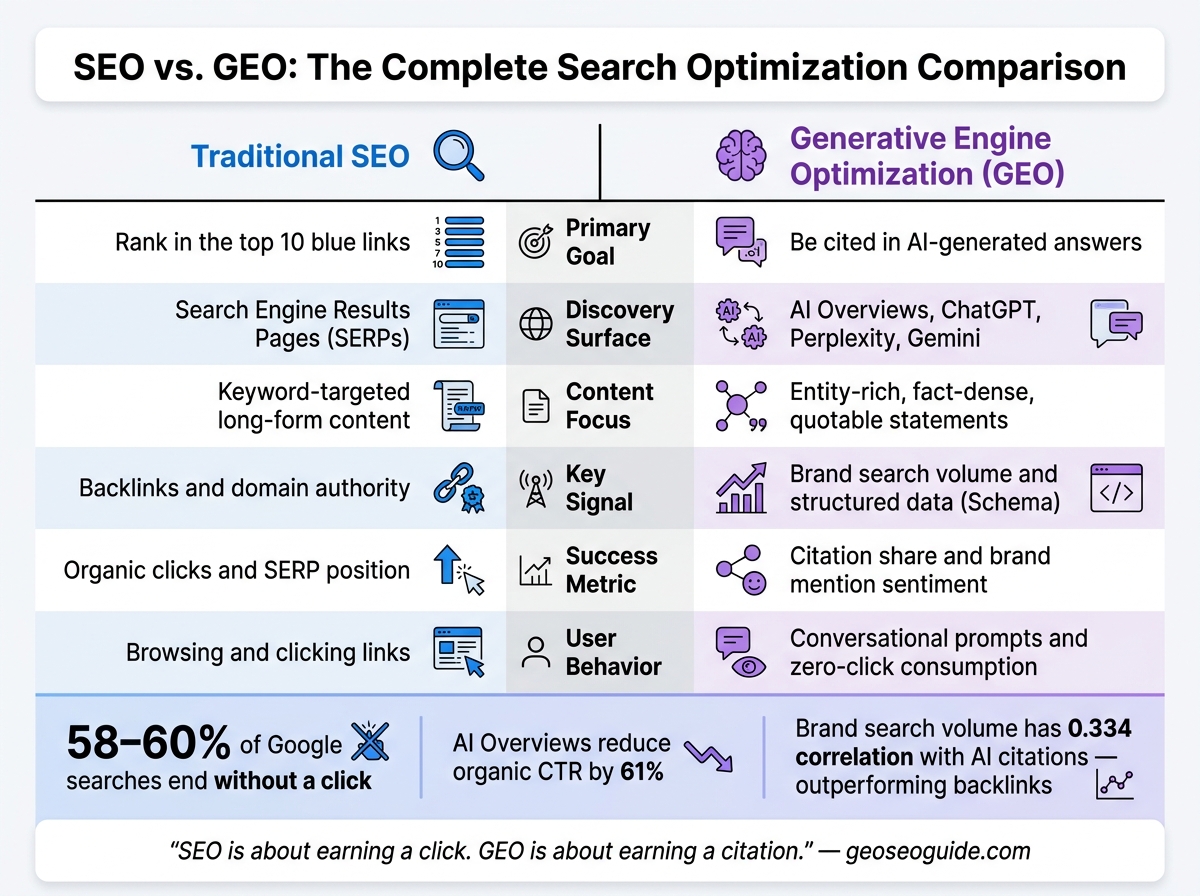
SEO vs GEO: The Complete Search Optimization Comparison
Search engine optimization (SEO) has long revolved around a straightforward principle: rank higher, get more clicks. The goal was to climb into the top 10 search results and funnel traffic to your website. But with the rise of Generative Engine Optimization (GEO), the game has changed. Instead of chasing rankings, the focus shifts to becoming the source that AI references in its answers. GEO flips the script - it's no longer about clicks but about being cited.
"SEO is about earning a click. GEO is about earning a citation." - geoseoguide.com
Key Differences Between SEO and GEO
The table below highlights the major contrasts between these two approaches:
| Factor | Traditional SEO | Generative Engine Optimization (GEO) |
|---|---|---|
| Primary Goal | Rank in the top 10 blue links | Be cited in AI-generated answers |
| Discovery Surface | Search Engine Results Pages (SERPs) | AI Overviews, ChatGPT, Perplexity, Gemini |
| Content Focus | Keyword-targeted long-form content | Entity-rich, fact-dense, quotable statements |
| Key Signal | Backlinks and domain authority | Brand search volume and structured data (Schema) |
| Success Metric | Organic clicks and SERP position | Citation share and brand mention sentiment |
| User Behavior | Browsing and clicking links | Conversational prompts and zero-click consumption |
In GEO, there’s no gradual climb in visibility like with SEO rankings. Either your brand gets cited, or it doesn’t appear at all. This binary outcome underscores why traditional SEO strategies are falling short in this new landscape.
Why Traditional SEO Is Losing Ground
The problem with traditional SEO in a world dominated by generative search is that it was built for an entirely different user behavior. It assumes users will browse a list of results, click on a link, and visit a site. That assumption no longer holds true.
Today, 58–60% of Google searches end without a click. When AI Overviews are displayed, organic click-through rates plummet by 61%. Even securing the #1 spot in search results doesn’t guarantee significant traffic anymore.
Traditional SEO signals, like backlinks, don’t align well with how AI systems retrieve information. Instead, brand search volume has emerged as the most reliable predictor of AI citations, with a correlation of 0.334 - outperforming backlinks as a ranking factor. AI models prioritize trustworthy entities that provide clear, structured facts, making the optimization process fundamentally different.
Recognizing these shifts is essential to understanding the mechanics of generative search engines and adapting to this new era.
How Generative Search Engines Work
Understanding how generative search engines operate can help you refine your content strategy for better results. These engines don't just match keywords to web pages - they analyze, interpret, and combine information to deliver tailored responses.
The Mechanics of Generative AI Search
At the heart of every generative search engine lies Retrieval-Augmented Generation (RAG). When you type in a query, the system goes through a series of steps: it retrieves web content, breaks it into smaller passages, converts these passages into numerical vectors, and then identifies the most relevant segments to craft its response.
"AI systems don't consume pages the way humans do. When generating answers, they retrieve specific passages from across the web and assemble them into a response." - Leigh McKenzie, Head of Growth, Backlinko
This shift means that the focus is now on individual passages rather than entire web pages. Structuring your content to make it easy for AI to extract and understand specific passages can significantly improve its visibility. To put this into perspective, Google's AI Overviews reach over 2 billion users each month, and the average ChatGPT query contains 23 words - far longer than the typical 4-word Google search. This shows how search behavior is moving toward more detailed, conversational queries.
How AI Models Select and Synthesize Answers
Once the retrieval process is complete, the AI takes additional steps to refine the information it uses. The process involves three key stages: retrieval, selection, and synthesis.
| Stage | Process | Key Indicators |
|---|---|---|
| Stage 1: Retrieval | Finds potential pages | Relevance, authority, and traditional quality signals |
| Stage 2: Selection | Analyzes specific passages | Focus on factual density, clarity, and citable content |
| Stage 3: Synthesis | Creates the final answer | Prioritizes fluency, accuracy, and contextual alignment |
For a passage to be "extractable", it must stand alone and convey its full meaning without relying on surrounding content. Passages that include specific data, quotes, or unique insights have a 30% to 40% higher chance of being cited by AI. However, competition is fierce - AI models typically reference only 2 to 7 domains per response.
AI engines also use entity resolution to cross-check information across platforms like your website, Reddit, LinkedIn, and Wikipedia. This process helps verify your brand's credibility on a given topic. Consistent and accurate mentions across these trusted sources can strengthen your brand's position in the AI's knowledge graph, increasing the chances of your content being selected for relevant queries.
Understanding these technical details can help you adapt your content strategy to thrive in this evolving search landscape.
Brand Signals That Matter in Generative Search
To succeed in the world of generative search, your brand needs to send clear, trustworthy signals. Understanding how generative engines gather and synthesize content is one part of the equation. The other part? Making sure your brand stands out and earns the trust of these AI systems, so they’re more likely to cite you.
Building Authority and Consistency as a Brand
Generative AI doesn’t just rely on your website - it cross-checks your brand across platforms like LinkedIn, Wikipedia, Reddit, news outlets, and industry directories. If your brand descriptions are inconsistent across these sources, AI systems may struggle to trust your authority.
"Generative systems reduce a complex idea – trust – to technical criteria. citation frequency, domain reputation, and content freshness signal credibility to AI." - Casey Nifong, Author and SEO Expert
To strengthen your authority, focus on being recognized as a distinct entity. Managing your Google Knowledge Panel and securing entries on platforms like Wikipedia or Wikidata can solidify your position in AI knowledge graphs. Here’s a key insight: articles from major media outlets are referenced in AI responses 27% of the time, and this figure jumps to 49% when recency is critical. This shows how much more weight generative engines place on earned media compared to your own branded content.
Take the example of INDYA, a sports nutrition brand. In early 2026, they boosted their AI visibility from 16% to 53% in just 10 days. Growth Manager Pedro Sala used the Omnia platform to focus on closing citation gaps in trusted third-party sources, instead of churning out new content. The takeaway? Being mentioned in the right places can outweigh simply creating more content.
Why Structured Data Matters for GEO
While authority is about where your brand appears, structured data ensures AI systems can clearly interpret your content. Schema markup (like JSON-LD) provides a machine-readable framework, helping AI understand exactly what your content represents - whether it’s a product, a guide, a person, or an organization.
"Schema markup helps large language models understand what your content is: a product, a person, an organization, a how-to guide. Properly structured data signals credibility and context, making your content easier for AI to classify and cite." - Mohammed Alami, AI Search Strategist
Structured data can have a big impact. Content with well-implemented schema sees a 3.4x higher citation rate in generative search results. To maximize your chances, use key schemas like Article, FAQPage, HowTo, Organization, and Person. Make sure each schema has a stable @id to maintain consistency across pages. The Person schema is particularly effective for linking content to named experts, which is a major factor AI uses for citations.
One thing to avoid? Relying heavily on client-side JavaScript for key content. Some AI crawlers can’t process it, meaning your structured data might go unseen.
| Signal | Impact on GEO |
|---|---|
| Structured Data (JSON-LD) | Makes facts machine-readable for direct extraction |
| E-E-A-T Signals | Author credentials improve citation likelihood |
| Clear Heading Hierarchy | Helps AI match answers to the right sections |
| Statistics and Sourced Data | Boosts citation rates by up to 40% |
| Consistent Entity Descriptions | Builds AI confidence across platforms |
Content Strategies for GEO
Once you've fine-tuned brand signals and structured data for GEO, it's time to turn your attention to content. The key to earning citations lies in providing clear, easily extractable answers.
How to Format Content for AI Readability
Generative AI processes content differently from humans. Rather than reading in a linear fashion, it breaks down content into small chunks, converts them into numerical data, and retrieves the most relevant pieces to construct an answer. This means a 400-word page with clear, concise information can outperform a 2,000-word essay if the critical facts are buried in dense prose.
Start with a direct answer in 60–100 words, and incorporate snippet bait - 40–60-word blocks crafted for verbatim extraction by language models. This approach boosts your brand's chances of being cited in AI-generated responses. Use question-based headings like "What is GEO?" and follow them with straightforward, concise answers.
"GEO rewards extractability - a page whose answers are cleanly formatted, clearly bounded, and explicitly marked is cited more than one whose answers are buried in prose." - Diego Alvarez, SEO & Blog Content Writer, Aibrify
Every paragraph should pass the Two-Sentence Test: it must be able to stand alone as a factual answer without relying on surrounding context. Avoid phrases like "as mentioned above" or "as we discussed earlier", as these references lose meaning when AI extracts content in isolation. Such phrasing can undermine the credibility of your content.
Once your content is optimized for extractability, shift your focus to addressing conversational queries directly.
Writing Content That Matches Conversational Queries
Clear formatting is just the start - your content also needs to align with the way users now search. Instead of simple phrases like "best travel laptop", users often phrase queries conversationally, such as, "What is the best laptop for travel under $1,500 with good battery life?" To meet this demand, your content must reflect these natural, conversational prompts.
This shift requires moving beyond targeting single keywords to embracing intent clustering. Structure your content to address the 8–12 sub-questions that naturally flow from a central topic. For instance, a page on email marketing for small businesses shouldn't just define the term. It should also cover topics like costs, setup time, tool recommendations, and common pitfalls - these are the follow-up questions both users and AI systems are likely to ask.
Content that includes specific statistics, expert quotes, and original data points can see a 30% to 40% increase in visibility in AI-generated responses. Vague or unsupported claims are often ignored, while precise, verifiable information gets cited. Incorporate exact figures, name specific tools, and detail concrete methods to increase your content's credibility.
To capture conversational phrasing, explore platforms like Reddit, Quora, and "People Also Ask." These sources provide a window into how your audience speaks and thinks - and they also influence how AI models are trained.
| Feature | Traditional SEO Content | GEO-Optimized Content |
|---|---|---|
| Primary Unit | Keyword/Phrase | Prompt/Intent Cluster |
| Structure | Narrative/Comprehensive | Answer-First/Modular |
| Paragraph Style | Flowing/Context-dependent | Self-contained/Extractable |
| Headings | Descriptive Labels | Question-based Headings |
| Goal | Rank for Clicks | Citation and Synthesis |
Technical Setup for GEO
Even the best content strategy can fall flat if AI crawlers can't access your pages. Recent data reveals that 73% of websites face technical issues that block AI crawlers, leaving nearly three-quarters of brands invisible to generative search. A solid technical setup ensures your content is not only created but also accessible to these crawlers, making it a vital part of your GEO strategy.
A GEO Technical Checklist
The first and most urgent step is to review your robots.txt file. AI systems rely on crawlers like GPTBot, PerplexityBot, ClaudeBot, and GoogleOther to fetch content. If these bots are blocked, your content won't even make it to the table.
"If your content isn't crawlable, it's invisible to these systems - it won't be included, cited, or summarized in generative responses." - Pieter Verschueren, Co-founder, Rankshift
Another critical issue is rendering. Many AI crawlers don't execute JavaScript - they may retrieve the file but won't process it. If your site depends on client-side rendering for key content, that content essentially becomes invisible. Server-Side Rendering (SSR) ensures that essential information is embedded directly in the HTML, ready for crawlers to access.
| Technical Factor | Requirement | GEO Impact |
|---|---|---|
| Crawlability | Allow GPTBot, PerplexityBot, ClaudeBot, and GoogleOther in robots.txt |
High |
| Rendering | Server-Side Rendering (SSR) for critical content | High |
| Structured Data | JSON-LD (FAQPage, Organization, Author, Product) | High - 2.5x higher citation chance |
| Page Speed | Load time under 3 seconds; LCP under 2.5 seconds | Medium |
| Content Freshness | Update content every 30 days with visible timestamps | High |
| Machine Guidance | llms.txt file at domain root |
Medium |
| Security | HTTPS with no mixed content warnings | Medium |
Keeping your content fresh is equally important. Pages left untouched for over 30 days experience a 2%–3% weekly drop in citation frequency. Regular updates - such as refreshing statistics, revising case studies, and updating the "Last updated" timestamp - can help maintain visibility and relevance.
Additional Technical Practices to Improve GEO Visibility
Beyond the checklist, there are more steps you can take to strengthen your GEO presence. For instance, creating an llms.txt file can be a game-changer. This plain-text file, placed at your domain root and kept under 40 lines, gives AI models a clear summary of your site's purpose and highlights key pages. Think of it as a "welcome mat" for AI crawlers.
Another important step is auditing your canonical tags. Duplicate content can confuse AI retrieval systems, so ensuring clean canonical URLs eliminates ambiguity. Additionally, consistency is key - use the same brand names, categories, and product descriptions across your website, schema markup, and external platforms like LinkedIn or Google Merchant Center. AI models often cross-reference multiple sources when generating responses.
Measuring GEO Performance
Once your technical setup is ready, the next step is measuring GEO performance by tracking how often AI tools mention or cite your brand. Traditional analytics won't give you the full picture here - up to 67% of AI-driven traffic is labeled as direct or branded search in Google Analytics because AI platforms often strip out referrer data.
Instead of focusing on traditional keyword rankings, GEO measurement evaluates how your brand appears and is portrayed in AI-generated responses.
How to Monitor Generative Search Visibility
The cornerstone of effective GEO monitoring is creating a defined prompt set - a list of 25 to 150 questions that reflect what your target audience is searching for. These prompts should cover a mix of:
- Category-level queries: Broad questions like "What's the best tool for X?"
- Problem-level queries: Questions about solving specific issues, like "How do I fix Y?"
- Comparison queries: Questions that stack solutions against each other, like "X vs. Y?"
Once your prompt set is ready, run these queries across multiple AI platforms - ChatGPT, Perplexity, Claude, Gemini, and Google AI Overviews. Each platform pulls data from different sources, and research shows that only 11% of cited domains appear on both ChatGPT and Perplexity at the same time. This means a brand visible on one platform might be entirely absent on another.
To dive deeper, use reverse prompting to ask AI tools directly about your brand. Analyze how your brand is described, check for accuracy, and identify which sources are being cited. For a more systematic approach, tools like Foglift GEO Monitor (starting at $49/month) can automate daily prompt checks across multiple platforms and provide alerts if your visibility drops due to algorithm updates.
"You can't optimize what you don't measure. Without monitoring, you have no idea whether your content optimizations are working." - Foglift GEO Guide
Here’s a real-world example: In early 2026, the sports nutrition platform INDYA used Omnia's GEO monitoring tools to identify gaps in their AI citations. By targeting trusted external sources and restructuring their content to make it easier for AI to extract, INDYA increased its AI visibility from 16% to 53% in just 10 days.
These visibility checks are essential for evaluating your GEO metrics effectively.
Metrics for Evaluating GEO Results
As GEO transforms digital engagement, specific metrics can help you gauge your brand’s performance. Focus on these five key signals: mention rate, citation rate, share of voice, sentiment, and position. Here’s what each metric reveals:
- Mention Rate: The percentage of prompts where your brand is included. This reflects overall brand awareness in AI-generated responses.
- Citation Rate: How often AI platforms link back to your URLs as a source. A high citation rate indicates that your content is trusted.
- Share of Voice (SoV): How your mention rate compares to competitors within the same prompt set. This highlights whether your brand is leading the conversation.
- Sentiment: The tone AI uses when referencing your brand. Are you "highly recommended", or does the AI include warnings about limitations?
- Position in Response: Where your brand appears in the AI's answer. Being listed first carries more weight for user engagement than being buried at the end.
Here’s a breakdown of these metrics and their strategic importance:
| Visibility Signal | Brand Performance Indicator | Strategic Meaning |
|---|---|---|
| High Mention Rate | Brand Awareness | Your brand is recognized as relevant in its category. |
| High Citation Rate | Authority & Trust | Your content is seen as a reliable source. |
| Positive Sentiment | Brand Equity | AI actively recommends your brand to potential customers. |
| Top Position | Preference / Lead Gen | Your brand captures the most user intent by being the primary recommendation. |
| High Share of Voice | Market Leadership | Your brand dominates the conversation compared to competitors. |
Additionally, monitor the Citation Stability Index (CSI), which measures how consistently your brand is cited week over week. Since 40%–60% of cited sources in AI responses change monthly, a high CSI indicates that your content is seen as reliable over time. You should also track brand search lift to connect AI citations with increases in direct search traffic.
Conclusion: Getting Ready for the Next Era of Search
The move from traditional SEO to GEO is already transforming how brands get discovered. If your brand isn’t appearing in AI-generated responses, it’s essentially invisible during key decision-making moments.
GEO changes the game, shifting the focus from page rankings to earning authoritative citations. Zach Cohen, Partner at Andreessen Horowitz, aptly stated: "How you're encoded into the AI layer is the new competitive advantage." This encoding depends on consistent brand signals, structured content, earned media, and ensuring your content is technically accessible to AI systems.
To succeed, brands need to embrace strategies that prioritize extractability and entity authority over outdated metrics like keyword density and backlinks. For instance, content featuring specific quotes and statistics enjoys 30–40% higher visibility in AI-generated answers, making it a smart starting point for optimization.
GEO isn’t a one-and-done effort - it demands constant attention. With 40%–60% of AI-cited sources changing monthly, brands that regularly monitor and adapt their strategies will maintain their edge. This kind of ongoing effort is essential as the search landscape continues to evolve.
As outlined in this guide, the brands that treat GEO as a long-term commitment, rather than a fleeting experiment, are the ones poised to lead in this new era of search.
FAQs
How do I know if AI tools are citing my brand?
To find out if AI tools are referencing your brand, keep an eye on how frequently and in what situations your brand is mentioned in AI-generated content. Look at the sources these models cite, track mentions of your URLs or domains, and evaluate how visible your brand is. Consistently review these citations and adjust your content to enhance how generative search engines recognize it.
What content gets cited most in generative search?
Content that appears most often in generative search is reliable, credible, and commonly referenced by AI models. Unlike traditional SEO strategies, Generative Experience Optimization (GEO) emphasizes being featured in AI-generated answers. To succeed, prioritize producing content that is consistent, precise, and dependable. This not only strengthens your brand's authority but also positions you as a trusted source across various platforms. AI models tend to prefer sources they frequently encounter in trustworthy contexts.
What technical fixes matter most for GEO?
When it comes to Generative Engine Optimization (GEO), a few technical tweaks can make a big difference. Focus on these areas to ensure your site is ready for AI systems:
- Crawlability: Make your site easy for AI crawlers to navigate. This includes simplifying your site structure and ensuring all important pages can be accessed without barriers.
- Load Times: Speed matters. Faster-loading pages not only improve user experience but also make it easier for AI systems to process your content.
- Mobile Responsiveness: With mobile usage dominating, your site must look and perform well on all devices.
Additionally, use clear semantic markup, schema.org tags, and structured data to give AI systems a better understanding of your content. For websites relying heavily on JavaScript or dynamic content, consider server-side rendering or pre-rendering. These methods ensure your pages are accessible to AI crawlers, opening up more opportunities for citation and visibility.