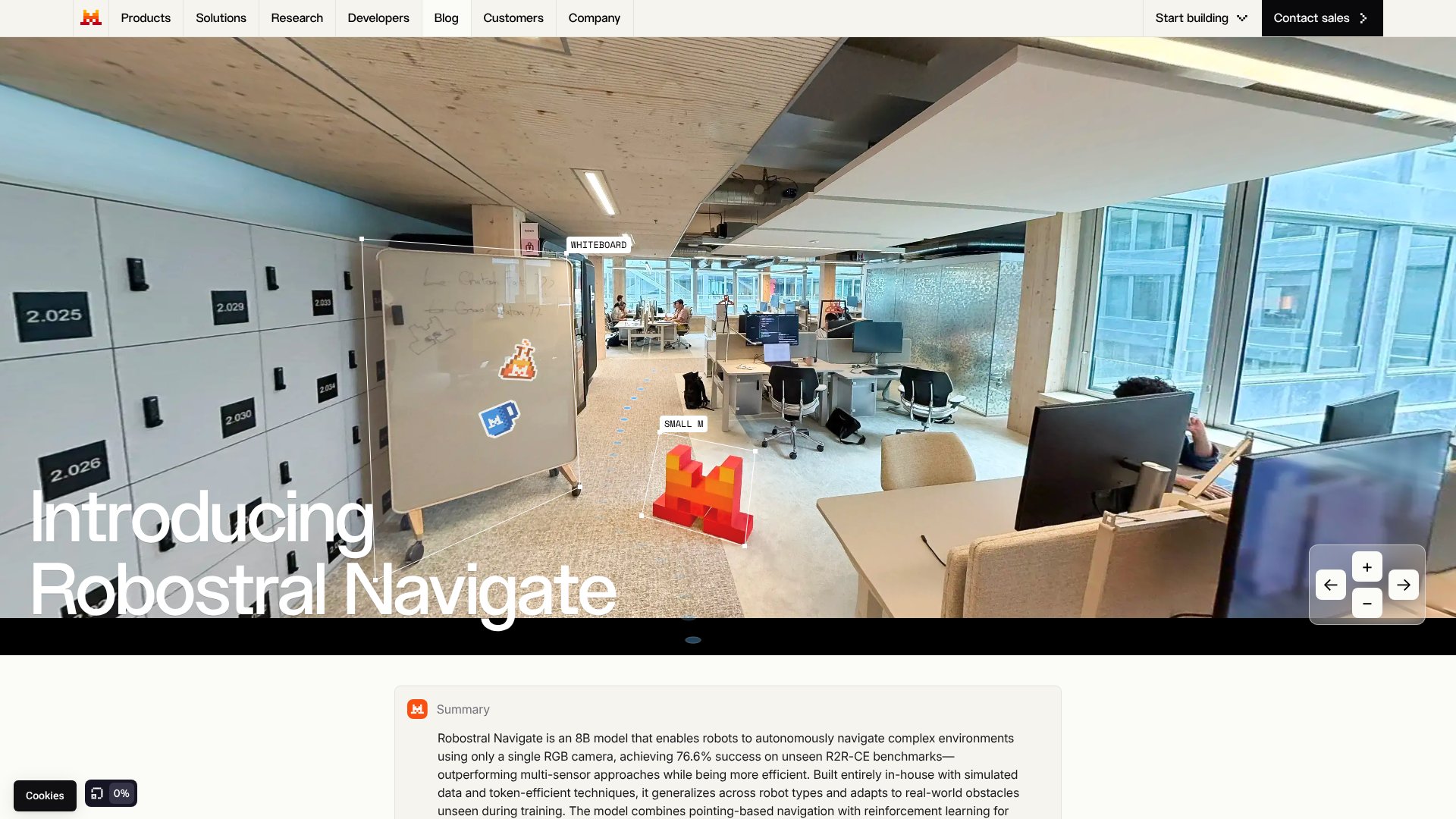
Robostral Navigate is an Automation tool. AI model that guides robots through spaces using a single camera and natural language. Key features include Single-Camera Navigation, Natural Language Control, and Hardware-Agnostic Design. Best for software developers and engineers, business consultants and data scientists and analysts.
About Robostral Navigate
Key Features
<strong>Single-Camera Navigation.</strong> Works with just one RGB camera instead of expensive LiDAR or depth sensors, cutting hardware costs while beating multi-sensor systems on standard benchmarks.
<strong>Natural Language Control.</strong> Takes plain-language instructions like 'Leave the lobby, walk through the corridor, enter the supply room' and turns them into robot movement commands.
<strong>Hardware-Agnostic Design.</strong> Runs on wheeled, legged, and flying robots from any manufacturer without custom engineering or sensor procurement.
<strong>Pointing-Based Navigation.</strong> Predicts target locations by pointing to image coordinates in the camera view, making it robust to different camera types and robot sizes.
<strong>Simulation-Trained Model.</strong> Built entirely using 400,000 simulated trajectories across 6,000 virtual scenes, so no expensive real-world data collection was needed.
<strong>Real-World Adaptation.</strong> Handles live spaces with people and obstacles it never saw during training, adapting to offices, warehouses, commercial buildings, and outdoor settings.
Frequently Asked Questions
Robostral Navigate is an 8 billion parameter AI model from Mistral AI that enables robots to navigate complex environments using only a single RGB camera and natural language instructions. It was released in July 2026 as Mistral's first model for embodied navigation.
No. Robostral Navigate works with just one ordinary RGB camera and no depth sensors or LiDAR. Despite this simpler setup, it achieves 76.6% success on unseen R2R-CE benchmarks, beating the best multi-sensor systems by 4.5 points.
Robostral Navigate is hardware-agnostic and works across wheeled, legged, and flying robots from different manufacturers. It generalizes across robot sizes and doesn't need recalibration when you switch camera modules or robot platforms.
The model is designed for manufacturing, delivery, logistics, and hospitality applications. It helps robots move through offices, warehouses, commercial buildings, and outdoor settings where autonomous navigation is needed.