Scikit-learn logo

Scikit-learn

Scikit-learn is a Python tool that helps you build machine learning models. It's great for tasks like predicting outcomes and grouping data.

No ratings yet
Visit Scikit-learn
View Alternatives
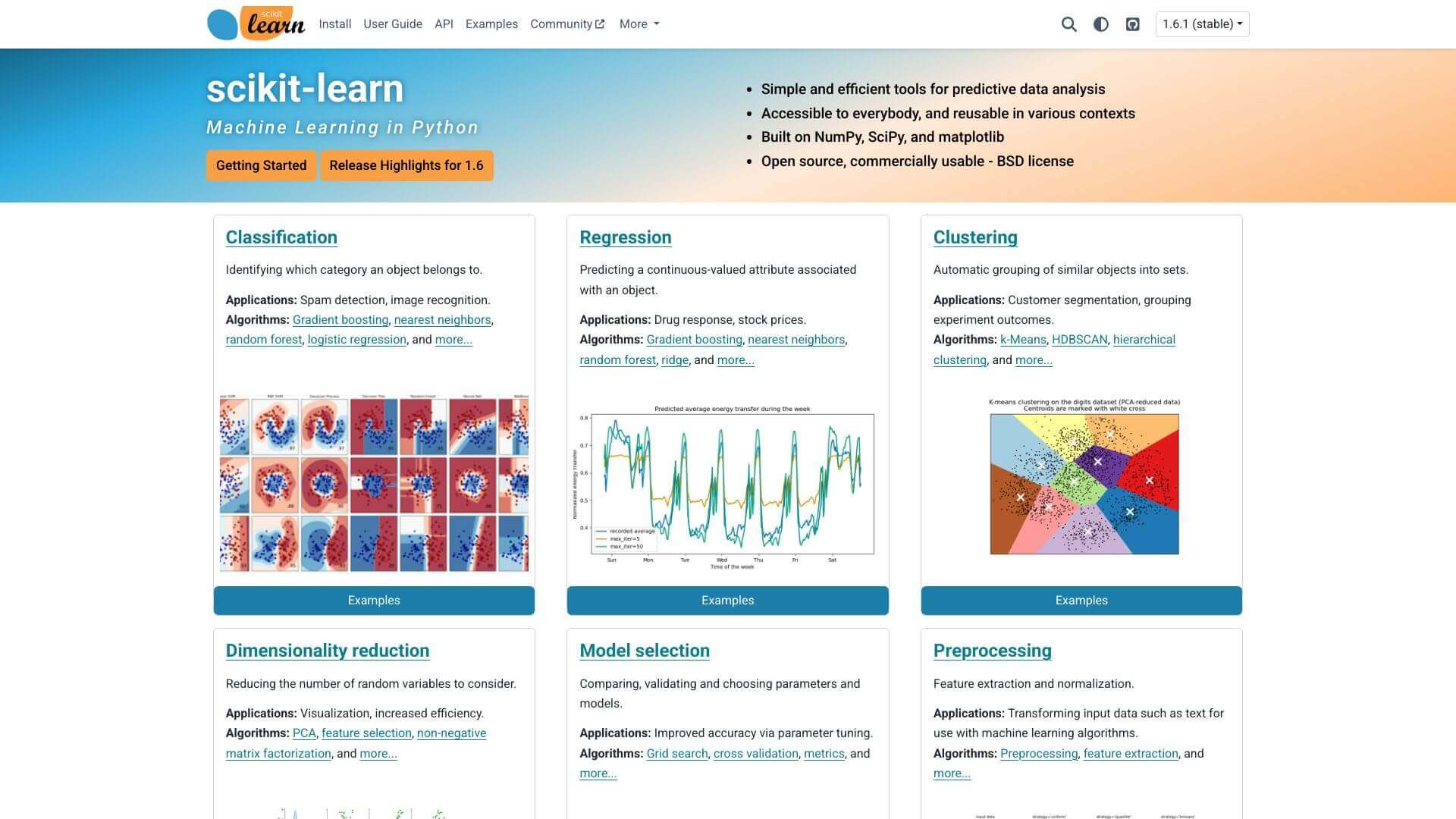
Scikit-learn screenshot

Scikit-learn is a Misc AI tool. Scikit-learn is a Python tool that helps you build machine learning models. It's great for tasks like predicting outcomes and grouping data. Key features include Supervised Learning Algorithms, Unsupervised Learning Algorithms, and Feature Extraction and Dimensionality Reduction. Best for data scientists and analysts, scientists and researchers and software developers and engineers.

4.6 (5 reviews)28 upvotes6 key features6+ alternatives →

About Scikit-learn

It's like a toolbox filled with machine learning algorithms for things like identifying patterns, making predictions, and simplifying complex data. It's free, easy to use, and has excellent documentation. While it’s not the best for deep learning, it’s perfect for many standard machine learning projects and works well with other Python data tools.

Key Features

Supervised Learning Algorithms.

Scikit-learn has all sorts of supervised learning models. It includes things like linear regression, support vector machines (SVMs), and decision trees. It's got you covered, no matter what kind of prediction task you're tackling.

Unsupervised Learning Algorithms.

It’s got tools for clustering, like grouping data. Plus, there's PCA for simplifying data and factor analysis which is a way of understanding relationships between observed variables. There are also unsupervised neural networks which are a great tool for learning complex patterns without labels.

Feature Extraction and Dimensionality Reduction.

The library helps you pick out the most important features in your data. It can make your data simpler with Principal Component Analysis (PCA) and t-distributed Stochastic Neighbor Embedding (t-SNE) which gets rid of the noise and focuses on what matters.

Ensemble Methods.

Scikit-learn lets you combine multiple machine-learning models into one super model. This ensemble approach can boost your predictions which makes your models more accurate and reliable.

Clustering.

It has many options for grouping unlabeled data. If you have data where you don't know the categories and want to find similarities, Scikit-learn provides various clustering methods to help.

Cross-Validation.

Cross-validation is a technique to see if your model is a good fit and can be used to resample a data set. Scikit-learn has excellent tools for slicing and testing models.

Frequently Asked Questions

You can install it using pip (pip install -U scikit-learn) or conda (conda install scikit-learn).

While Scikit-learn has some tools like neural networks, it's not ideal for deep learning tasks. Libraries like TensorFlow or Keras are more suitable.

Scikit-learn uses NumPy arrays or Pandas DataFrames for input data, typically divided into a feature matrix X and a target vector y for supervised learning.

Yes, Scikit-learn provides extensive support for cross-validation to evaluate model performance on unseen data.


User Reviews

Similar Tools

View all →