Digital Transformation
How AI Agents Are Replacing SaaS: Why Software Stocks Are Crashin
AI agents automate workflows, undercut per-seat SaaS pricing, and sparked massive software stock declines as businesses shift to outcome-based models.

How AI Agents Are Replacing SaaS: Why Software Stocks Are Crashin
AI agents are shaking up the software industry, and the financial impact is massive. Over $2 trillion in market value vanished from software companies in early 2026 as AI agents began replacing traditional SaaS tools. These agents operate autonomously, handling tasks like customer service, data analysis, and marketing without human input. Unlike SaaS, which charges per user, AI agents use cheaper, outcome-based pricing, making them a cost-effective alternative.
Key points:
- AI agents automate workflows across platforms like Salesforce, Slack, and Asana.
- SaaS companies relying on per-seat pricing models are losing customers and revenue.
- Stock prices for major SaaS players (e.g., Atlassian, Salesforce) have plummeted by 20–35%.
- AI-driven firms now generate far more revenue per employee than SaaS companies.
This shift is forcing businesses to rethink software investments, favoring AI-driven solutions that deliver better efficiency at lower costs. Investors are also moving toward companies with usage-based pricing and strong data capabilities, as SaaS faces a major structural challenge.
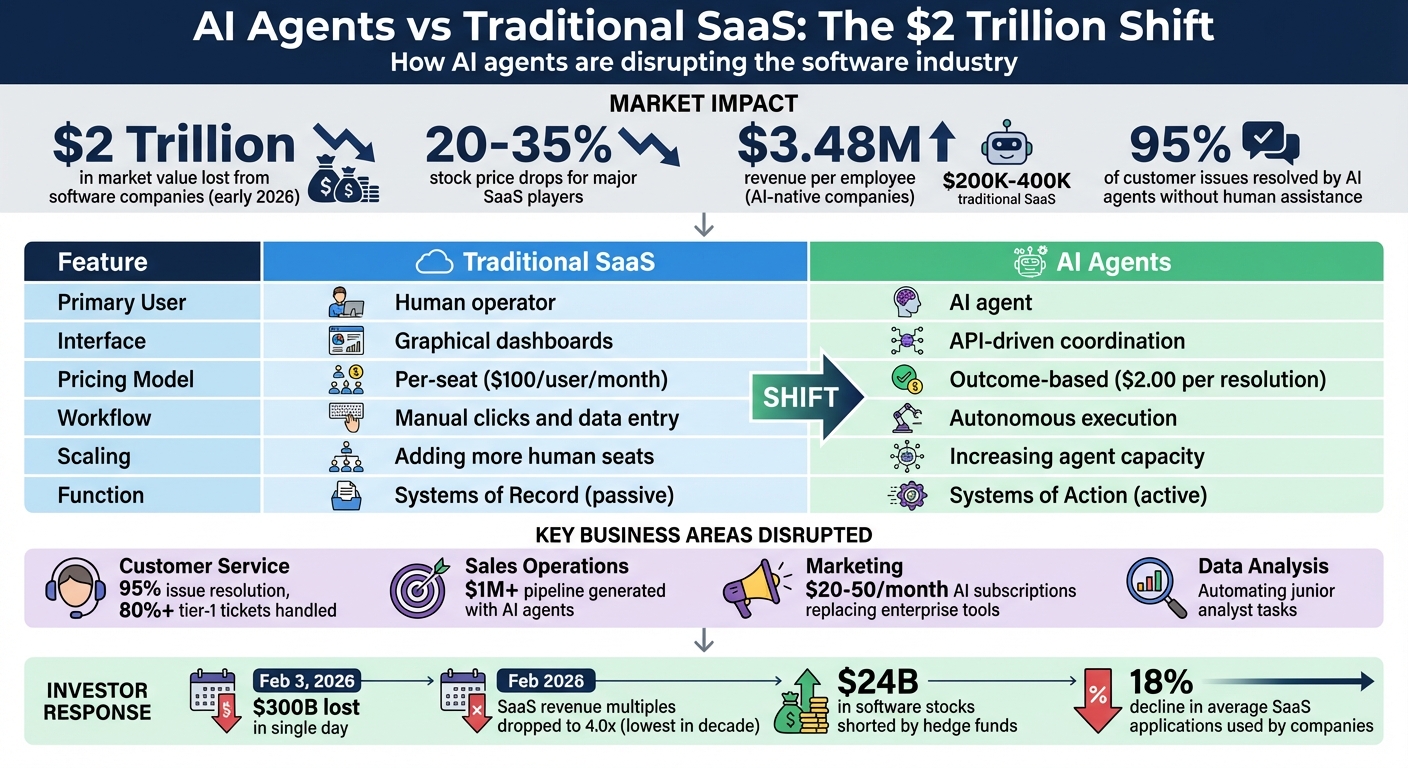
AI Agents vs Traditional SaaS: Key Differences and Business Impact
What AI Agents Are and How They Work
Defining AI Agents
AI agents are designed to autonomously complete multi-step tasks by leveraging integrated API workflows. Unlike traditional tools that rely on user prompts, these agents can interpret high-level objectives - such as "finalize month-end financials" or "resolve customer support issues" - and independently figure out the necessary steps to achieve those goals. They directly engage with databases and APIs across various platforms, making decisions and taking actions without human intervention.
What sets these agents apart is their ability to learn and adapt, turning passive software into active workflow managers. As NFX Analysis succinctly put it:
"The constraint is no longer engineering or resources; it's vision. We are no longer deploying software; we are deploying intelligence."
This shift marks a significant departure from traditional software design. Older systems relied on dashboards and grids for human interaction, while AI agents operate behind the scenes, coordinating tasks through APIs. This intelligence-driven approach to workflow management highlights how AI agents are fundamentally different - and often faster - than traditional SaaS tools.
Key Differences Between AI Agents and SaaS Tools
AI agents are reshaping how businesses interact with software, moving away from manual oversight toward autonomous execution. Traditional SaaS tools depend on human users to input data and manage processes, whereas AI agents take the initiative to complete tasks independently.
While traditional SaaS tools primarily serve as Systems of Record, passively storing data, AI agents act as Systems of Action, actively performing tasks like negotiating contracts or updating CRM systems. They also bridge gaps between software silos, seamlessly transferring data and managing workflows across platforms like Slack, Salesforce, and Jira. This capability reduces reliance on specific vendors, eroding the vendor lock-in that has long defined SaaS models.
| Feature | Traditional SaaS | AI Agents |
|---|---|---|
| Primary User | Human operator | AI agent |
| Interface | Graphical dashboards | API-driven coordination |
| Pricing Model | Per-seat (e.g., $100/user/month) | Outcome-based (e.g., $2.00 per resolution) |
| Workflow | Manual clicks and data entry | Autonomous execution |
| Scaling | Adding more human seats | Increasing agent capacity |
This shift is already evident in real-world examples. In late 2024, Klarna replaced its Salesforce CRM with a custom AI solution, showcasing how even major SaaS platforms can be replaced by AI-driven systems. Similarly, in early 2026, Sierra, an AI customer service startup led by former Salesforce CEO Bret Taylor, reached $100 million in annual recurring revenue in under two years. Their success was driven by an outcome-based pricing model, charging fees only for successfully resolved cases. These developments illustrate how AI agents are transforming the software landscape and putting pressure on traditional SaaS business models.
Business Advantages of Using AI Agents
The benefits of AI agents are reshaping business operations, particularly in areas like customer support. These systems can resolve up to 95% of issues without needing human assistance. Additionally, AI-driven companies generate an average of $3.48 million in revenue per employee, far surpassing the $200,000–$400,000 range typical for traditional SaaS firms.
AI agents also streamline operations by taking on workloads that once required entire teams. This allows businesses to consolidate multiple user licenses into a single agent subscription, significantly reducing costs. Moreover, companies no longer need to settle for rigid, off-the-shelf software solutions. The reduced cost and complexity of developing custom AI tools mean businesses can now create systems tailored to their specific needs and workflows. Morgan Stanley highlighted this trend, noting:
"The rise of AI agents that can operate enterprise software autonomously poses a structural threat to per-seat SaaS pricing models."
This evolution in software functionality is not only improving efficiency but also driving a broader shift in how businesses approach technology investments.
sbb-itb-212c9ea
Business Areas Where AI Agents Replace SaaS Products
Customer Service Automation
AI agents are transforming customer service by independently resolving issues, routing tickets, and managing support workflows. According to data, these agents handle 95% of issues and manage over 80% of tier-1 tickets.
This evolution is reducing the reliance on traditional help desk software. Instead of requiring human agents to log into dashboards and manually respond to customer inquiries, AI agents directly interact with support systems through APIs. They resolve issues and update records automatically, eliminating the need for time-consuming data entry. By streamlining these tasks, AI agents free up resources to address more complex business challenges.
Content Creation and Marketing Operations
AI agents are also making waves in marketing, taking on tasks like copywriting, video production, campaign management, and real-time performance optimization. These systems not only create content but also fine-tune advertising strategies based on live data.
This level of automation reduces the dependency on specialized marketing software and minimizes the need for hands-on oversight. Companies are discovering that AI subscriptions priced between $20 and $50 per month can outperform traditional enterprise marketing tools, which often come with a much higher price tag.
Sales Processes and Data Analysis
Sales operations are another area where AI agents are making a notable impact. Tasks like lead identification, pipeline management, and follow-up communications are increasingly handled by these systems. For example, Jason Lemkin, founder of SaaStr, replaced a 10-person sales team with 20 AI agents. These agents generated over $1 million in outbound pipeline and closed deals worth another $1 million, all while reducing human headcount to just 1.2 full-time equivalents and doubling the win rate in just eight months.
"We're done with hiring humans in sales. We're going to push the limits with agents."
- Jason Lemkin, Founder, SaaStr
AI agents are also reshaping data analysis by taking over routine tasks traditionally handled by junior analysts. From crunching Excel data to formatting slides and reconciling invoices, these systems are automating the grunt work. These advancements highlight how AI agents are steadily replacing SaaS tools across critical business functions.
Why Software Stocks Are Declining
Threats to SaaS Pricing Models
The traditional SaaS model has long relied on a straightforward equation: more employees mean more software licenses. Companies like Salesforce, Atlassian, and HubSpot have built their success by charging anywhere from $25 to $150 per user each month. But the rise of AI agents is disrupting this setup. These agents can replace multiple human-operated licenses, rendering the per-seat pricing model less viable. In early 2026, Atlassian reported its first-ever decline in enterprise seat counts, leading to a 35% drop in its stock price.
This shift raises concerns that traditional SaaS platforms could be reduced to little more than passive data storage systems, which typically command lower valuations. Reflecting these fears, forward earnings multiples for software companies fell sharply - from 39x to 21x - by early 2026.
"The rise of AI agents that can operate enterprise software autonomously poses a structural threat to per-seat SaaS pricing models."
- Morgan Stanley
AI-native companies are also setting a new benchmark for efficiency, generating an average of $3.48 million in revenue per employee, compared to the $200,000 to $400,000 range typical of traditional SaaS firms. This stark difference is putting legacy software companies under immense pressure to rethink their pricing strategies.
How Investors Are Responding
The disruption in SaaS pricing models triggered a swift and severe reaction from investors. Between late January and early February 2026, the software sector shed around $2 trillion in market value. On February 3, 2026, cloud software companies collectively lost $300 billion in a single day, with major players like Intuit dropping nearly 11%, and Salesforce and Adobe each falling around 7%. The iShares Expanded Tech-Software Sector ETF (IGV) saw year-to-date losses ranging from 22% to 30% by February 2026. Hedge funds also jumped in, shorting an estimated $24 billion in software stocks during this period.
Some companies faced even steeper declines due to their vulnerability to AI-driven disruption. For instance, Salesforce's market value dropped 28% amid slowing customer acquisition. Other notable losses included ServiceNow (22%), Workday (20%), and HubSpot (25%). IBM experienced its sharpest single-day decline since 2000 - falling 13.2% on February 23, 2026 - after Anthropic introduced Claude Cowork plugins that automated workflows across multiple platforms.
"The concern is that if AI agents become the primary interface for executing work, traditional platforms could be relegated to passive data stores."
- Matthew Martino, Analyst, Goldman Sachs Research
By February 2026, the median public SaaS revenue multiple had dropped to 4.0x - the lowest level in a decade. This marked a significant departure from the growth-focused mindset that had previously driven software investments.
What This Means for the Software Industry
As pricing models come under strain and investor confidence wanes, the software industry is facing a wave of financial and structural changes. Many SaaS companies are moving away from per-seat pricing, opting instead for outcome-based or consumption-based models. For example, Salesforce introduced its Agentic Enterprise License Agreement (AELA), a flat-fee model designed to retain customers who might otherwise cancel their subscriptions.
Meanwhile, enterprise IT budgets are shifting away from SaaS subscriptions toward AI infrastructure and compute credits. By 2025, the average number of SaaS applications used by companies had already declined by 18%. This trend is accelerating as businesses increasingly use AI to create custom, on-demand tools, bypassing the need for standardized software solutions.
The industry also appears to be headed for consolidation. Companies that fail to adapt to agent-native models may face mergers or market exits. The gap between "value creators" and "systems of record" is becoming more pronounced, with the latter seeing their valuations shrink. Additionally, traditional vendor lock-in is weakening as AI agents make it easier to move data across platforms, reducing the barriers that once protected legacy software providers.
Not everyone sees this shift as a crisis. Nvidia CEO Jensen Huang remarked, "The notion that AI is somehow going to replace software companies is the most illogical thing in the world". However, market trends suggest investors are betting on a future where only those companies that adapt to the agent-driven landscape will thrive.
How Businesses and Investors Can Respond
Using AI Agents to Improve Your Business
Start by organizing your SaaS subscriptions and pinpointing workflows that follow straightforward rules, like CRM data entry, project updates, or basic customer support. These are prime candidates for automation through AI agents. Begin with low-risk tasks such as scheduling or generating reports, ensuring your data is well-structured and readily accessible for the AI to function effectively.
Leverage the rise of AI alternatives during contract negotiations. Instead of automatically renewing long-term SaaS agreements, consider that some software might become outdated within a year. Push for flexible pricing models, such as usage-based or outcome-focused pricing, instead of traditional per-seat licenses. With predictions that 75% of organizations will invest in agent-based AI by 2026, vendors are under pressure to adapt.
Shift your workforce's role from manually operating software to managing AI systems. This transition means employees will focus on setting objectives, reviewing AI-generated outputs, and addressing complex scenarios that require human intervention. At the same time, secure and preserve proprietary data like usage patterns and transaction histories to maintain a competitive edge.
Establish governance structures early on. Develop ethical AI guidelines and robust identity management systems to control what data AI agents can access or modify. Without these safeguards, the risks of security breaches or compliance failures could outweigh the time and cost savings.
By making these operational adjustments, businesses can lay a strong foundation for investing in AI agent technologies.
Where to Invest in AI Agent Technology
The traditional reliance on user interfaces is fading as AI agents now interact directly with databases via APIs, bypassing UIs altogether. Focus your investments on companies that own proprietary data critical to AI agent functionality. These "data moats" are becoming a key competitive advantage.
Efficiency metrics like revenue per employee are emerging as indicators of success. AI-driven companies are achieving $3.48 million in revenue per employee, compared to $200,000–$400,000 for traditional SaaS firms. This stark difference highlights which business models are better positioned for the future.
Avoid investing in tools focused solely on workflow automation or software heavily reliant on user interfaces - these are the most vulnerable to being replaced by AI agents. Instead, prioritize infrastructure and platform-level companies that enable AI orchestration. For instance, in March 2025, ServiceNow acquired Moveworks, an AI agent platform, for $2.85 billion, signaling a strategic pivot toward integrating agent technology.
Keep an eye on enterprise plugin launches from major AI developers like Anthropic and OpenAI. These often indicate which SaaS categories are likely to face disruption. For example, when Anthropic introduced its Claude Cowork plugins on January 27, 2026, enabling AI agents to automate workflows across tools like Slack, Salesforce, and Asana, it immediately impacted SaaS stock valuations.
Companies already operating on usage-based pricing models, such as Snowflake and Cloudflare, are better positioned to weather the shift away from per-seat subscriptions. Their pricing structures naturally align with the growing adoption of AI agents.
Staying Competitive as Software Evolves
As investments increasingly favor AI-native models, businesses must rethink their software strategies. Lower barriers to software development have encouraged many companies to build their own AI systems rather than continue paying for costly SaaS contracts. This marks a shift in the "build versus buy" debate.
Monitor your software expenses regularly, as 80% of organizations are expected to adopt AI solutions by 2026. The number of SaaS applications used by companies dropped by 18% by 2025, and this trend is accelerating.
"The business logic is all going to these AI agents. They're not going to discriminate between what the backend is - they'll update multiple databases, and all the logic will be in the AI tier."
- Satya Nadella, CEO, Microsoft
Prepare for a shift toward outcome-based pricing, where vendors charge based on resolved issues or achieved business results rather than per user. This change requires businesses to evaluate software investments based on measurable outcomes instead of feature lists.
Avoid long-term commitments with vendors that lack a clear strategy for transitioning to AI-driven architectures. As business logic increasingly moves into centralized AI systems capable of managing multiple databases simultaneously, much of today's software may become little more than passive data storage. Position your business to adapt to these changes and stay ahead of the curve.
We replaced our sales team with 20 AI agents - here’s what happened next | Jason Lemkin (SaaStr)
Conclusion
The transition from traditional SaaS to AI-driven agents marks a major shift in how software delivers value. Between late January and February 2026, SaaS companies collectively lost over $1 trillion in value. This wasn't just a reactionary market dip - it reflected a deeper change. AI agents, capable of performing tasks previously handled by multiple users, have disrupted the per-seat license model that SaaS relied on for decades. This change highlights a new way of evaluating software, where performance and efficiency take center stage.
AI-native companies are setting a new benchmark, generating $3.48 million in revenue per employee compared to the $200,000–$400,000 range typical of traditional SaaS firms. At the same time, SaaS revenue multiples fell to 4.0x in early 2026, the lowest point since 2016. Once-premium SaaS companies are now being viewed as utilities - or even outdated infrastructure. This shift underscores the growing importance of operational efficiency and flexible pricing models, reshaping the software industry's landscape.
"This may be the first time in history that the terminal value of software is being fundamentally questioned, materially reshaping how SaaS companies are underwritten going forward." - Abdul Abdirahman, Investor, F-Prime
For businesses and investors, recognizing this shift early offers a clear advantage. The traditional "build versus buy" decision has flipped, thanks to AI coding agents that allow companies to develop custom tools at a fraction of the cost of SaaS subscriptions. Enterprise IT spending on AI surged by 110% in 2025, far outpacing the overall IT growth rate of 8%.
To stay ahead, businesses should reevaluate their software spending, avoid locking into long-term contracts with vendors lacking a clear AI strategy, and prepare for pricing models based on measurable outcomes. Investors, meanwhile, should focus on companies with strong data moats and flexible, usage-based pricing models. The software industry is entering uncharted territory, and those who adapt quickly will define the next era of technology.
FAQs
What is an AI agent, exactly?
An AI agent is a software program designed to carry out tasks and make decisions independently, without constant human input. By leveraging artificial intelligence techniques such as reasoning, planning, and memory, these agents can adapt to evolving requirements. They also process various types of data - like text, voice, and video - and actively engage with their surroundings.
AI agents are increasingly stepping in where traditional SaaS tools once dominated. They excel at automating workflows, streamlining decision-making, and solving problems, which is reshaping the software industry in a big way.
Will AI agents eliminate per-user SaaS pricing?
AI agents are shaking up the standard per-user SaaS pricing model, making it cheaper for businesses to develop and implement their own software solutions. This evolution is decreasing the need for per-seat subscriptions. Experts suggest that usage-based or value-based pricing models will likely take over as AI-powered tools deliver increased efficiency, gradually rendering the traditional SaaS approach obsolete.
How can a company adopt AI agents without major security risk?
To integrate AI agents securely, businesses should take a well-rounded approach that includes governance and monitoring tools from the start. Incorporating identity and access management is crucial for maintaining control over the actions of AI systems. Additionally, designing these systems with privacy and security as core priorities helps ensure compliance with regulations such as HIPAA, GDPR, and CCPA. Continuous oversight throughout the AI agent's lifecycle is essential to prevent unauthorized activities and effectively manage potential risks.