Digital Transformation
Top AI News for January 2026: Breakthroughs, Launches & Trends You Can’t Miss
January 2026 AI roundup: compact reasoning models, physical AI for robots and vehicles, real-time speech, agentic AI growth, and major startup funding.

Top AI News for January 2026: Breakthroughs, Launches & Trends You Can’t Miss
AI is transforming industries in January 2026, with major advancements across robotics, autonomous vehicles, and specialized tools. Key highlights include NVIDIA's updates in physical AI, the release of compact, high-performing models like Falcon-H1R, and the growing popularity of agentic AI solutions. Here's what you need to know:
- NVIDIA's Physical AI Progress: Tools like Alpamayo enhance autonomous vehicle reasoning, while Nemotron Speech ASR delivers faster real-time speech recognition.
- Falcon-H1R Model by TII: A compact AI model excelling in reasoning tasks, outperforming larger systems with improved efficiency.
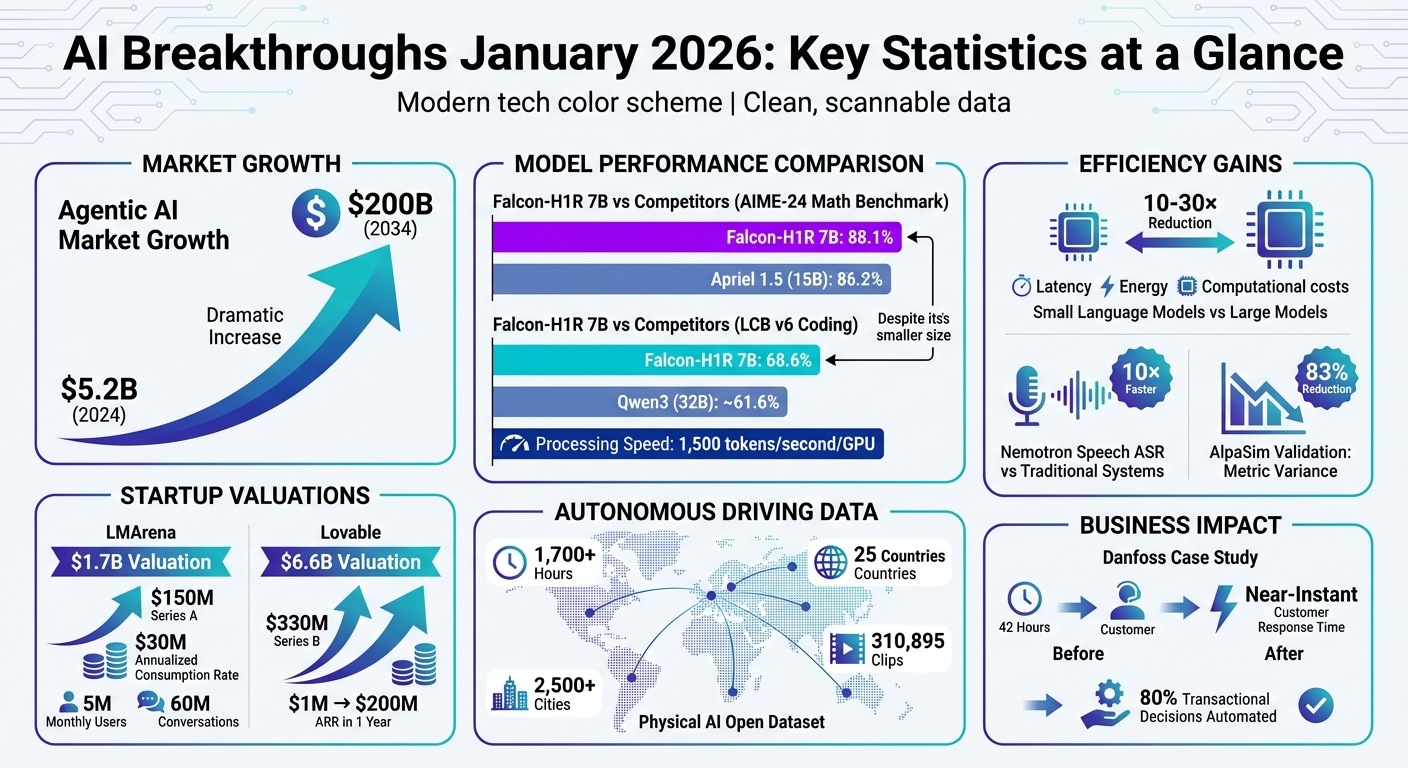
- Agentic AI Growth: The market is projected to grow from $5.2B in 2024 to $200B by 2034, focusing on smaller, task-specific models.
- Startup Success: LMArena and Lovable achieve billion-dollar valuations, showcasing strong revenue growth and enterprise adoption.
These advancements are reshaping AI's role in daily life and business operations. Stay updated with tools like the AI Apps Directory, which organizes over 1,000 tools to help professionals navigate this fast-evolving landscape.
AI Industry Key Statistics January 2026: Market Growth, Model Performance & Adoption Metrics
Major AI Developments in January 2026
Falcon-H1R: 7B Reasoning Model
In January 2026, the Technology Innovation Institute (TII) unveiled Falcon-H1R 7B, a compact AI model that delivers performance comparable to systems up to seven times its size. Built on a Transformer–Mamba hybrid architecture, Falcon-H1R strikes a balance between speed and memory efficiency, making it a great fit for applications relying on limited hardware resources.
Falcon-H1R scored 88.1% on the AIME-24 math benchmark, surpassing the 15-billion-parameter Apriel 1.5 model, which scored 86.2%. It also achieved 68.6% on LCB v6 coding tasks, outperforming the 32-billion-parameter Qwen3 by about 7 percentage points. Impressively, it processes around 1,500 tokens per second per GPU at a batch size of 64.
"Falcon H1R 7B marks a leap forward in the reasoning capabilities of compact AI systems. It achieves near-perfect scores on elite benchmarks while keeping memory and energy use exceptionally low."
- Dr. Najwa Aaraj, CEO, TII
One standout feature of Falcon-H1R is its DeepConf (Deep Think with Confidence) capability. This feature filters out low-quality reasoning during test-time scaling without the need for additional training, ensuring more reliable outputs. The model is freely available for commercial use on Hugging Face under the Falcon LLM license. Its compact design makes it a strong candidate for powering robotics, autonomous vehicles, and edge computing solutions.
Falcon-H1R reflects a growing trend toward specialized AI systems tailored for specific tasks, signaling a shift toward more efficient, purpose-driven models.
New Directions: Agentic AI and Small Language Models
January 2026 highlighted a shift in the AI industry toward smaller, task-focused models and agentic AI solutions. Small Language Models (SLMs) are increasingly used for specific, repetitive tasks, offering significant benefits in terms of latency, energy, and computational efficiency - delivering up to 10–30× reductions compared to their larger counterparts. Meanwhile, the agentic AI market is on a steep growth trajectory, projected to expand from $5.2 billion in 2024 to nearly $200 billion by 2034.
One exciting development this month was the launch of LG CLOiD, a smart home AI robot from LG Electronics. Powered by the NVIDIA Jetson Thor platform and tested using NVIDIA Isaac Sim, LG CLOiD can simulate and refine its behavior in virtual domestic settings before being deployed in real homes.
"The era when AI only communicated through screens and speakers inside computers is over. To learn the common sense of the physical world... three core computing systems are essential: training, inference, and simulation."
- Jensen Huang, CEO, NVIDIA
Manufacturing is also seeing transformative changes. NVIDIA and Siemens AG announced a partnership to bring "Physical AI" into factories. By integrating digital twin technology with AI models, they aim to simulate and validate entire factory designs and operations virtually before real-world implementation. This approach not only addresses skilled labor shortages by enhancing workers' efficiency with AI companions but also strengthens supply chain resilience. For instance, factories can now adapt in real time to challenges like weather disruptions or port delays.
The AI trade's next evolution after AMD, Nvidia's CES announcements, plus 2026 energy outlook
New AI Product Releases
NVIDIA continues to push the boundaries of AI, showcasing its dedication to real-time performance and advanced problem-solving with its latest offerings.
NVIDIA Nemotron Speech ASR
One standout release is Nemotron Speech ASR, an open-source automatic speech recognition model designed for real-time applications. This model is 10 times faster than traditional systems, making it perfect for live captions, voice assistants, and in-car voice commands.
Nemotron Speech ASR is available as an NVIDIA NIM microservice, enabling secure deployment across edge devices, cloud platforms, and data centers. While development, testing, and research access are free for members of the NVIDIA Developer Program, production use requires an NVIDIA AI Enterprise license.
"Nemotron Speech comprises leaderboard-topping open models, including a new ASR model, that deliver real-time, low-latency speech recognition for live captions and speech AI applications."
- NVIDIA
Bosch has already integrated Nemotron into its in-car command systems, and NVIDIA has released the associated dataset to encourage open-source innovation in this field.
Shifting gears from speech recognition to autonomous driving, NVIDIA has also unveiled a cutting-edge platform for mobility solutions.
NVIDIA Alpamayo for Autonomous Driving
Another groundbreaking release is Alpamayo, NVIDIA’s new platform for autonomous driving. The centerpiece of this platform is Alpamayo 1, a 10-billion-parameter Vision-Language-Action (VLA) model that leverages chain-of-thought reasoning to handle complex driving scenarios.
To complement its reasoning capabilities, Alpamayo integrates AlpaSim, a simulator that tests AI policies in highly realistic virtual environments. This tool has been shown to reduce validation metric variance by up to 83%. Additionally, the platform includes the Physical AI Open Dataset, which features 1,700+ hours of driving data collected from 25 countries and over 2,500 cities, with 310,895 clips captured using multi-camera setups, LiDAR, and radar sensors.
"Alpamayo brings reasoning to autonomous vehicles, allowing them to think through rare scenarios, drive safely in complex environments and explain their driving decisions - it's the foundation for safe, scalable autonomy."
- Jensen Huang, Founder and CEO, NVIDIA
Mercedes-Benz has confirmed that its upcoming CLA model will be the first passenger vehicle to feature the Alpamayo-powered DRIVE full-stack platform. The CLA has already earned a EuroNCAP five-star safety rating and is slated for a U.S. release in early 2026, with launches in Europe and Asia to follow. Other major players, including JLR, Lucid, and Uber, are also adopting Alpamayo to accelerate their Level 4 autonomy initiatives.
Alpamayo 1 serves as a "teacher model", enabling developers to generate high-quality training data or distill it into smaller, more efficient models for hardware like NVIDIA DRIVE AGX Thor. NVIDIA has made the model weights, simulation tools, and datasets available on Hugging Face and GitHub, ensuring global researchers can freely access these resources.
sbb-itb-212c9ea
AI Startups Raising Capital
These recent funding rounds reflect the growing momentum in the AI sector, where technical advancements are matched by rapid market adoption. January 2026 saw two standout examples of AI startups achieving major funding milestones as they scaled their businesses.
LMArena's $1.7 Billion Valuation
On January 6, 2026, LMArena secured $150 million in Series A funding, bringing its valuation to an impressive $1.7 billion. The round was led by Felicis and UC Investments, with additional backing from Andreessen Horowitz and Kleiner Perkins. After launching its "AI Evaluations" service in September 2025, the company quickly gained traction, reaching an annualized consumption rate of $30 million by December 2025. Today, LMArena's crowdsourced platform boasts 5 million monthly users and facilitates 60 million conversations. Julie Bort of TechCrunch described the platform's leaderboards as "something of an obsession among model makers".
Lovable's $6.6 Billion Valuation
Swedish startup Lovable took its growth to new heights, raising $330 million in Series B funding and tripling its valuation to $6.6 billion within just six months. The company achieved explosive growth, scaling its annual recurring revenue from $1 million to $200 million in just one year. Lovable's "vibe coding" platform allows non-technical users to create enterprise-grade applications using simple text prompts. Laela Sturdy, Managing Partner at CapitalG, highlighted its impact, saying, "The demand we're seeing from Fortune 500 companies signals a fundamental shift in how software gets built." CEO Anton Osika emphasized the platform's accessibility, stating, "Everyone can be a developer of software." By the end of 2025, Lovable had raised over $500 million in total funding.
These funding successes highlight the growing investor interest in AI startups that demonstrate strong revenue growth and enterprise adoption.
How to Track AI Tools and Developments
Staying on top of AI tools in 2026 can feel overwhelming, but a focused strategy can make all the difference. With new tools hitting the market every week, Weiwei Hu recommends using what she calls a "home base" model - relying on one main tool to anchor your workflow. She puts it simply:
"I use one primary tool with a backup and avoid unused additions".
This method helps reduce distractions and keeps your workflow running smoothly. To make things even easier, maintaining a dedicated directory of trusted tools can save time when you need to find reliable options quickly.
Discovering New Tools with the AI Apps Directory
The AI Apps Directory is a treasure trove for anyone looking to explore the latest in AI technology. It features a curated collection of over 1,000 tools, neatly organized into categories like AI Text Generators and AI Art Tools. Instead of combing through endless corporate blog posts or scattered announcements, you can use the directory to filter tools by category and pinpoint exactly what you need - whether it’s help with long-form writing or real-time speech recognition. Plus, its structured layout makes it easy to find dependable backup tools for your most important tasks.
Get Your AI Tool Listed in AI Apps
If you’ve developed an AI tool, submitting it to the AI Apps Directory can connect you with professionals actively searching for high-quality, production-ready solutions. The submission process includes multi-step verification to ensure the tools meet quality and relevance standards. Tools that excel in design and functionality may even earn a featured spot, boosting their visibility within the directory.
For startups debuting in 2026, this kind of exposure is invaluable. As the industry moves beyond initial hype to focus on practical applications, developers are encouraged to prioritize specialized solutions that solve real-world problems. A directory like this offers a direct path to the professionals who need those solutions most.
Conclusion
January 2026 signals a major transformation as AI progresses beyond simple chatbots to autonomous agents capable of executing complex, multi-step tasks. Tools like Falcon-H1R and NVIDIA's Nemotron Speech ASR are no longer just concepts - they're ready for immediate application. Physical AI has also become a reality, with models like Alpamayo enhancing autonomous vehicle reasoning. Meanwhile, hardware advancements now support models with up to 120 billion parameters running locally with zero delay. These strides are already driving tangible improvements in business operations.
For instance, Danfoss slashed customer response times from 42 hours to nearly instant by automating 80% of transactional decisions using AI agents. As Anil Jain, Global Managing Director of Strategic Industries at Google Cloud, aptly states:
"2026 will be the year AI agents fundamentally reshape business".
To stay ahead, professionals must adopt tools aligned with emerging trends like agentic workflows, direct code execution, and machine-to-machine payment systems. But navigating this rapidly evolving landscape requires a dependable guide.
The AI Apps Directory serves as a comprehensive resource to track these developments. Featuring over 1,000 curated tools organized by category, it simplifies the search for reliable, production-ready solutions. Whether you're looking for advanced reasoning models or exploring new autonomous agents, the directory is your go-to source for tools that align with the latest industry trends.
FAQs
Why is Falcon-H1R considered a top-performing AI model despite its smaller size?
Falcon-H1R 7B makes a strong impression by delivering top-tier performance with just 7 billion parameters. It’s able to match - or even outperform - models that are 2 to 7 times larger, thanks to its hybrid Transformer-Mamba architecture, test-time scaling using DeepConf, and a two-stage fine-tuning approach that blends supervised learning with reinforcement learning.
These innovations allow Falcon-H1R to work faster, use tokens more efficiently, and deliver highly accurate results. It brings advanced reasoning capabilities without requiring massive computational power, making it a standout choice for industries looking for AI solutions that are both effective and resource-conscious.
What impact will agentic AI have on industries by 2034?
Agentic AI refers to autonomous systems designed to make decisions and carry out tasks without human oversight. By 2034, these systems are projected to redefine industries by automating intricate workflows such as software development, customer service, precision manufacturing, and even surgical procedures. This level of automation will allow employees to shift their focus toward more strategic and creative responsibilities.
Industries like retail, finance, manufacturing, and logistics are already reaping the rewards of AI-powered systems. These technologies can analyze data in real-time and make instant, optimized decisions. Fast forward to 2034, and we’re looking at independent agents capable of streamlining processes, cutting costs, and driving innovations - think self-adjusting production lines or fully automated financial trading platforms.
The rise of autonomous, data-driven ecosystems isn’t just about improving productivity. It’s poised to reshape the competitive landscape entirely, especially for businesses that adopt agentic AI early in the game.
What are the main features of NVIDIA's Alpamayo platform for autonomous vehicles?
NVIDIA's Alpamayo platform pushes the boundaries of Level 4 autonomous driving by integrating state-of-the-art tools and technologies. It features an open-source collection of reasoning-driven VLA models, advanced simulation tools called AlpaSim, and comprehensive physical-AI datasets. These resources are designed to help autonomous vehicles perceive their environment, make decisions, and act with judgment that mirrors human capabilities.
The platform prioritizes safety validation, interpretability, and scalability, ensuring that deployments are both reliable and efficient. Additionally, it includes support for fine-tuning and distillation techniques, empowering developers to enhance performance for practical, real-world scenarios.