Creative Tools
AI Tools for Content Creation in 2026: The Complete Stack for Writers, Marketers & Creators
Build an integrated AI content stack that cuts creation time, scales output, and unifies writing, SEO, design, and video workflows.

AI Tools for Content Creation in 2026: The Complete Stack for Writers, Marketers & Creators
Content creation in 2026 revolves around AI as the standard, not the exception. Over 80% of marketing teams and creators now depend on AI daily to save time, improve quality, and boost output. The focus has shifted from "if" to "how" to use AI effectively. With tools that handle research, drafting, SEO, and even video editing, creators can produce 3x more content in half the time.
Here’s what you need to know:
- Agentic AI automates tasks like CMS setup and campaign management, saving 2.5 hours per week.
- AI tools streamline workflows, cutting blog writing time by 60%-70% and video editing time by over 80%.
- SEO-focused AI tools improve rankings faster, with some users seeing organic traffic grow by 34%.
- A cost-effective AI stack costs $96–$105/month, covering writing, design, video, SEO, and automation.
The key to success? Build an integrated system where tools complement each other, letting AI handle repetitive tasks while you focus on strategy and creativity.
10 AI Tools That Save Creators 20+ Hours Every Week
sbb-itb-212c9ea
Benefits of AI for Content Creation
AI tools are transforming content creation by improving speed, refining quality, and offering data-driven insights. Creators are already seeing measurable improvements at every stage of the process.
Saving Time with Automation
One of the most noticeable changes AI brings is reducing repetitive tasks. Writers no longer have to start from scratch - AI can produce first drafts, outlines, and even topic suggestions in a matter of minutes. For example, a 60-minute podcast can be repurposed into more than 20 platform-specific social media posts without manual intervention. Tasks like writing a 3,000-word blog post, which used to take a week, can now be completed in just a few hours.
AI writing tools have been shown to cut the time needed for creating blog posts and marketing copy by 60% to 70%. Video editing is another area seeing huge time savings: a 30-minute interview can be condensed into a polished highlight reel in only 18 minutes using text-based editing, compared to over 2 hours with traditional methods. Similarly, creating a 15-slide presentation deck with AI takes less than a minute, whereas doing it manually could take 4 to 6 hours.
With research, drafting, SEO optimization, and publishing now integrated into automated workflows, human involvement is only needed at key quality checkpoints. When AI is embedded directly into content management systems (CMS) or design tools, the entire process becomes even more efficient.
This increased speed doesn’t come at the expense of quality - attention to detail remains a priority.
Better Content Quality
AI tools help ensure consistency in brand voice and reduce errors, cutting down on the need for extensive manual reviews. Platforms like Jasper use features such as "Brand Voice Memory" to analyze previous content, style guides, and proprietary data, making it easier to maintain a cohesive tone.
For example, Grammarly can identify up to 60% of repetitive AI-generated patterns, reducing the time editors spend reviewing long-form articles from 30 minutes to just 12 minutes. Tools like Descript include features such as "Filler Word Removal" to clean up unnecessary language with a single click, while "Studio Sound" enhances audio quality to professional standards.
AI also excels in maintaining relevance. Tools like Notion AI and Claude can process entire libraries of research in one prompt, ensuring that the content aligns closely with the specific project instead of producing generic results.
In addition to improving quality, AI also optimizes content for better performance in search engines.
SEO and Analytics Features
AI doesn’t just streamline creation - it also ensures content performs well. Tools like Surfer SEO provide real-time analysis of top-ranking pages and offer actionable recommendations for keyword usage, header structure, and article length. These tools even provide live scoring, enabling creators to make adjustments on the fly.
The results are clear: users have reported a 34% increase in organic traffic after adopting AI-driven SEO tools. Content optimized with AI ranks in the top 10 positions 73% faster than manually optimized articles - taking 21 days compared to 38 days on average. For instance, one SaaS blog saw a 140% increase in organic traffic within six months by using AI for content briefs and optimization.
Modern AI platforms also help identify competitive gaps, showing why competitors rank higher and highlighting topics your content may be missing. These tools can suggest internal links, pinpoint backlink opportunities, and automatically configure metadata based on SEO best practices. Some even track how often your brand appears in AI-driven search results from tools like ChatGPT, Perplexity, and Google's AI summaries.
AI Tools by Category
The world of AI content creation has expanded into specialized categories, each designed to handle specific tasks more efficiently. Many modern platforms now offer multi-model orchestration, allowing users to access cutting-edge models like GPT-5.2, Claude Opus 4.5, and Gemini 3 Pro within a unified interface. This streamlined approach has fueled the growth of the AI writing assistant market, which is expected to jump from $2.3 billion in 2024 to $8.3 billion by 2030. These advancements simplify workflows and reduce the need for overlapping subscriptions, forming the foundation of a comprehensive AI toolkit for 2026. Below, we’ll explore how various tool categories cater to the evolving needs of content creators.
AI Writing Assistants
AI writing tools have grown far beyond basic text generation. Today, they provide tailored solutions for different domains. For example, creative writers can use tools designed for world-building, academic researchers benefit from assistants with real-time database access, and business users have platforms that support strategic planning. Persistent memory also enables these tools to adapt to user preferences across multiple sessions.
"The model itself is not going to be the main differentiator. What matters now is orchestration: combining models, tools, and workflows."
– Gabe Goodhart, Chief Architect, AI Open Innovation at IBM
Some standout tools include:
- Claude: Known for its ability to handle long-form, complex writing, thanks to a massive 200,000+ token context window, making it ideal for processing large research datasets.
- ChatGPT: A highly versatile option with an extensive plugin ecosystem and advanced reasoning capabilities.
- Jasper: A favorite for enterprise marketing, offering features like campaign workflows and brand voice analysis to ensure consistency.
Pricing for individual professional plans typically starts at around $20 per month, while specialized marketing platforms range between $39 and $186 per month. Many of these tools are now integrated directly into platforms like WordPress and Google Workspace, eliminating the need for constant context switching. This integration saves creators an average of 2.5 hours weekly, with 68% of users preferring AI embedded within their content management systems.
AI Editing and Proofreading Tools
AI-powered editing tools have become indispensable for quality control. For instance, an e-commerce agency used Jasper's "Brand Voice" feature to produce over 200 product descriptions weekly, cutting quality assurance time by 40%. Video creators also benefit from innovations like text-based editing, where platforms such as Descript allow users to edit video content simply by modifying the transcript.
AI SEO Optimization Tools
SEO has evolved significantly, shifting toward Answer Engine Optimization (AEO) and Generative Engine Optimization (GEO). These strategies focus on optimizing content for AI-driven search platforms like ChatGPT, Perplexity, and Google AI Overviews. With 65% of searches now ending without a click - thanks to direct answers provided by AI - content strategies must adapt to target multiple platforms simultaneously.
"Traditional SEO tools that only optimize for Google now capture less than 35% of potential traffic. Content must also perform well in AI-driven search interfaces like ChatGPT, Perplexity, Google AI Overviews, and Claude."
– Udit Goenka
Top tools in this category include:
- Surfer SEO and Clearscope: These platforms use natural language processing to analyze top-ranking pages and provide real-time optimization recommendations.
- MarketMuse and Frase: Help creators identify content gaps and build topical authority through clustering related subjects.
Practical examples of success include Qcall.ai, which used SEOengine.ai to generate 47 optimized articles, leading to 2.18 million impressions and 5,000 clicks, with 70% of the content ranking on page one. Similarly, Autoposting.ai created 38 technical articles, resulting in 1.39 million impressions and a 340% increase in brand mentions across AI-driven search engines. Tools like Alli AI also simplify technical SEO tasks, enabling bulk updates for schema, meta tags, and internal links without requiring developer input.
AI Graphic Design Generators
AI has transformed graphic design by eliminating the "blank canvas" problem. These tools can generate multiple visual concepts in seconds, streamlining the creative process. Over 40% of marketers now use AI-powered design tools to accelerate production. Automated features like background removal, resizing, and color adjustments save valuable time, while "Brand Kits" ensure consistency across high-volume outputs.
Popular tools include:
- Midjourney: Known for its artistic quality, it’s perfect for concept art and hero images but lacks built-in editing tools.
- Canva: Offers templates and brand kits, making it ideal for daily social media content, though its image quality is slightly lower.
- Ideogram: Excels at rendering text within images, making it great for headlines and taglines.
One example of efficiency: A social media manager for a consumer goods brand used Copy.ai to generate over 200 captions monthly, saving 15 hours each month by personalizing top outputs instead of starting from scratch. Pricing for these tools varies, with Midjourney starting at $10 per month, Canva Pro at $14.99, and Adobe Express at $4.55.
"An AI graphic design generator removes the slowest parts of the creative process: the blank canvas, the repetitive resizing, and the back-and-forth on first drafts."
– Lipsa Das, HubSpot
AI Video Creation Platforms
AI video tools have made professional-quality production accessible to everyone, regardless of technical expertise. In 2026, 38% of marketers use AI specifically for creating image-based and video content. Advanced models like Sora, Kling AI, and Luma Dream Machine enable users to produce cinematic-quality videos from simple text prompts. AI avatars, available through platforms like HeyGen and Synthesia, eliminate the need for traditional cameras and actors, making it easy to create training and marketing videos in multiple languages. These platforms also integrate image, video, and audio generation into a unified workflow, enabling seamless multimedia campaigns.
The Complete AI Stack for 2026
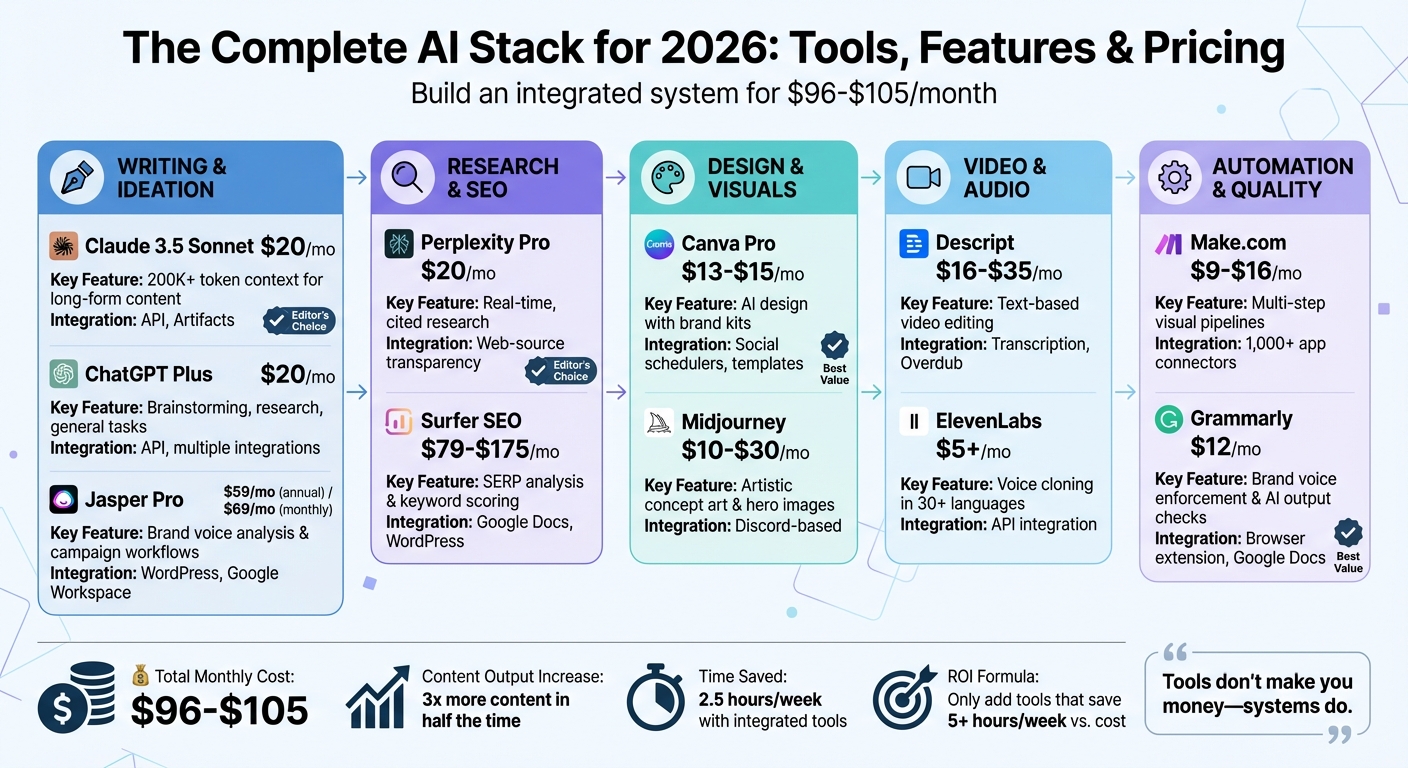
Complete AI Content Creation Stack 2026: Tools, Features, and Pricing Comparison
By 2026, a well-designed AI stack is all about efficiency and integration. It’s not just about collecting tools but creating a system where each tool complements the others. With over 12,000 AI tools available, the challenge is narrowing down the options to address your biggest bottlenecks. Interestingly, the most effective creators often rely on fewer tools, diving deep into their capabilities and connecting them through automation.
"The gap between 'AI-curious' and 'AI-native' creators isn't about having more toys in the toolbox. It's about building... an integrated system where each tool amplifies the others."
– Artimind
A streamlined Minimum Viable Stack costs roughly $96–$105 per month and covers four key areas: Writing & Ideation, Image & Design, Video & Audio, and Productivity & Automation. This approach emphasizes mastering a core set of tools before expanding. For example, creators often transform long-form articles into social media graphics, video scripts, and SEO-friendly snippets, maximizing their content’s reach.
AI Stack Components
The ideal AI stack for 2026 is built with complementary layers, avoiding redundant subscriptions. For writing and brainstorming, Claude 3.5 Sonnet ($20/month) excels at handling long-form content with its extensive 200,000+ token context window. Meanwhile, ChatGPT Plus ($20/month) serves as a versatile tool for brainstorming and general tasks. For enterprise-level marketing, Jasper Pro ($59/month annually) ensures consistency with brand voice analysis and campaign workflows.
For creators focused on research and SEO, specialized tools are essential. Perplexity Pro ($20/month) delivers reliable, cited research in real time, while Surfer SEO (starting at $79/month) provides keyword scoring and SERP analysis, helping articles rank faster than manual efforts. For those prioritizing SEO-first content, Writesonic offers plans ranging from $16 to $79 per month.
When it comes to visuals and multimedia, tools like Canva Pro ($13–$15/month) simplify the creation of branded social media assets, while Midjourney ($10–$30/month) generates stunning concept art and hero images. For video and audio production, Descript ($16–$35/month) allows for text-based video editing, cutting production time significantly. ElevenLabs (starting at $5/month) adds another layer with its voice cloning capabilities in over 30 languages.
The backbone of this stack is automation. Platforms like Make.com (starting at $9/month) streamline workflows by connecting tools. For instance, it can automate tasks like publishing blog posts, extracting quotes for social media, and scheduling content distribution. Lastly, tools like Grammarly ($12/month) ensure quality control by catching repetitive AI-generated phrasing and maintaining brand consistency.
"Tools don't make you money - systems do."
– Scalopa
Comparison Table: Features, Pricing, and Integration
| Category | Tool | Key Feature | Integration Capability | Monthly Cost |
|---|---|---|---|---|
| Writing | Claude 3.5 Sonnet | 200K+ token context for long-form content | API, Artifacts | $20 |
| Versatility | ChatGPT Plus | Brainstorming, research, and general tasks | API, multiple integrations | $20 |
| Marketing | Jasper Pro | Brand voice analysis and campaign workflows | WordPress, Google Workspace | $59 (annual) / $69 (monthly) |
| Research | Perplexity Pro | Real-time, cited research | Web-source transparency | $20 |
| SEO | Surfer SEO | SERP analysis and keyword scoring | Google Docs, WordPress | $79–$175 |
| Design | Canva Pro | AI design with brand kits | Social schedulers, templates | $13–$15 |
| Video | Descript | Text-based video editing | Transcription, Overdub | $16–$35 |
| Audio | ElevenLabs | Voice cloning in 30+ languages | API integration | $5+ |
| Automation | Make.com | Multi-step visual pipelines | 1,000+ app connectors | $9–$16 |
| Quality Control | Grammarly | Enforces brand voice and checks AI outputs | Browser extension, Google Docs | $12 |
With a total cost hovering around $96–$105 per month, this stack provides a powerful, repeatable system for content creation. The workflows it supports can replace hours of manual work, making tools like Jasper Pro’s $59 plan a smart investment. Up next, we’ll dive into how to seamlessly integrate these tools into your creative process.
Building Your Workflow with AI Apps Directory
Creating an efficient AI workflow starts with choosing the right tools, and a trusted directory can make all the difference. AIapps.com offers a curated selection of over 1,900 verified AI tools, specifically designed for content creators, writers, and marketers. Every tool listed undergoes a thorough editorial review process to ensure quality and reliability. Here's how you can use this directory to discover and compare tools that fit your needs.
Finding Tools with AIapps.com
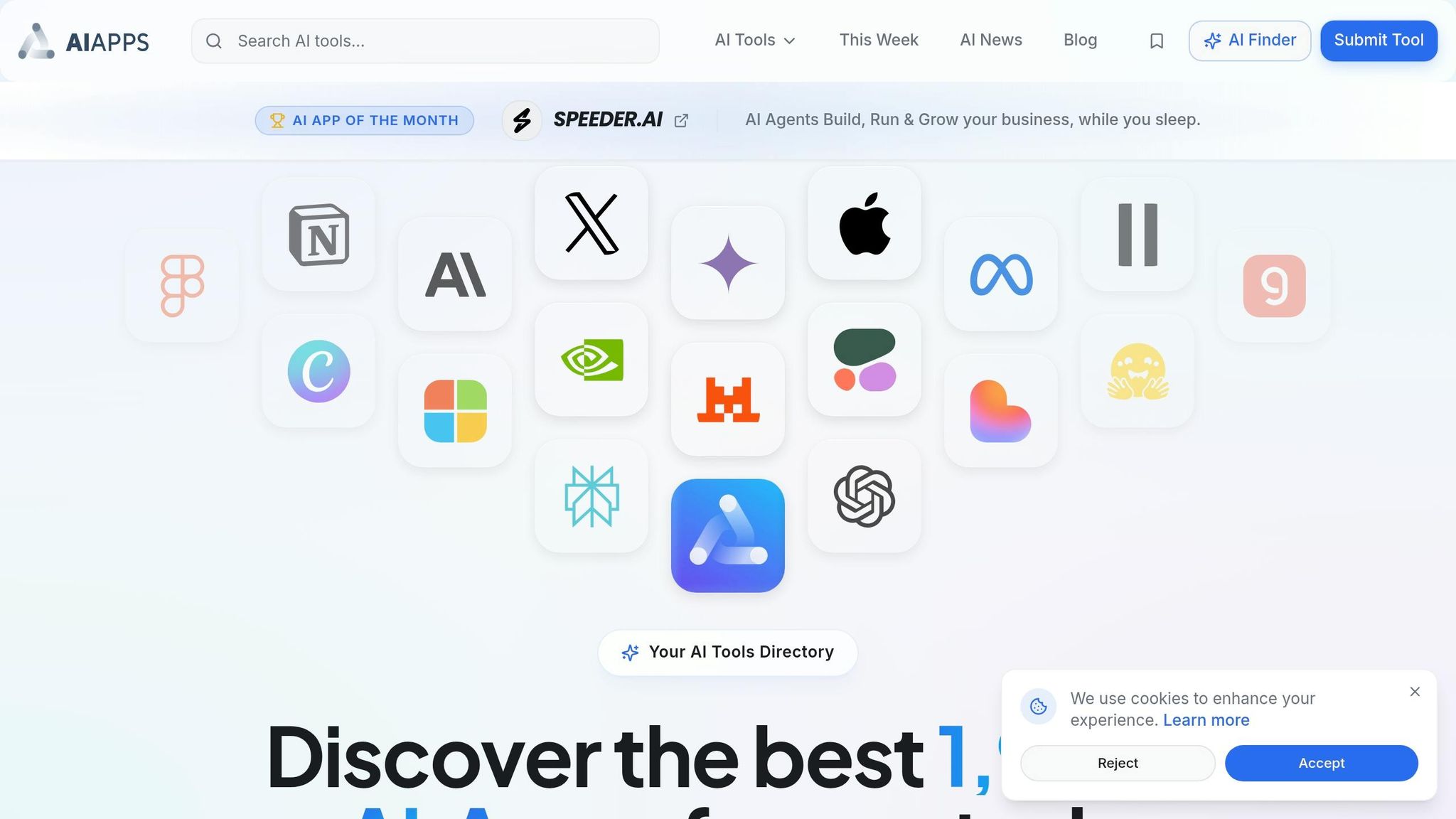
AIapps.com organizes its tools into more than 30 categories, making it easy to find what you need for your content creation process. For example, if you're working on SEO-focused blogging, you can explore categories like AI SEO Tools (44 tools), AI Writing (77 tools), or Blogging & Publishing (12 tools). To save even more time, the platform features sections like "Editor's Picks" and "Trending Now", which highlight standout tools. A great example is ChatGPT (GPT-5.4), a top-rated tool in 2026, used weekly by 10% of internet users due to its impressive 1M token context window.
Filtering and Comparing Tools
The platform's advanced filtering options make narrowing down your choices simple. You can filter tools by pricing models such as Free (119 tools), Free Trial (74 tools), Freemium (275 tools), or Paid (205 tools). Once you've shortlisted tools, the comparison feature lets you evaluate them side-by-side. For instance, you can compare ChatGPT (4.9/5, 250k reviews) with Claude Sonnet (4.9/5, 95k reviews), examining differences in features like context window size, pricing, and document analysis capabilities. Each tool listing includes a detailed breakdown of features, pros and cons, and even verification badges, so you can confidently choose tools that meet your standards. This streamlined process reduces the hassle of flipping between tabs and helps you build a cohesive AI tool stack with ease.
Implementation Tips
Incorporating AI tools into your workflow doesn’t have to be overwhelming. The most effective content teams follow a structured three-phase roadmap: Foundation (choosing tools), Pilot (testing with one content type), and Scale (expanding to all formats). This phased approach avoids the common pitfall of adopting too many tools prematurely, which can disrupt workflow consistency.
Step-by-Step Tool Integration
Begin by identifying your biggest bottleneck - the task that slows down your content creation the most. Is it video editing, SEO research, or scaling social media efforts? Once you’ve pinpointed the issue, focus on mastering one tool that directly addresses it. For instance, if drafting takes too much time, consider starting with a writing assistant like ChatGPT or Claude, which costs around $20/month. Dedicate two to four weeks to learning how to use it effectively, including creating prompt templates tailored to your brand’s voice.
From there, build a supporting stack around this primary tool. If a writing assistant is your centerpiece, add tools for upstream tasks (like research using Perplexity) and downstream tasks (such as SEO optimization with Surfer SEO, priced at $89–$99/month). To streamline the entire process, integrate automation platforms like Make ($9/month), Zapier ($19.99/month), or n8n to connect tasks from ideation to publication seamlessly.
Keep human oversight at the forefront. AI can handle drafting, research, and optimization, but strategic decisions, brand voice, and final edits should remain in your hands. For example, set up a Slack notification or similar alert system to review content before it goes live.
"The most successful content teams do not use AI to replace human creativity - they use it to eliminate repetitive tasks so humans can focus on strategy, voice, and ideas that AI cannot replicate." - Digital Applied
When evaluating new tools, apply the ROI Formula: only invest in tools that save at least five hours per week compared to their cost. This approach ensures your stack stays efficient and avoids the temptation of adding unnecessary tools for minor tasks before your core workflow is established.
Workflow Examples
Adapt these strategies based on your specific role to optimize your workflow.
For Writers:
Start your day by using Claude or ChatGPT to generate three article outlines based on trending topics identified through Perplexity. Optimize one draft with Surfer SEO to target specific keywords, then refine it with Grammarly. Take inspiration from a solo B2B creator in the SaaS marketing space who, in March 2026, used a stack of Claude, Surfer SEO, Perplexity, and Opus Clip. Over 90 days, they increased weekly content output by 4.2x, cut the time from idea to publication by 62%, and boosted organic traffic per article by 31%.
For Marketers:
Extend the reach of your content by adopting the "1-3-1" Distribution Rule: create one long-form piece (like a blog post or video), use AI to generate three shorter derivatives (e.g., social media clips or infographics), and schedule these over a week using tools like Buffer (starting at $5–$6 per channel/month). Automate this workflow so that publishing a blog post triggers the creation and scheduling of related social media content. Teams using this method often produce 3–5x more content and report an average ROI of 340% within the first year.
For Video Creators:
Record your main content, then use Descript (starting at $16/month) for editing and transcription. Feed the transcript into ChatGPT to create SEO-friendly video descriptions and captions. Use Opus Clip to automatically generate short clips for platforms like TikTok, Instagram Reels, and YouTube Shorts, and schedule them with Buffer. This layered approach organizes tools into three categories: Thinking (ideas and research), Production (writing and editing), and Distribution (repurposing and analytics).
Centralize prompt templates and brand guidelines using platforms like Notion or Airtable to maintain consistency. Conduct quarterly audits of your AI stack to eliminate tools that add unnecessary complexity. While 75% of marketers now use AI tools daily, the real difference between "AI-curious" and "AI-native" creators isn’t the number of tools - it’s about crafting an integrated system where each tool complements the others.
Conclusion
By 2026, the way we create content has transformed dramatically. AI-native creators now generate three times more content in half the time. Meanwhile, those who hesitate to adopt these tools risk falling behind. For around $100 per month, professional-grade AI setups eliminate hours spent on manual editing, formatting, and admin work - freeing up time to focus on strategy and your unique voice. With 82% of marketing teams using generative AI daily, the conversation is no longer about if you should use AI but how to integrate it effectively.
"The highest-earning AI operators use fewer tools than you think – but they use them deeper, with better prompts, better workflows, and better integration between tools. Depth beats breadth every time." - SCALOPA
Thriving in 2026 means embracing a "human-in-the-loop" approach. AI can handle tasks like drafting, research, and optimization with incredible speed, but the real power comes from what only humans can bring: strategic insights, authentic storytelling, a distinct brand voice, and ethical decision-making. Experts agree that the edge goes to creators who design systems where tools work together seamlessly, amplifying each other through smart automation.
FAQs
Which 3–5 AI tools should I start with first?
If you're diving into content creation in 2026, these AI tools can help you streamline your workflow and produce standout materials:
- ChatGPT-5: Perfect for crafting polished text and assisting with writing tasks.
- Canva: A go-to for creating visually striking designs with AI-powered features.
- Veo 3.1: Converts webinars, blogs, and podcasts into engaging video content.
- Jasper: Ideal for producing scalable marketing content that stays true to your brand's voice.
- Postiv AI: A versatile tool for research, SEO optimization, and automating workflows.
These tools cover everything from writing to design, video production, and productivity, making them essential for modern creators.
How do I connect my AI tools into one workflow?
To streamline your workflow, consider integrating AI tools for tasks like research, writing, SEO, and content distribution through automation platforms. Start by outlining your content creation process - from brainstorming ideas to publishing - and identify where tools can automate repetitive steps. For example, you might begin by automating the transition from research to drafting. As you get comfortable, gradually expand these integrations to other parts of your process. This approach minimizes manual effort, improves efficiency, and helps you get the most out of your AI tools in a cohesive system.
How do I keep AI content on-brand and accurate?
To keep AI-generated content aligned with your brand and accurate, it's essential to integrate human oversight into your process. Review the outputs to ensure they match your brand's tone and verify any claims with reliable sources. Opt for AI tools that offer features like built-in citations and edit tracking to streamline this process. Regular human reviews and careful verification play a crucial role in maintaining trust, consistency, and accuracy in your content.