Writing Tools
AI Tools for SEO Content: Pros and Cons
Review of eight AI SEO tools: features, pricing, limits, and why human oversight remains vital for accuracy and strategy.

AI Tools for SEO Content: Pros and Cons
AI tools are transforming SEO content creation, offering faster workflows and new optimization techniques. But they’re not perfect. While these tools can generate articles in minutes and identify content gaps, human-written content still outperforms AI in attracting visitors, with a significant gap in monthly traffic (283 vs. 52 visitors).
Here’s a quick breakdown of 8 popular AI SEO tools:
- Surfer SEO: Best for real-time content scoring and NLP-based optimization.
- Clearscope: Known for its grading system and content monitoring tools.
- Frase: Focuses on research and content briefs with dual SEO + AI scoring.
- Semrush AI Toolkit: Combines traditional SEO tools with AI visibility tracking.
- Ahrefs: Offers data-driven keyword insights and competitive analysis.
- Geoptie: Specializes in Generative Engine Optimization (GEO) for AI citations.
- Alli AI: Automates large-scale on-page SEO fixes.
- AI Writing Assistants (e.g., Jasper, Scalenut): Great for quick drafts and short-form content.
Each tool has strengths and limitations, making it critical to choose based on your specific needs. For instance, Surfer SEO excels in optimization, but over-relying on it could risk keyword stuffing. Meanwhile, Clearscope is ideal for editorial teams but comes with high costs.
Quick Comparison:
| Tool | Strengths | Best For | Limitations |
|---|---|---|---|
| Surfer SEO | Real-time scoring, NLP tools | Content audits & briefs | Risk of over-optimization |
| Clearscope | Simple grading, monitoring | Editorial workflows | Expensive credit-based pricing |
| Frase | Research + briefs | Mid-size content teams | Limited suite depth |
| Semrush AI Toolkit | SEO + AI visibility tracking | Comprehensive SEO strategies | Steep learning curve |
| Ahrefs | Data-driven insights | Research-heavy workflows | Not a standalone writing tool |
| Geoptie | GEO-focused optimization | Local SEO, AI citations | Narrow use case |
| Alli AI | Bulk on-page SEO changes | Technical SEO for large sites | Requires oversight |
| AI Assistants | Quick drafts, short content | Marketing copy, metadata | Factual accuracy issues |
The key takeaway? AI tools are great for speeding up SEO workflows, but they work best when paired with human expertise. Use AI for tasks like keyword clustering and content briefs, but rely on humans for accuracy, creativity, and strategy.
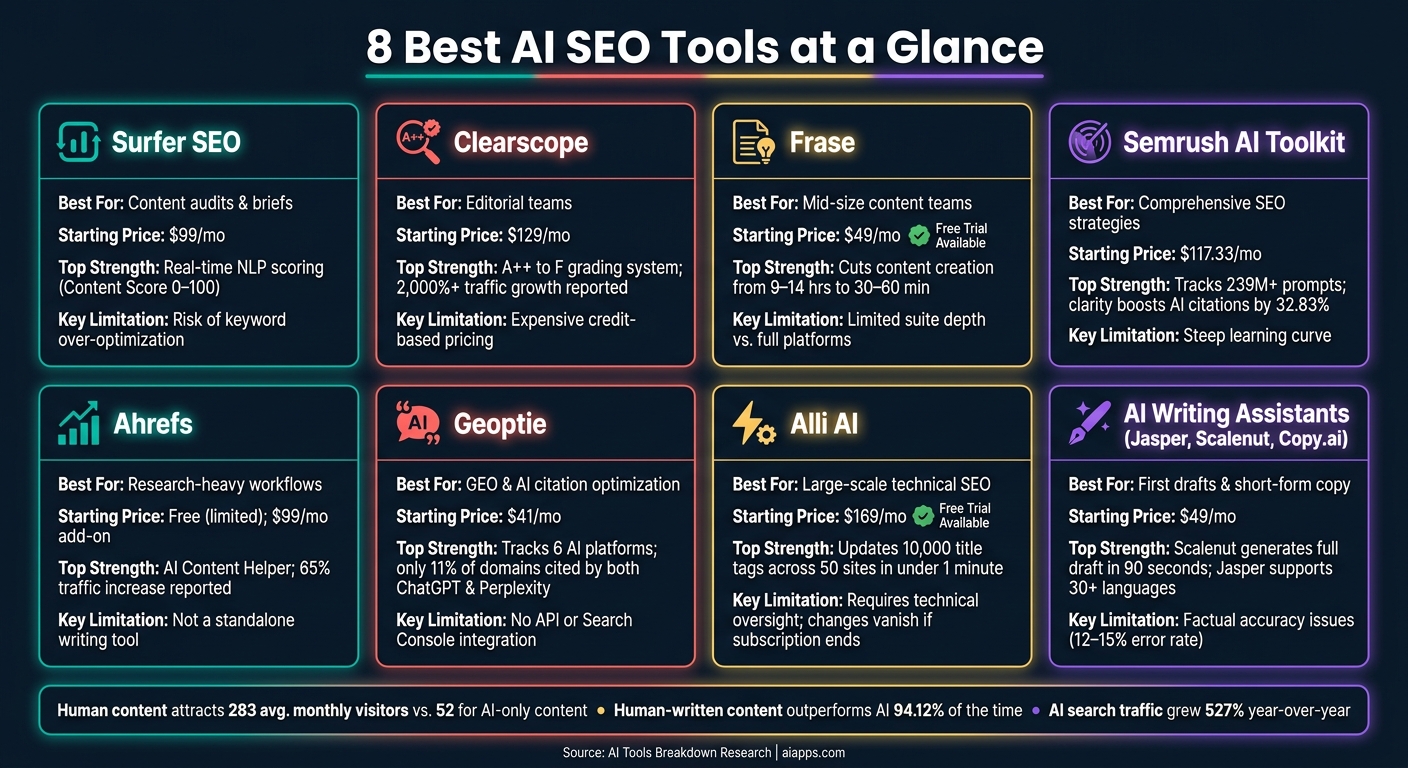
8 Best AI SEO Tools: Features, Pricing & Limitations Compared
The Best AI SEO Content Optimizations Tools in 2026
sbb-itb-212c9ea
1. Surfer SEO
Surfer SEO supports over 150,000 users with real-time insights by analyzing the top 20–50 ranking pages and offering actionable recommendations based on the data it gathers.
Content Optimization Features
At the heart of Surfer is its Content Editor, which evaluates content with a Content Score ranging from 0 to 100. This score is based on factors like structure, keyword usage, headings, and semantic relevance. A score of 67 or higher signals good optimization, but aiming to surpass competitors' scores by 10–20 points can give you an edge. Key tools like Auto-Optimize (which adds missing NLP terms without altering your tone) and Boost Coverage (which identifies content gaps and generates copy to address them) make it suitable for both new content and updates.
The impact can be impressive. For instance, after trimming 22,000 words based on Surfer's recommendations, a page climbed to the #1 spot on Google in just two days. Similarly, GetResponse integrated Surfer's NLP suggestions into three already-optimized articles and saw 15% organic traffic growth in the first month.
"With NLP words introduced into three, already optimized articles, we managed to reach the top five in Google search for relevant keywords. Within the first month of using Surfer, we recorded 15% organic traffic growth." - Oksana Kosachenko, GetResponse
Keyword Research and SERP Insights
Surfer's keyword research includes features like keyword clustering and a Topical Map to identify content gaps. However, it doesn't match the depth of specialized keyword research tools. A common approach among SEO professionals involves using a dedicated keyword research tool and then importing the findings into Surfer's Content Editor for optimization.
Pricing and Plans
| Plan | Monthly Price | Key Inclusions |
|---|---|---|
| Essential | $99/mo | 30 Content Editor articles, 100 audits, keyword research |
| Scale | $219/mo | Everything in Essential + Surfer AI, Auto Internal Links, Workspaces |
| AI Visibility | $219/mo | AI Search Guidelines, Mention Gap, Sentiment Analysis |
| Enterprise | $399/mo | Advanced Workspaces, Priority Support, Custom Integrations |
If you opt for annual billing, the Essential plan costs $79/month. While there’s no free trial, all plans come with a 7-day money-back guarantee. Surfer is best suited for users publishing at least four SEO articles per month.
"Surfer SEO is worth the $99/month if you publish 4+ SEO articles per month and want a structured optimization workflow. Below that cadence, the price is hard to justify." - Alex Carter, Lead Reviewer, AI Tools Breakdown
Scalability and Integrations
Surfer integrates seamlessly with tools like Google Docs, WordPress, Jasper, Copy.ai, and ChatGPT. Its Auto Internal Links tool uses large language models and Search Console data to add contextual links automatically. In 2026, Surfer introduced an AI Tracker to monitor brand visibility in AI-generated results from platforms like Gemini, ChatGPT, and Perplexity, reflecting the growing importance of Generative Engine Optimization (GEO).
Up next, we’ll dive into Clearscope and its range of features.
2. Clearscope
Clearscope is a high-end content optimization platform known for driving impressive results. It tackles the challenge of creating content efficiently while maintaining strong SEO performance. For instance, Paired increased its organic traffic by over 2,000% in under a year using Clearscope. Similarly, Brafton experienced an 83.7% average boost in click traffic on English-language blogs after implementing Clearscope's optimization tools.
Content Optimization Features
Clearscope uses a grading system that ranks content from A++ to F, based on how well it addresses a topic compared to the top 30 ranking pages. This system, powered by IBM Watson, OpenAI, and Google Cloud, identifies related themes and provides real-time feedback as writers work.
"Clearscope transformed our content production process by giving our writers clear, actionable feedback in real-time. The letter grading system created healthy competition among our team." - Alex Rivera, Content Director, Horizon Digital Marketing
One of its standout tools is the Content Inventory, which monitors published pages and flags potential ranking declines early, helping prevent traffic dips. Another noteworthy feature is Answer Engine Optimization (AEO), which tracks how often your content is referenced by AI tools like ChatGPT, Gemini, and Google AI Overviews.
Keyword Research and SERP Insights
Clearscope's keyword research focuses on search intent rather than just raw search volume. By analyzing the top 30 search engine results pages (SERPs), it uncovers competitor strategies, including their angles, depth of coverage, and key subtopics. The Topic Explorations feature helps teams create content clusters that build topical authority. It also provides standard metrics like search volume, competition levels, and CPC values.
Pricing and Plans
Clearscope’s premium features come at a price. The Essentials plan starts at $129 per month and includes 20 content reports and monitoring for up to 50 pages. The Business plan, at $399 per month, offers 50 reports and tracking for up to 300 pages. All plans support unlimited users, making it a practical choice for agencies or large teams. However, there’s no free trial - you’ll need to request a demo before deciding.
| Plan | Monthly Price | Content Reports | Pages Monitored |
|---|---|---|---|
| Essentials | $129 | 20 | 50 |
| Business | $399 | 50 | 300 |
| Enterprise | Custom | Custom | Custom |
Scalability and Integrations
Clearscope is designed for teams looking to scale their SEO efforts. It integrates seamlessly with tools like Google Docs, WordPress, and Microsoft Word, enabling writers to access live grades and term suggestions directly within their writing platforms. The unlimited-seat model means adding new team members doesn’t increase costs. Additionally, Clearscope supports optimization in five languages - English, Spanish, French, German, and Italian - making it a strong option for multilingual content strategies.
3. Frase
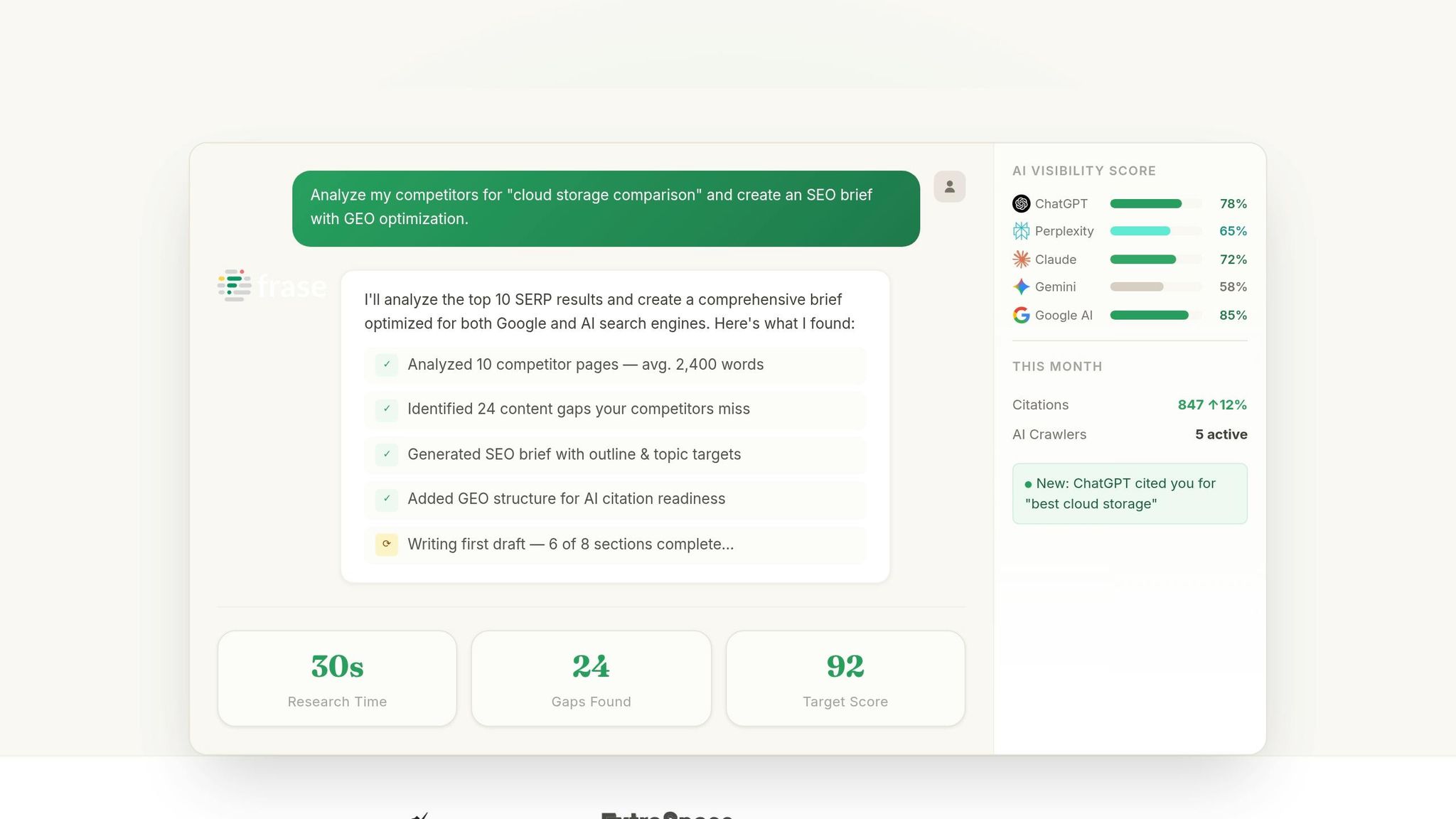
Frase approaches content creation differently than tools like Clearscope. Instead of focusing mainly on scoring completed content, Frase zeroes in on the research and briefing phase - the groundwork before writing even begins. Its AI Agent simplifies a 6-step process with over 80 specialized skills, cutting content creation time from 9–14 hours to just 30–60 minutes. This sets it apart from Clearscope and highlights the variety of methods available for AI-driven SEO optimization.
Content Optimization Capabilities
Frase brings something unique with its dual SEO + GEO scoring system. It evaluates content for both traditional search engines like Google and Bing, as well as generative AI platforms like ChatGPT and Perplexity. This dual focus is increasingly important, as Google AI Overviews now show up in 58% of search queries, and AI platforms are becoming critical for brand visibility.
Another standout feature is the Content Watchdog, which tracks published pages for changes in ranking or AI citations. It even suggests one-click fixes to address any issues.
"Frase has fundamentally changed our content workflow. The AI Agent handles research in seconds that used to take our team hours. Our organic traffic is up 3x since we started." - Kevin Indig, Director of SEO, Shopify
Keyword Research and SERP Analysis
Frase excels at turning complex SERP data into actionable insights. It synthesizes the top 20 results into a structured brief and surfaces high-intent questions from resources like People Also Ask, Reddit, and Quora. Its Topic Gap Analysis visually highlights areas where competitors' content outshines your draft, making it easier to address gaps before publishing.
However, Frase isn't without its drawbacks. Its SERP analysis takes 15–30 seconds per query, which is slower than some competitors. Additionally, its focus is limited to Google, leaving out other platforms like YouTube that are becoming increasingly influential in AI-driven search.
Pricing and Accessibility
Frase offers a 7-day free trial without requiring a credit card - something that sets it apart from Clearscope, which requires a demo request. Paid plans include the following options:
| Plan | Monthly Price | Annual Price | Articles/mo | Users |
|---|---|---|---|---|
| Starter | $49/mo | $39/mo | 10 | 1 |
| Professional | $129/mo | $103/mo | 40 | 3 |
| Scale | $299/mo | $239/mo | 100 | 5 |
| Enterprise | Custom | Custom | Custom | Custom |
Even the Starter plan includes the AI Agent, SEO and GEO scoring, and AI visibility tracking.
Scalability and Integrations
Frase stands out with its read-write Model Context Protocol (MCP). Unlike tools that only allow read-only data access, Frase's MCP enables external AI agents like Claude or Cursor to create, optimize, and directly publish content to a CMS. This makes it ideal for teams looking to automate their content production. Teams can also purchase additional seats, articles, or audit pages individually, offering a flexible pay-as-you-grow model.
"The AI visibility tracking alone is worth the price. We can see exactly which AI engines cite our content and optimize accordingly. No other tool does this." - Brendan Hufford, Growth, ActiveCampaign
With its integration capabilities and scalability, Frase continues to streamline SEO workflows in a rapidly evolving AI landscape.
4. Semrush AI Toolkit
Semrush combines traditional SEO tools with AI-powered search visibility features, making it a solid choice for teams managing both organic rankings and brand visibility in AI-generated content.
Content Optimization Capabilities
Semrush's SEO Writing Assistant evaluates your draft in real time across four key areas: SEO, readability, tone of voice, and originality. It benchmarks your content against the top 10 ranking competitors for your target keyword. Additionally, the AI Search Optimizer examines clarity, structure, and E-E-A-T (Experience, Expertise, Authoritativeness, and Trustworthiness) signals to improve your chances of being cited by AI platforms like ChatGPT and Perplexity.
Research highlights the importance of these factors: clarity and structure can increase AI citations by 32.83%, while E-E-A-T signals and Q&A formatting contribute an extra 30.64% and 25.45%, respectively.
"Clarity and structure are not SEO shortcuts. They simply make information easier for both people and AI systems to interpret." - Cecilia Meis, Senior Editor at Semrush
The Brand Voice Customization feature analyzes your existing content to establish a consistent tone and applies it to new content automatically. It can also repurpose a single article into formats like LinkedIn posts, email newsletters, or Google Business Profile updates, helping teams distribute content across multiple platforms efficiently. This is a common challenge for content creators looking to scale their output.
Keyword Research and SERP Analysis
Semrush's keyword research tools go beyond basic metrics like search volume and difficulty. The Personal Keyword Difficulty (PKD%) score provides a domain-specific measure of how challenging it would be for your site to rank for a particular term. Meanwhile, the Keyword Strategy Builder uses AI to cluster thousands of keywords into related topics, helping you build authority across broader subject areas instead of targeting isolated keywords.
For tracking AI-driven visibility, Semrush offers Prompt Tracking, which works like rank tracking but for AI responses. It monitors how often your brand appears in results from platforms like ChatGPT, Google AI Mode, Gemini, Perplexity, and DeepSeek. This data is sourced from a massive database of over 239 million prompts across eight regions. As SEO strategist Zach Paruch explains:
"You can't fix your AI visibility without seeing the SEO picture alongside it."
Pricing and Accessibility
The Content Toolkit comes standard with Semrush's plans, which include:
- Pro: $117.33/month (10 articles/month)
- Guru: $229/month (30 articles/month)
- Business: $449/month (50 articles/month)
The AI Visibility Toolkit is offered as a $99/month add-on per domain or as part of the Semrush One bundle:
| Plan | Price | Key Limits |
|---|---|---|
| AI Visibility Toolkit (Add-on) | $99/month per domain | 25 daily prompts, Brand Performance reports |
| Semrush One (Starter) | $199/month | 50 daily prompts, 1 domain, 500 keyword positions |
| Semrush One (Pro+) | $299/month | 100 daily prompts, 1,500 keywords, historical SEO data |
| Semrush One (Advanced) | $549/month | 200 daily prompts, 5,000 keywords, Share of Voice |
For smaller teams or individual bloggers, the included Content Toolkit often provides enough functionality without needing the AI Visibility add-on.
Scalability and Integrations
For larger teams or agencies, Semrush One bundles both toolkits into a single subscription, offering better value compared to purchasing the AI Visibility add-on separately. Higher-tier plans include Model Context Protocol (MCP) access, enabling deeper integration with external AI models.
Semrush also integrates seamlessly with platforms like WordPress, Mailchimp, and Zapier. A Chrome extension allows for quick rephrasing directly within Google Docs or WordPress. Barbara Ferrigno, CEO of Concept Marketing Group, shared that her team achieved a 12× faster content production rate and doubled readership on AI-optimized articles, leading to a 10–15% business growth after adopting the toolkit.
Next, we’ll delve into Ahrefs AI-Driven Content Features for a side-by-side comparison.
5. Ahrefs AI-Driven Content Features
Ahrefs has crafted an AI-powered content toolset that prioritizes topic coverage over simple keyword frequency. At the heart of this is the AI Content Helper, which evaluates your content on a scale from 0 to 100. This score reflects how well your content addresses the core topics covered by top-ranking competitors for a specific keyword. The idea? Cover topics thoroughly to improve your rankings.
"The goal isn't keyword stuffing: it's comprehensive topic coverage. AI Content Helper puts the writer in the driving seat, providing competitor insights to refine your content - instead of delegating away your creativity wholesale and churning out another copycat article in the process." - Ryan Law, Director of Content Marketing at Ahrefs, a company known for providing some of the best AI tools for marketers,
Content Optimization Capabilities
The AI Content Helper includes a built-in AI chat feature that analyzes your draft alongside competitor data, making it easier to identify content gaps. It also integrates brand kits based on your existing articles, ensuring that its suggestions align with your unique tone and style. In 2024, Louise from the Ahrefs blog team used the tool to spot and fill content gaps, resulting in a 65% increase in traffic.
Another handy feature is the AI Content Level column in Site Explorer. It estimates how much of a competitor's content is AI-generated, offering valuable insights when benchmarking your own work. According to Ahrefs' research, 81.9% of the top 20 ranking pages for 100,000 random keywords used some level of AI assistance, while only 13.5% were entirely human-written.
Keyword Research and SERP Analysis
Ahrefs' AI Search Intent tool categorizes SERPs by intent - showing, for instance, how much traffic goes to informational versus transactional results. This helps you focus on the right competitors rather than analyzing the entire SERP. The AI Overviews filter in Keywords Explorer is another standout feature. It identifies keywords that trigger Google AI Overviews, which often have a median Keyword Difficulty of just 12, compared to 33 for non-AIO keywords. These lower-competition opportunities can be a goldmine.
For more extensive research, the instant keyword clustering feature automatically groups large keyword sets by Parent Topic. Meanwhile, the Brand Radar tool tracks your brand's visibility across AI platforms like ChatGPT, Perplexity, and Microsoft Copilot, showing where your brand appears - or doesn’t - in AI-generated answers. This comprehensive research suite is a game-changer for planning content and pricing strategies.
Pricing and Accessibility
Ahrefs offers a free plan, but it’s limited to one AI Content Helper document per month - enough to test the tool but not much more. To unlock its full potential, you’ll need to explore the paid options:
| Plan / Add-on | Price | Key Limit |
|---|---|---|
| Free / All Paid Plans | Included | 1 document/month |
| Enterprise Plan | Included | 5 documents/month (team sharing) |
| AI Content Helper Add-on | $99/month | 50 documents/month |
| Content Kit Add-on | $299/month | 250 documents/month + AI Content Grader |
Advanced features like AI Search Intent, AI Suggestions, and AI Translations require at least a Standard plan. The Batch AI feature, which automates metadata creation across multiple pages, is available through the Project Boost Max add-on.
Scalability and Integrations
Ahrefs’ pricing structure supports scalability, making it well-suited for teams managing larger projects. For example, the Batch AI feature in Site Audit can generate or update metadata across hundreds of pages in one go. Enterprise accounts also allow team members to share access to AI Content Helper documents, streamlining collaboration.
Ahrefs also stands out with its Model Context Protocol (MCP), which allows external AI tools like Claude to access its keyword and backlink database in real time. This level of data connectivity goes beyond standard API integrations. As Ryan Law pointed out: "AI content can and does rank highly... Using AI is no excuse for publishing shoddy content".
6. Geoptie
Geoptie approaches optimization from a fresh perspective. Instead of focusing on traditional search rankings, it zeroes in on Generative Engine Optimization (GEO) - helping your content get cited by AI engines like ChatGPT, Perplexity, Claude, and Gemini. With the rise of AI-driven search, being included in an AI's response is becoming just as important as ranking high on Google. Geoptie is specifically designed to help your content achieve this.
"SEO gets you clicked; GEO gets you quoted." - Omer Faruk Celik
Content Optimization Capabilities
Geoptie’s GEO Content Checker evaluates your content across six key areas: Content Structure, Factual Density, Semantic Clarity, Answer Completeness, Authority Signals, and Competitive Differentiation. The aim? To make your content "citation-worthy" for AI engines rather than just optimizing for traditional search engines. Its integrated Content Studio provides real-time GEO scoring, encouraging users to prioritize verifiable data and credible sources. This is a key practice for AI tools for writers aiming for high-quality output. This approach ensures your content is ready to be picked up by AI engines.
Keyword Research and SERP Analysis
Geoptie’s Keyword Finder identifies conversational queries and phrases that are more likely to lead to AI citations. However, it doesn’t include traditional SEO metrics like search volume or keyword difficulty scores. If you’re still tracking those, you’ll need to pair Geoptie with another tool.
On the monitoring side, Geoptie offers visibility tracking for six major AI platforms: ChatGPT, Claude, Perplexity, Gemini, Bing AI, and Google AI Overviews. This feature is especially useful given that only 11% of domains are cited by both ChatGPT and Perplexity. Multi-platform tracking helps you see where your brand is being mentioned and how often.
Pricing and Accessibility
Geoptie provides a generous free tier, giving access to tools like the GEO Audit, Content Checker, Keyword Finder, and a limited Rank Tracker. For those needing more, here’s how the paid plans break down:
| Plan | Monthly Price | Annual Price | Monitoring Prompts | Brands |
|---|---|---|---|---|
| Starter | $41/mo | $490/yr | 15 | 2 |
| Professional | $83/mo | $990/yr | 100 | 10 |
| Enterprise | $166/mo | $1,990/yr | 400 | Unlimited |
The free tier is perfect for small teams or agencies looking to test the platform without committing upfront.
Scalability and Integrations
Geoptie caters well to agencies, offering support for multiple brands with scalability up to unlimited brands on the Enterprise plan. Additional user seats can also be added for a monthly fee. However, it does have its limitations. Geoptie operates as a standalone tool without API access, Google Search Console integration, or Zapier connectivity. For teams that depend on a fully integrated SEO stack, this could be a drawback worth considering.
7. Alli AI
Alli AI focuses on automating on-page SEO optimizations, making it especially useful for agencies and teams managing large websites. By eliminating the need for manual CMS edits, it provides a streamlined solution for handling SEO tasks at scale.
Content Optimization Capabilities
One of Alli AI's standout features is its ability to automate bulk optimizations. For instance, you can set a single rule - like updating title tag formats - and deploy it across thousands of pages in seconds. In fact, Alli AI can update 10,000 title tags across 50 sites in under a minute. These changes are pushed live via a JavaScript snippet, bypassing the need for developer involvement.
The platform also includes a visual on-page editor, allowing users to click directly on live page elements, make edits, and deploy changes instantly. Additionally, it can automatically generate metadata, such as title tags, meta descriptions, and schema markup, based on page content. For example, TrivoShop leveraged Alli AI to execute 17 million code fixes instantly, significantly improving their SEO.
Another key feature is its server-side rendering (SSR) capability. This ensures that JavaScript-heavy sites - built with frameworks like React, Vue, or Next.js - are readable by AI crawlers. Given that about 63% of modern JavaScript-based websites are invisible to AI search platforms, this is a game-changer.
"I manage all my clients with Alli AI. There's simply no faster way to optimize a website. We've gone from taking months to get tasks done manually to seeing the changes live instantly." - Lauren Mabra, Founder, LaurenLabeled
This focus on large-scale automation makes Alli AI a strong complement to tools centered on research and analysis, such as the best AI apps for content creators.
Keyword Research and SERP Analysis
While Alli AI tracks rankings for existing keywords, it falls short in keyword discovery, with 67% of users reporting the need for additional research tools and guidance on how to choose the right AI writing tool. However, it does offer unified visibility tracking, monitoring rankings across Google and Bing, and tracking citations from AI platforms. This feature is increasingly relevant as AI-related search traffic has grown by 527% year-over-year.
Pricing and Accessibility
Alli AI offers a 10-day free trial and is currently used by over 26,000 companies. Here’s a breakdown of its pricing:
| Plan | Monthly Price | Sites | Keywords Tracked |
|---|---|---|---|
| Small Biz | $169–$299 | 1–10 | 100–1,000 |
| Consultant | $399 | 5 | 500 |
| Agency | $699 | 15–25 | 2,000–2,500 |
| Enterprise | $1,249 | 50+ | 5,000–10,000 |
Annual billing offers up to a 17% discount. However, payments are non-refundable, even if you cancel an annual plan mid-cycle. It’s also worth noting that since Alli AI relies on a JavaScript overlay, optimizations disappear if your subscription ends. To prevent this, you can export changes via CSV and implement them directly into your source code.
Scalability and Integrations
Designed for scalability, Alli AI's Agency and Enterprise plans accommodate 15 to 50+ sites. These plans also include white-label reporting and allow additional sites to be added for $19–$59 each. The platform is CMS-agnostic, supporting platforms like WordPress, Shopify, Wix, Squarespace, Webflow, BigCommerce, and Magento.
Onboarding is quick, with most users getting set up in about 15 minutes. However, enabling AI crawler features may require whitelisting Alli AI in your firewall, such as Cloudflare. While it excels as a deployment and tracking tool, its lack of native keyword research capabilities means it works best as part of a broader SEO strategy rather than a standalone solution.
8. AI Writing Assistants (e.g., Jasper, Copy.ai, Scalenut)
AI writing assistants like Jasper, Copy.ai, and Scalenut take a different approach compared to dedicated SEO platforms. Instead of starting with SEO data, they focus on the writing process and integrate SEO features along the way. Let’s take a closer look at how these tools handle content optimization, keyword research, and scalability.
Content Optimization Capabilities
When it comes to SEO, Scalenut stands out. Its "Cruise Mode" can generate a complete article draft in under 90 seconds by analyzing the top 30 ranking competitors. Plus, its built-in SEO scoring system (on a 0–100 scale) provides real-time feedback, eliminating the need for separate tools. This streamlined process can reduce the time spent on creating an article from 45–60 minutes to just 15–25 minutes.
Jasper excels in producing polished, brand-aligned content. However, it relies on Surfer SEO for optimization insights. On the other hand, Copy.ai is designed more for marketing automation than SEO. Tests show its long-form content scored 62% on optimization benchmarks, with a Hemingway readability level at Grade 15, compared to Scalenut's more accessible Grade 9.
These tools highlight how combining writing and SEO features can simplify content creation - a key focus in modern AI-powered SEO strategies.
"The integrated workflow is the authentic differentiator. While Jasper and Surfer SEO excel individually, Scalenut integrates writing and SEO seamlessly." - AI Unveiled
Keyword Research and SERP Analysis
Scalenut shines in this area with native keyword clustering and SERP analysis. It groups queries based on actual search result overlap, which helps in planning content for topical authority. Jasper, through its Surfer SEO integration, provides solid data but doesn’t analyze as broad a competitor range as Scalenut. Meanwhile, Copy.ai lacks any significant SERP analysis capabilities.
For teams focusing on international SEO, Jasper supports content creation in over 30 languages, making it a strong choice for multilingual campaigns. However, Scalenut currently supports only English.
Pricing and Accessibility
| Tool | Entry-Level Price | Free Option | Notes |
|---|---|---|---|
| Jasper | $49/mo (Creator, billed annually) | 7-day trial | Surfer SEO (~$85+/mo) sold separately |
| Scalenut | ~$59/mo (Essential Max, billed annually) | No | All-in-one SEO workflow |
| Copy.ai | $49/mo (Pro) | Yes (2,000 words/mo) | Unlimited words on paid plans |
"Jasper is amazing for marketing copy but terrible for SEO content. I had to buy Surfer SEO anyway, so now I'm paying $150/month total." - Verified User, G2
Scalability and Integrations
Jasper is designed for professional teams, offering features like role-based permissions, advanced brand voice customization, and direct WordPress publishing. It’s trusted by over 70,000 writers and content creators. Copy.ai has shifted its focus toward being a Go-To-Market (GTM) platform, making it better suited for sales and marketing automation rather than large-scale SEO content efforts. Scalenut, on the other hand, includes tools like a built-in plagiarism scanner , AI humanizers, and a Link Manager on higher-tier plans, which are particularly useful for managing extensive content hubs.
For teams on a tight budget looking for an all-in-one solution that handles research, writing, and optimization, Scalenut offers a streamlined workflow. Its comprehensive approach makes it a practical choice for those managing large-scale content operations.
Pros and Cons of Each Tool
Every tool discussed in this article has its own standout feature and a notable drawback. Here's a closer look at what makes each tool shine and where it falls short, highlighting the challenge of balancing efficiency with strong SEO practices.
Surfer SEO is a standout for its NLP-based content audits and AI-driven content briefs. Writers benefit from its real-time scoring, which provides immediate feedback during the writing process. However, an overemphasis on achieving high Surfer scores can tempt users into keyword stuffing, potentially leading to penalties under Google's helpful content guidelines.
Clearscope offers a straightforward and intuitive content grading system, making it a favorite for editorial teams. However, its pricing - based on credits - can be steep, and it doesn't offer the comprehensive features of a full SEO suite.
Frase is a solid choice for teams looking to combine SERP analysis with drafting tools. It simplifies research and content creation, though it lacks the expansive capabilities of more robust platforms like Semrush.
The Semrush AI Toolkit integrates live search data seamlessly, with tools like Topic Finder and SEO Brief Generator ensuring content aligns with actual search demand. However, the platform's depth can be overwhelming, requiring significant time to master, and many users only utilize a fraction of its features.
Ahrefs' AI-powered features excel in delivering data-rich insights, particularly for keyword and backlink research. However, these features are best used as a supplement to its core tools, as they don't serve as a standalone content creation solution.
Geoptie carves out a niche in local and geo-targeted SEO, making it especially useful for agencies managing multi-location clients. That said, its specialized focus makes it less practical for general content teams.
Alli AI is tailored for technical on-page SEO, streamlining tasks like meta tag updates, schema deployment, and canonical fixes across numerous pages. While this automation is efficient, it requires careful monitoring to avoid unintended errors going live.
AI writing assistants such as Jasper, Copy.ai, and Scalenut are perfect for generating quick drafts and short-form content. However, their factual accuracy can be unreliable, particularly for sensitive topics like YMYL (Your Money or Your Life), where errors can harm a site's credibility.
"AI tools shine in structure, not strategy. They speed up keyword clustering, content briefs, and on-page fixes, but don't make judgment calls." - Subiksha Gopalakrishnan, Growth Marketer, Factors.ai
The table below provides a quick overview of each tool's primary strength, ideal use case, and its main limitation:
| Tool | Primary Strength | Best For | Key Limitation |
|---|---|---|---|
| Surfer SEO | NLP analysis & real-time scoring | Content audits & briefs | Risk of over-optimization |
| Clearscope | Simple content grading | Editorial teams & integrations | High cost per credit |
| Frase | Research + drafting in one place | Mid-size content teams | Limited suite depth |
| Semrush AI Toolkit | Live search data integration | Keyword-backed drafting | Steep learning curve |
| Ahrefs AI Features | Data-rich keyword insights | Research-first workflows | Not a standalone writing tool |
| Geoptie | Geo-targeted optimization | Local SEO agencies | Narrow use case |
| Alli AI | Technical on-page automation | Large-scale SEO fixes | Requires technical oversight |
| AI Writing Assistants | Speed & content volume | First drafts & short-form copy | Factual accuracy issues |
Tips for Getting the Most Out of AI SEO Tools
AI SEO tools can be incredibly powerful, but they aren't a substitute for human judgment. Research shows that human-written content outperforms AI-generated content 94.12% of the time. This isn’t a reason to shy away from AI - it’s an opportunity to use these tools more effectively.
The best strategy? Adopt a "human-in-the-loop" workflow. Let AI handle tasks like keyword clustering, creating outlines, or drafting initial content. Then, step in to refine, ensuring accuracy, adding insights, and maintaining your brand's unique voice. Stephanie Wallace, SVP of Marketing at Nebo Agency, captures this perfectly:
"Treat AI as an intern who can get work started – don't rely on it as you would an expert on your team."
This approach naturally leads to a structured editing process. Here’s a three-step system to consider:
- Step 1: Verify every statistic and claim. Generative AI can produce errors in 12–15% of its outputs.
- Step 2: Add unique insights, such as real-world examples or proprietary data, to elevate the content.
- Step 3: Polish the language to remove generic phrases that might signal AI-generated text to both readers and search engines.
Google emphasizes this balance, stating:
"The penalty trigger is not 'this was made with AI.' The penalty trigger is 'this content exists only to rank, not to help users.'" - Deepanshu Udhwani, Founder, itsdeep.io
Equally important is selecting the right tools for your workflow. Instead of relying on an all-in-one suite, build a focused tech stack. Platforms like AI Apps can help you narrow down tools from over 1,900 options based on specific capabilities, integrations, and use cases. For instance, you might use one tool for keyword clustering, another for real-time on-page scoring, and a third for generating first drafts. Combining specialized tools with human expertise is the key to driving SEO success.
Conclusion
There’s no one-size-fits-all AI tool for every SEO scenario. The right choice depends on your specific goals. Tools like Surfer SEO and Clearscope shine when it comes to real-time content grading and simplifying editorial workflows. On the other hand, Frase is ideal for research-focused teams working with limited budgets. For those needing seamless integration into broader SEO efforts, Semrush and Ahrefs are strong contenders, while Alli AI is particularly effective for large-scale, technical site optimizations. Meanwhile, AI writing assistants like Jasper and Scalenut excel at producing high-volume, structured content - think product descriptions or metadata - but fall short for more nuanced editorial projects. This variety highlights why blending AI capabilities with human expertise often yields the best results.
As mentioned earlier, the combination of AI efficiency and human creativity is crucial. For example, a B2B SaaS company replaced a $7,000/month agency with a semi-automated workflow, resulting in a 56% boost in organic sessions and a drop in CPA from $340 to $127. This demonstrates how AI, when used as a support system rather than a standalone solution, can drive meaningful results.
Choosing the right tool also depends on the content type. Leverage AI for high-volume, top-of-funnel content, exercise caution for middle-of-funnel pieces, and rely solely on human expertise for bottom-of-funnel conversion pages. This tiered strategy emphasizes the importance of precision at every stage.
"Cheap content that doesn't convert is the most expensive content you'll produce." - Dogukan Emre Demirel, Founder, Wyrote
To explore these tools further, visit AI Apps. Their curated directory lets you compare top AI tools by features, use cases, and integrations, helping you find the perfect fit without the trial-and-error hassle.
FAQs
Will Google penalize AI-written SEO content?
Google doesn’t automatically penalize content created with AI. However, it does take action against content designed purely to manipulate search rankings or break its spam policies. To stay on the safe side, prioritize creating useful, original content that adheres to Google’s E-E-A-T guidelines - emphasizing Expertise, Experience, Authoritativeness, and Trustworthiness.
How do I combine AI tools with human editing for better rankings?
Using AI tools can streamline tasks like creating drafts, building outlines, or conducting research, which saves a lot of time. However, it's crucial to have human editors step in to refine the content. This ensures the final product maintains high quality, reflects originality, and stays consistent with your brand’s voice. Combining AI’s efficiency with human oversight helps avoid pitfalls like poorly written or duplicate content. Plus, it boosts relevance and strengthens SEO performance. A thorough quality control process is key to guaranteeing accuracy, the right tone, and proper optimization before anything goes live.
Which AI SEO tool should I pick for my specific workflow?
The best AI SEO tool for you depends on what you're looking to accomplish. AI shines in areas like site analysis, content creation, and optimization, but its usefulness can vary depending on the task. Need a quick site audit? AI can deliver insights in just minutes. For content creation, blending AI with human creativity ensures the final product is both high-quality and original. Pick a tool that fits seamlessly into your workflow - whether you're focusing on data analysis, crafting content, or fine-tuning optimization - and make sure it integrates smoothly with your existing processes.