Digital Transformation
65 Most Popular AI Tools Ranked by Traffic (February 2026 Update)
Feb 2026 traffic ranking of 65 leading AI tools: monthly visits, market share, and trends across conversational, creative, productivity, and niche categories.
65 Most Popular AI Tools Ranked by Traffic (February 2026 Update)
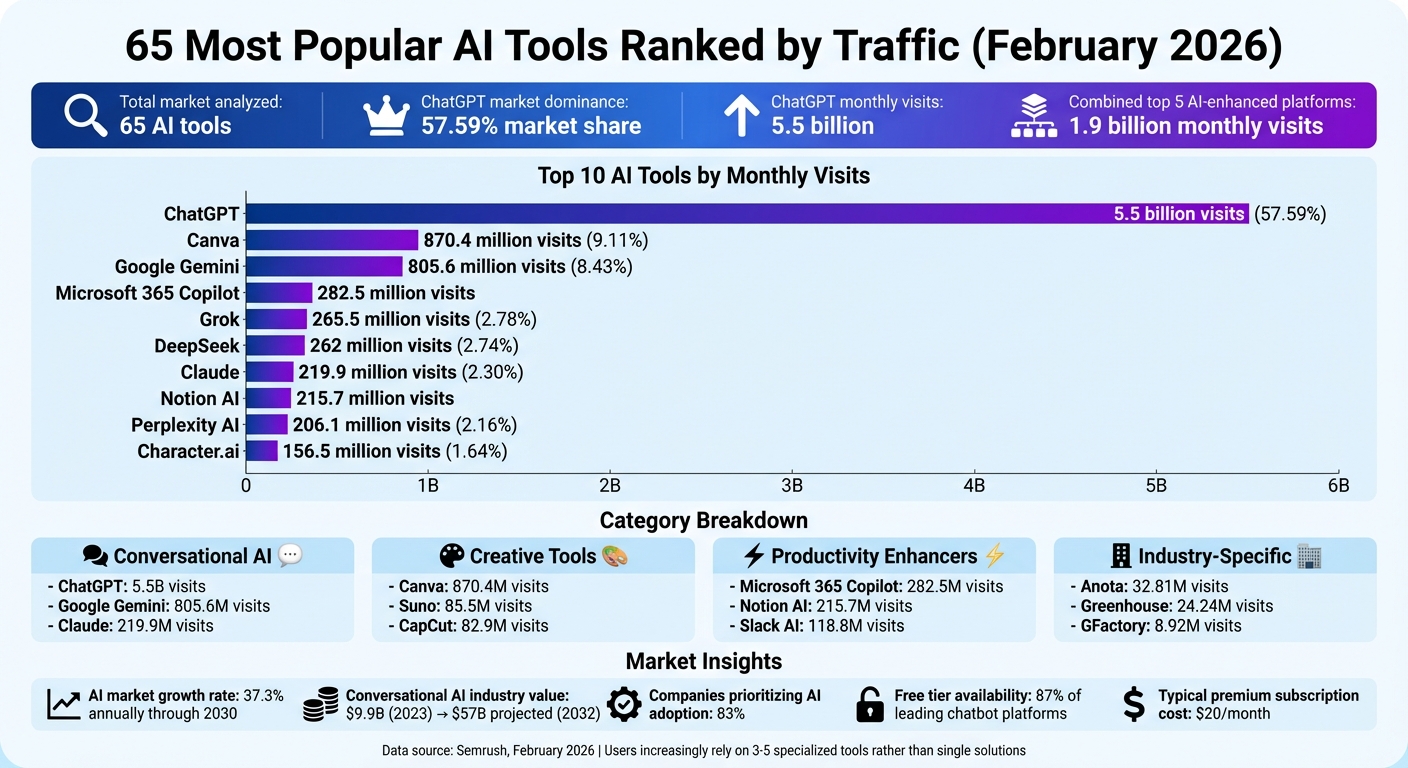
ChatGPT leads the pack with 5.5 billion monthly visits, capturing 57.59% of the market share among the top 65 AI tools. Canva follows with 870.4 million visits, and Google Gemini secures third place at 805.6 million visits. This ranking, based on February 2026 web traffic data from Semrush, highlights the most-used AI tools across various categories like conversational AI, creative tools, productivity enhancers, and industry-specific solutions.
Key insights:
- Conversational AI: ChatGPT dominates, while tools like Google's Gemini, Claude, and Perplexity AI cater to specific needs like coding, real-time research, and multilingual support.
- Creative Tools: Canva leads with 870.4 million visits, followed by platforms like Suno for music generation and CapCut for video editing.
- Productivity Enhancers: Microsoft 365 Copilot and Notion AI streamline workflows with millions of monthly users.
- Industry-Specific Tools: Platforms like Anota and Greenhouse address niche needs in sectors like food service and recruitment.
The AI market is evolving rapidly, with specialized tools gaining traction by addressing unique user needs. Users increasingly rely on a mix of tools rather than a single solution, signaling a shift toward tailored AI applications.
Top 65 AI Tools by Monthly Traffic and Market Share - February 2026
These 8 AI Tools Will Save You 1000 Hours in 2026
sbb-itb-212c9ea
1. Conversational AI
Conversational AI tools are at the forefront of monthly traffic rankings, evolving from simple chatbots into versatile assistants that can reason, conduct research, and perform tasks autonomously.
ChatGPT leads the pack with an impressive 5.5 billion monthly visits and a commanding 57.59% market share among the top 65 tools. Google Gemini follows with 805.6 million visits, benefiting from seamless integration with Android devices, Google Workspace, and over 500 million mobile app downloads since its launch in February 2024. Grok and DeepSeek are also notable players, with 265.5 million and 262 million visits, respectively. Grok capitalizes on real-time data from the X platform, while DeepSeek's open-weight models rival GPT-4 benchmarks.
Claude by Anthropic has carved out a niche with 219.9 million monthly visits, appealing to users who need advanced reasoning and coding capabilities. The company reached a valuation of $380 billion in February 2026 after its Series G funding round. Meanwhile, Perplexity AI attracts 206.1 million visits by offering direct answers with real-time citations, moving away from traditional search engine-style links.
Enterprise use cases highlight the practical impact of these tools. For example, Humana leveraged IBM watsonx Assistant to handle over 7,000 daily voice calls from healthcare providers in 2025, drastically reducing agent handling times. A major U.S. telecom provider serving 32 million customers saved $3.5 million in its first year by deploying Kore.ai's XO Platform for multilingual customer support. Similarly, KLM Royal Dutch Airlines used Google Dialogflow to automate multilingual customer inquiries, streamlining flight detail and booking assistance.
The table below outlines key metrics and strengths of the leading tools:
| Tool | Monthly Visits (Feb 2026) | Market Share | Key Strength |
|---|---|---|---|
| ChatGPT | 5.5 billion | 57.59% | Dominant general-purpose assistant |
| Google Gemini | 805.6 million | 8.43% | Deep integration with Google services |
| Grok | 265.5 million | 2.78% | Real-time X platform data access |
| DeepSeek | 262 million | 2.74% | Open-weight model transparency |
| Claude | 219.9 million | 2.30% | Advanced reasoning and coding |
| Perplexity AI | 206.1 million | 2.16% | Real-time research with citations |
| Character.ai | 156.5 million | 1.64% | Personalized character interactions |
| Microsoft Copilot | 94.5 million | <1% | Office suite integration |
These platforms are reshaping user interactions by enabling systems to act autonomously rather than just providing text responses. Tools like Kore.ai offer flexibility by allowing enterprises to switch between GPT-4, Gemini, and Claude, avoiding vendor lock-in. Privacy-focused options like Venice AI and Duck.ai are gaining traction by not storing user conversations for training purposes.
Free tiers remain a common strategy for user acquisition, with 87% of leading chatbot platforms offering them. Premium subscriptions typically cost around $20 per month for tools like ChatGPT, Claude, and Gemini. Enterprise pricing varies, such as IBM watsonx Assistant's Plus plan starting at $140 per month for 1,000 active users, while Intercom Fin AI charges $0.99 per resolved conversation.
Voice-based conversational AI is also growing, with tools like Retell AI (rated 4.8 out of 5 on G2) charging $0.07 per minute for voice agents. ECHO Incorporated achieved an 83% call deflection rate using Oracle Digital Assistant, scaling from 500 to 3,000 monthly chats without increasing staff. The conversational AI industry, valued at $9.9 billion in 2023, is projected to surpass $57 billion by 2032.
"If millions of people keep coming back every month, that's not marketing - that's trust." - KEAR AI
While ChatGPT remains the dominant player, specialized tools are gaining ground by addressing specific needs like real-time updates, privacy, coding support, or voice interaction. Traffic trends suggest users are increasingly exploring multiple platforms instead of sticking to a single general-purpose model.
2. Creative Tools
AI-powered creative tools are reshaping how we approach visual, audio, and video production. Canva continues to lead the way with an impressive 870.4 million monthly visits as of February 2026, holding a 9.11% market share and serving over 260 million active users. These tools are driving new possibilities in video creation, music production, and other specialized creative tasks.
Video Production
The demand for short-form video content, fueled by platforms like TikTok, has driven rapid growth in video production tools. CapCut, for instance, boasts around 490 million users across iOS and Android. Meanwhile, tools like Luma AI's Dream Machine can generate high-quality 5-second video clips from text or images in just 120 seconds. On the professional side, Synthesia offers solutions for businesses, enabling video creation in over 160 languages with more than 65 pre-designed AI avatars. This allows companies to update training videos by simply modifying text scripts instead of re-recording entire segments.
Music AI
AI is also making waves in music production. Platforms like Suno have become major players, with 85.5 million monthly visits as of February 2026, earning it the 12th spot among popular AI tools. Suno allows users to create full songs from simple text prompts and provides a free tier with 50 daily credits.
For marketing teams, tools like Midjourney have become indispensable. They can produce stunning 4K visuals quickly, saving both time and money compared to traditional design methods, which often cost over $500 per graphic.
Specialized Creative Utilities
Specialized tools continue to attract attention by solving niche creative challenges. Remove.bg, for example, simplifies background removal and garners 73.8 million monthly visits. Similarly, ElevenLabs, with over 1 million registered users following an $80 million Series B funding round, offers features like custom voice cloning. Its free tier includes 10,000 characters, while the Creator plan unlocks more advanced options.
Top Creative AI Tools by Traffic
| Rank | Creative AI Tool | Feb 2026 Monthly Traffic | Primary Creative Use Case |
|---|---|---|---|
| 1 | Canva | 870.4 Million | Graphic Design & Magic Studio |
| 2 | Suno | 85.5 Million | AI Music & Song Generation |
| 3 | CapCut | 82.9 Million | Video Editing & TikTok Templates |
| 4 | Remove.bg | 73.8 Million | Automatic Background Removal |
| 5 | HeyGen | 16.5 Million | AI Avatars & Video Localization |
| 6 | Midjourney | 16.4 Million | High-End Stylized AI Art |
| 7 | Leonardo | 15.8 Million | Image, Video, & 3D Textures |
| 8 | DeepAI | 13.1 Million | General Image & Video Generation |
| 9 | InVideo | 11.7 Million | Text-to-Video Content Creation |
| 10 | Runway | 7.1 Million | Professional AI Video Editing |
| 11 | Luma AI | 3.6 Million | Realistic Video & 3D Modeling |
| 12 | Stable Diffusion | 2.8 Million | Open-Source Image Generation |
| 13 | Synthesia | 2.7 Million | Avatar-Based Corporate Video |
| 14 | Filmora | 2.4 Million | AI-Enhanced Video Editing |
| 15 | Pictory | 2.0 Million | Short-Form Branded Video |
| 16 | MS Designer | 1.5 Million | Social Media Post Design |
These tools are not just tools - they're becoming indispensable for creators, businesses, and marketers looking to streamline workflows and achieve professional results with less effort. From video and music to niche creative solutions, the options are growing and evolving at an incredible pace.
3. Productivity Enhancers
AI productivity tools have become a staple in today's software landscape. Leading the charge is Microsoft 365 Copilot, boasting an impressive 282.5 million monthly visits as of February 2026, followed by Notion AI with 215.7 million visits. These tools are reshaping how we approach workflows and efficiency.
A major evolution in this space is the rise of autonomous AI. Unlike traditional chatbots that merely respond to queries, these advanced tools can handle complex, multi-step tasks independently. For instance, in December 2025, Meta acquired Manus, an AI agent platform, for a reported $2 billion to incorporate seamless workflow automation into its ecosystem. Similarly, OpenAI's February 2026 acquisition of OpenClaw - a popular open-source agent project on GitHub - has enhanced ChatGPT's capabilities, enabling it to perform tasks across platforms like WhatsApp and Telegram. These developments highlight how automation and precision are driving productivity gains.
Tools like Notion AI and Mem take it a step further by offering knowledge grounding. They connect directly to your workspace data, providing context-aware answers. Adding to the momentum, Google introduced Personal Intelligence in January 2026, integrating its Gemini assistant with Gmail, Photos, and YouTube. This allows users to access specific details, such as hotel bookings or purchase history, without any manual input.
Pricing for top productivity tools has become relatively uniform, with services like ChatGPT Plus, Claude Pro, Gemini Advanced, and Perplexity Pro generally costing $20 per month. Microsoft Copilot, now used by over 37,000 organizations, has crossed the milestone of 1 million paying users. Meanwhile, Notion has seen its AI adoption rate among paying users soar from 20% to over 50% between 2025 and 2026.
Top Productivity AI Tools by Traffic
| Rank | Productivity Tool | Feb 2026 Monthly Traffic | Key Use |
|---|---|---|---|
| 1 | Microsoft 365 Copilot | 282.5M | Enterprise Workspace |
| 2 | Notion AI | 215.7M | Knowledge Management |
| 3 | Slack AI | 118.8M | Team Communication |
| 4 | Grammarly | 54.4M | Writing Enhancement |
| 5 | QuillBot | 47.3M | Paraphrasing/Research |
| 6 | Monday.com AI | 34.7M | Project Management |
| 7 | ClickUp AI | 34.4M | Task Management |
| 8 | Gamma | 24.4M | Presentation Generation |
| 9 | Cursor | 19.2M | AI Coding |
| 10 | Zapier | 8.4M | Workflow Automation |
4. Industry-Specific Solutions
Beyond general-purpose tools, industry-specific AI solutions highlight how tailored approaches are transforming individual sectors.
AI has become a cornerstone across industries, with specialized platforms addressing challenges that generic models often overlook. Whether it's legal research or managing restaurant orders, these tools tackle critical tasks like regulatory compliance, clinical documentation, and predicting judicial outcomes with precision.
Take Anota, an AI-powered restaurant order management platform, which leads in Latin America with a staggering 32.81 million visits. Similarly, Greenhouse and PointClickCare focus on recruitment and long-term care, drawing 24.24 million and 6.26 million visits, respectively. The legal field has also embraced AI, with platforms like Trellis and CaseMine - each garnering over 2 million visits - enhancing judicial outcome prediction.
In gaming, GFactory has carved out a niche by specializing in AI-generated game assets, attracting 8.92 million visits. Meanwhile, Simple.life, an AI health coach, has reached 8.96 million visits by providing personalized health guidance.
Localized solutions are also thriving. For instance, MISA in Vietnam and Anota in Latin America demonstrate how platforms can achieve regional dominance by addressing specific regulatory needs and workflows. On the enterprise side, tools like Veeva Vault for life sciences and SAP SuccessFactors for HR often follow enterprise pricing models, typically without free tiers.
This trend of industry-focused platforms highlights a preference for solutions that understand the nuances of compliance, operations, and sector-specific language. With over 83% of companies prioritizing AI adoption, the global AI market is expected to grow at an annual rate of 37.3% through 2030.
Conclusion
The AI landscape in February 2026 highlights a market that’s both maturing and evolving rapidly. With ChatGPT reaching an impressive 5.5 billion monthly visits, the rise of specialized tools is equally striking, showcasing how quickly the market adapts when new capabilities emerge. This rapid pace of change underlines the importance of staying up-to-date to maintain a competitive edge.
AI has seamlessly transitioned from being a novelty to becoming an integral part of everyday software. The top five AI-enhanced platforms - Canva, Adobe, Microsoft 365 Copilot, Shopify, and Notion - now attract a combined 1.9 billion monthly visits. This shift illustrates that the future isn’t about choosing between traditional software and AI but embracing platforms where AI is woven into every interaction by default. This integration is redefining how workflows are optimized for efficiency and productivity.
Interestingly, professionals are moving away from relying on single, all-encompassing solutions. Instead, they typically leverage a stack of 3–5 specialized AI automation tools tailored to automate their most time-consuming tasks.
"90% of human traffic will go away as consumers outsource browsing to AI agents. Brands must adapt from targeting 'best pages' to providing 'best answers.'" – Chris Andrew, CEO, Scrunch AI
This insight underscores the need for brands and professionals to rethink their strategies in an AI-driven world.
FAQs
How was the traffic data measured?
Traffic figures were gathered using web traffic estimates from platforms such as SimilarWeb. These estimates rely on browser-based data to monitor visits to AI tools' websites, focusing solely on organic web traffic.
Does high traffic mean the tool is best for me?
High traffic might indicate a tool's popularity, but it doesn't automatically mean it's the right choice for you. Traffic numbers show how many people visit or use the tool, but they don't reflect how well it matches your unique goals or specific needs. Prioritize what matters most to you - whether that's certain features, usability, or compatibility with your objectives.
How do I pick a 3–5 tool AI stack?
When building a 3–5 tool AI stack, it’s essential to focus on tools that address your specific requirements and have a strong reputation based on traffic rankings and industry trends. Begin by pinpointing the core functions you need - whether it’s communication, design, or data analysis. Then, choose tools in each category that are both highly rated and widely used.
To keep things streamlined, ensure the tools you select are compatible and integrate seamlessly with one another. This approach not only enhances efficiency but also helps maximize your return on investment.