
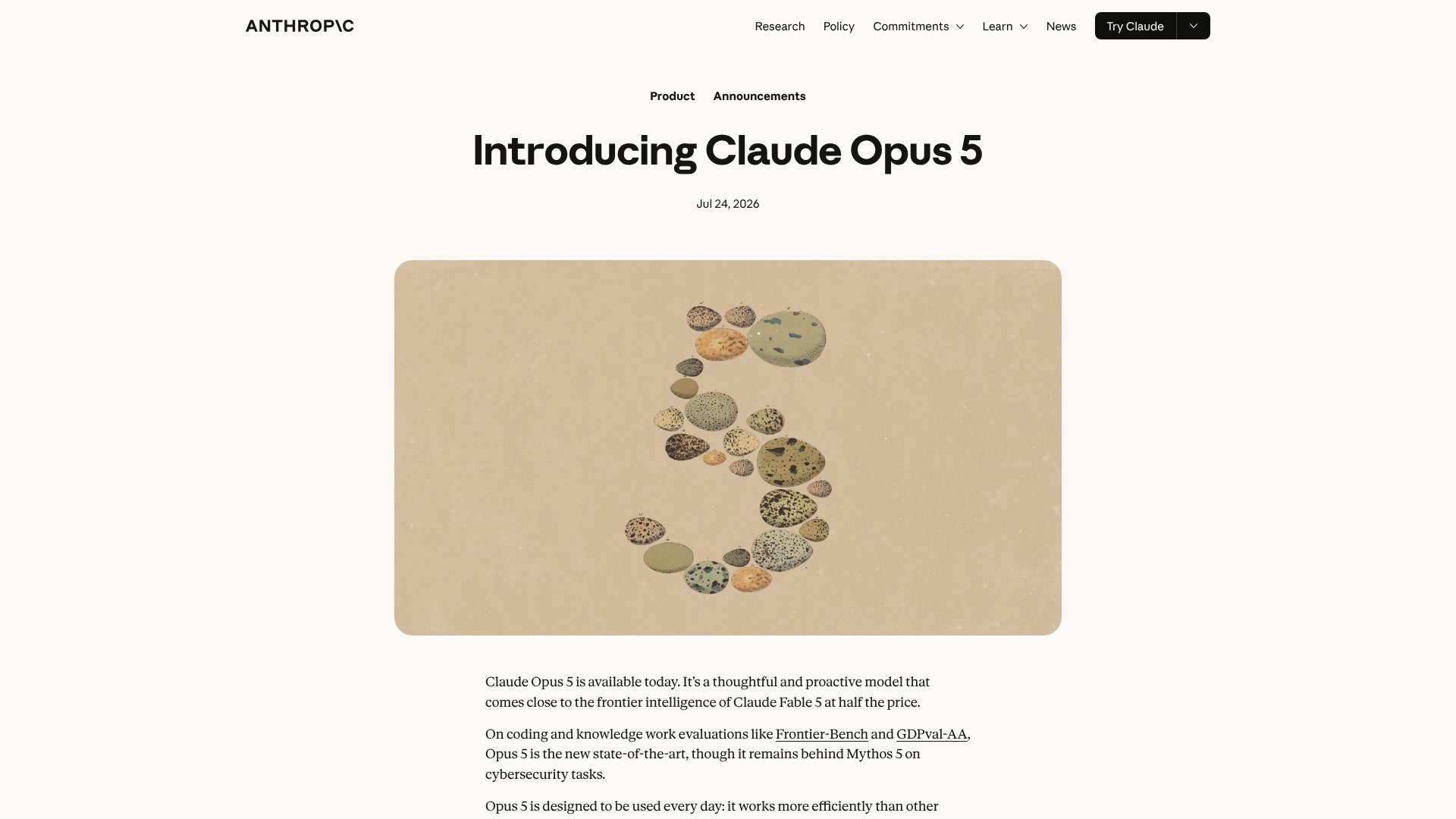
Claude Opus 5 is a Large Language Models (LLMs) tool. AI model for coding, knowledge work, and enterprise automation at half the cost. Key features include Agentic Coding, Cost-Effective Performance, and Adjustable Effort Setting. Best for software developers and engineers, data scientists and analysts and business consultants.
About Claude Opus 5
Claude Opus 5 is Anthropic's latest large language model that delivers near-frontier intelligence for coding, enterprise workflows, and agentic tasks. It matches the capabilities of Fable 5 at half the price, making it ideal for daily business use.
Key Features
Agentic Coding.
Cost-Effective Performance.
Adjustable Effort Setting.
Knowledge Work Excellence.
Code Review and Debugging.
Long-Running Agentic Tasks.
Frequently Asked Questions
Claude Opus 5 is Anthropic's latest large language model designed for coding, enterprise workflows, and agentic tasks. It approaches the intelligence of Claude Fable 5 at half the cost, making it suitable for daily business use. The model is now the default on Claude Max and the strongest model available on Claude Pro.
Claude Opus 5 costs $5 per million input tokens and $25 per million output tokens, the same pricing as its predecessor Opus 4.8. This makes it half the price of Claude Fable 5 while delivering comparable performance on most tasks. A fast mode is also available at 2.5x the default speed for twice the base price.
Claude Opus 5 excels at agentic coding, knowledge work, enterprise automation, code review, and scientific research. It's particularly strong at multi-file features, debugging, root-cause analysis, and long-running tasks that require sustained reasoning. Companies use it for software development, legal work, financial modeling, and business automation.
Claude Opus 5 comes close to Fable 5's frontier intelligence at half the cost. It outperforms Fable 5 on some coding and knowledge work benchmarks but remains behind on specialized cybersecurity tasks. The model is designed for everyday use rather than the most demanding edge cases.