
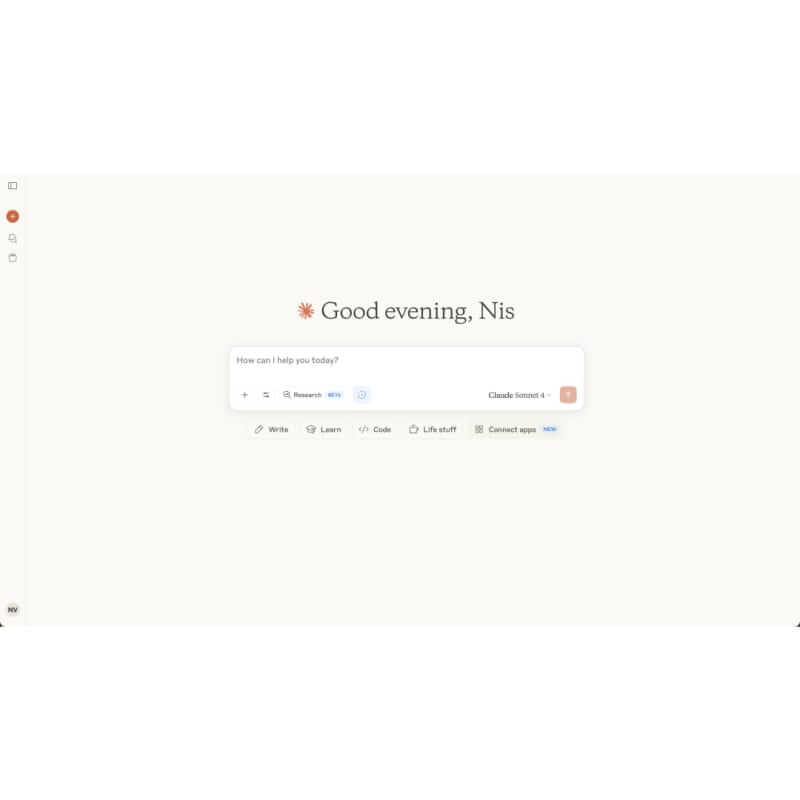
Claude Sonnet 4 is a Large Language Models (LLMs) tool. Claude Sonnet 4 helps with tasks like research, writing, data, and coding. It's built to be fast and efficient for common AI work. Key features include Superior Instruction Following, Advanced Reasoning and Tool Use, and Large Context Window. Best for teachers, marketers and content creators.
About Claude Sonnet 4
Claude Sonnet 4 is Anthropic's mid-tier Claude model in the Sonnet line, tuned for production work where consistent quality and speed matter more than the maximum reasoning depth of Opus. The model excels at structured tasks: research, instruction-following, content creation, data analysis, and routine automation across a broad range of professional use cases.
The core features that matter
- Superior instruction following with the model designed to handle intricate, multi-step instructions accurately, suitable for complex processes where each step needs to land correctly
- Advanced reasoning and tool use combining deep reasoning with external tool integration, producing thoughtful responses that draw on both internal logic and available external resources
- Large context window that reduces hallucinations when answering questions over large information sets, supporting workflows where context volume matters
- Content generation and analysis covering both writing engaging content and deeply analyzing existing material in the same conversation
- Visual data extraction for pulling information from diagrams, charts, and other visual aids, useful for analytical work with mixed-format source material
- Robotic process automation for routine task execution, helping streamline workflows that would otherwise require manual steps or custom scripting
How it stands out
Claude Sonnet 4 sits in the mid-tier of frontier model competition. ChatGPT, Anthropic's own Claude Opus, Google's Gemini Pro all occupy similar territory. The differentiation between these models on most tasks is narrow (meaningful but not dramatic) and depends heavily on the specific workload. Claude Sonnet 4 tends to lead on instruction-following accuracy and structured analytical tasks.
The honest qualifier: choosing between frontier models depends on your actual use cases more than benchmark scores. For users doing significant analytical work with mixed content types (text, visuals, charts), Claude Sonnet 4 is a strong fit. For pure code generation, sometimes alternatives outperform; for some creative writing tasks, other models produce more varied output. For users committed to one provider, Claude Sonnet 4 covers the breadth Anthropic offers at this tier.
Key Features
Superior Instruction Following.
Advanced Reasoning and Tool Use.
Large Context Window.
Content Generation and Analysis.
Visual Data Extraction.
Robotic Process Automation.
Frequently Asked Questions
It does a lot! It helps with things like quickly researching information from different sources, creating and checking content, and pulling data from visuals like charts. It can also automate routine tasks.
It's great at following instructions, even for complicated tasks. It can also think deeply and use different tools to give you better answers. Plus, it remembers a lot of information at once, so it makes fewer mistakes when answering questions using large amounts of text. It's also good at creating content, analyzing content, pulling data from visuals, and doing repetitive tasks automatically.
It's super smart and can do many different things, like coding and analyzing data. It also works fast and efficiently. However, it can be expensive, especially for small businesses, and you might need some technical skills to get the most out of it.
There’s a free plan for basic use. Then there’s Claude Pro at $20 a month, and a Team Plan for $30 per user each month.