Digital Transformation
Top 15 AI Agents & Agentic Systems Transforming Work in February 2026
Agentic AI tools automate tasks, cut manual work, and reshape workflows across software, support, and operations.

Top 15 AI Agents & Agentic Systems Transforming Work in February 2026
AI agents are revolutionizing how work gets done. These tools automate tasks, improve efficiency, and reduce time spent on repetitive work. From coding assistants to multi-agent workflows, here are the top 15 AI systems reshaping productivity in February 2026:
- Devin by Cognition Labs: Automates software engineering tasks like code migrations and CVE fixes.
- Claude by Anthropic: Handles complex workflows, reducing meeting prep time by 95%.
- AutoGen by Microsoft: Coordinates multiple AI agents for tasks like supply chain optimization.
- CrewAI: Structures AI agents into specialized teams, cutting curriculum design time by 90%.
- LangChain Agents: Flexible for building autonomous systems, with over 90 million monthly downloads.
- MultiOn: Automates web navigation, even on platforms without APIs.
- Adept AI: Converts natural language into actions, bypassing traditional API needs.
- ReAct Agents: Combine reasoning and actions for dynamic problem-solving.
- BabyAGI: Focuses on autonomous task execution and reprioritization.
- SuperAGI: Streamlines workflows with memory systems for continuous improvement.
- AgentGPT: Browser-based tool automating tasks with high-level goals.
- SmythOS: Offers structured AI workflows with drag-and-drop agent design.
- Lindy AI: Simplifies business processes with "AI employees."
- Cloud Optimization Agents: Improve operational efficiency in industries like finance and logistics.
- Multi-Agent Orchestration Systems: Coordinate specialized agents for enterprise-wide automation.
These systems are helping businesses save time, cut costs, and improve workflows by automating everything from customer service to software development. Companies like Fujitsu, ServiceNow, and IBM have already seen measurable productivity gains. Whether you're looking to automate small tasks or overhaul entire processes, these AI tools offer scalable solutions for the workplace.
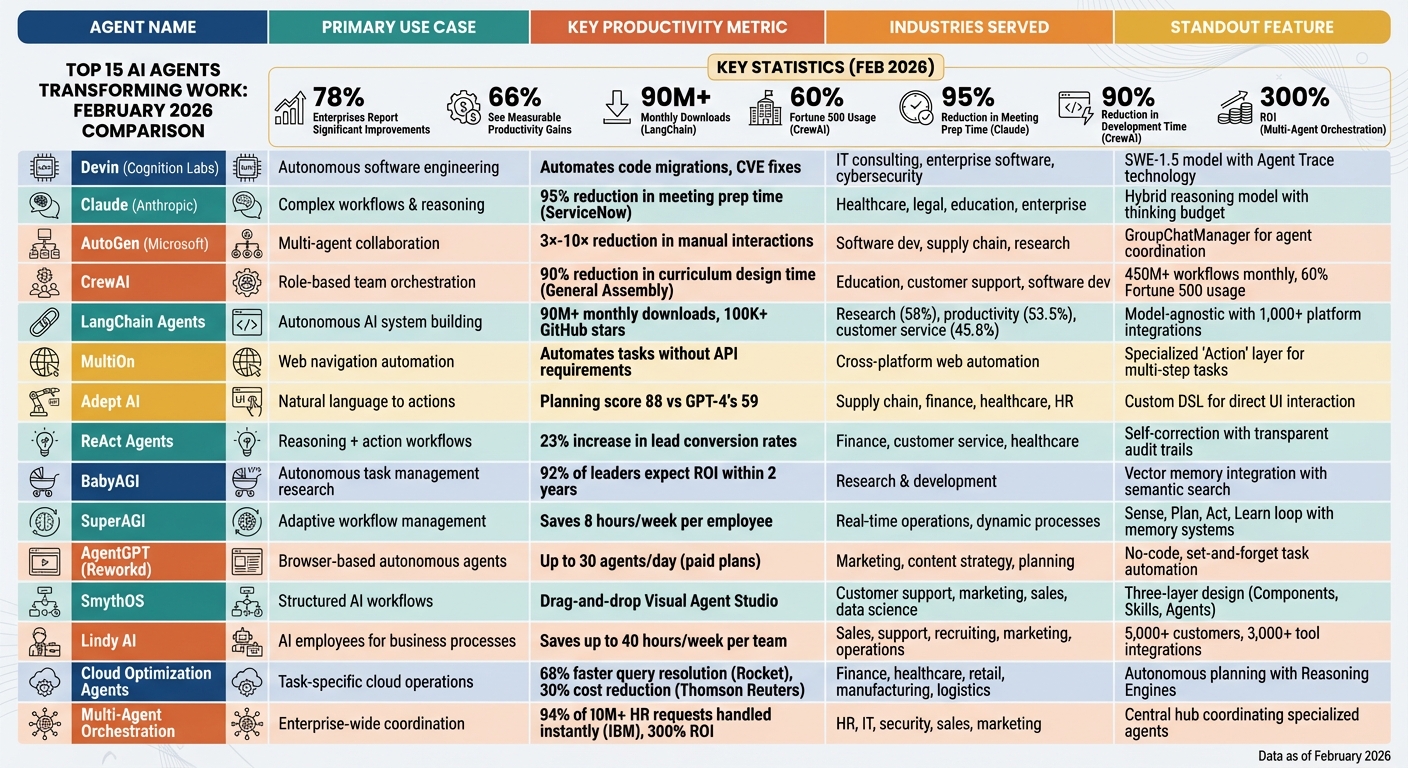
Top 15 AI Agents Comparison: Features, Industries, and Productivity Impact 2026
How AI Agents Will Transform in 2026 (a16z Big Ideas)
1. Devin by Cognition Labs
Devin is an autonomous AI tool designed to function as a software engineer, capable of writing, running, and testing code independently. Unlike traditional coding assistants that merely suggest snippets, Devin operates within its own integrated development environment (IDE), terminal, and browser. It can browse documentation, execute commands, and test web applications in real time. This capability allows it to manage entire workflows from start to finish, earning its role as what Cognition Labs describes as a "junior engineer" on your team.
Impact on Productivity and Workflow Efficiency
Devin is particularly adept at managing backlog tasks like fixing CI failures, performing linting, and addressing CVEs. Companies like Cognizant and Infosys have already leveraged Devin to improve development efficiency.
For more complex tasks, Devin automates large-scale code migrations and modernizations. In October 2025, Cognition Labs showcased Devin’s ability to autonomously migrate legacy .NET Framework applications to .NET Core, handling everything from refactoring to updating dependencies. It also supports framework upgrades, such as moving from Angular 16 to 18, and even language migrations, like transitioning from JavaScript to TypeScript. Its ability to integrate seamlessly with existing tools makes it a valuable addition to any development team.
Industries and Use Cases Served
Devin is tailored for IT consulting firms, enterprise software teams, and cybersecurity departments. It shines in environments dealing with legacy modernization, technical debt, and CVE remediation. Its strengths lie in completing well-defined, entry-level tasks that can be verified through CI checks and tests. Some of its common applications include working with unfamiliar APIs, creating custom product demos, and building internal tools for customer engineering teams.
Ease of Integration into Existing Systems
Devin connects effortlessly with platforms like GitHub, GitLab, Bitbucket, Slack, Microsoft Teams, Jira, and Linear. Users can access it via a web app, API, or direct collaboration channels. For enterprise-level needs, it supports VPN setups and self-hosted source control systems, making it compatible with a wide range of development environments.
Unique Features That Set Devin Apart
Devin’s SWE-1.5 model and Agent Trace technology allow it to capture context graphs, enabling a deeper understanding of code. The platform also supports the Model Context Protocol (MCP) Marketplace, which links it to external data sources and tools for added functionality. Developers can monitor Devin’s progress through a conversational interface and step in to "take over" at any point within the IDE. The team behind Devin boasts an impressive track record, with 10 International Olympiad in Informatics (IOI) gold medals, and by late 2025, the tool had been in active use for over 18 months.
"Devin is most effective when it's part of your team and your existing workflow." - Cognition Labs
2. Claude by Anthropic

Claude has evolved into a tool capable of reasoning, planning, and executing complex workflows autonomously. In January 2026, ServiceNow began using Claude as the default Build Agent for its 29,000+ employees. The results were eye-opening: sales teams saw a 95% drop in meeting prep time as Claude seamlessly integrated real-time enterprise data with web search results. ServiceNow CEO Bill McDermott highlighted the partnership's mission:
"ServiceNow with Anthropic is turning intelligence into action through AI-native workflows for the world's largest enterprises. This partnership is about reimagining how work gets done".
Now, let’s dive into how these capabilities translate into measurable productivity boosts.
Impact on Productivity and Workflow Efficiency
Claude has proven to be a game-changer for productivity across various roles. Claude Code, for instance, automates tasks like code migrations, bug fixes, and refactoring. Early tests revealed a 3× reduction in code churn for engineering teams. GitHub’s Chief Product Officer, Mario Rodriguez, noted that Claude Opus 4.5 powers advanced workflows within GitHub Copilot, "outperforming internal coding benchmarks while halving token usage".
For non-technical users, Claude Cowork on macOS facilitates direct interaction with local files, folders, and productivity apps. It can organize documents, perform web research, and edit content across multiple tools. ServiceNow estimates that Claude-driven automation will cut product implementation timelines by 50% and reduce healthcare claims processing from days to hours.
Industries and Use Cases Served
Claude thrives in industries where precision is critical. In healthcare, Claude Opus 4.5 leads evaluations in medical and life sciences, making it a trusted tool for healthcare organizations. In the legal field, Robin AI incorporated Claude in March 2023 to assess contract language and suggest customer-friendly revisions. Robin AI’s CEO Richard Robinson shared that Claude’s ability to simplify complex legal language boosted user engagement and helped close more deals.
Education has also seen notable benefits. Juni Learning integrated Claude into their Discord-based "Juni Tutor Bot", providing students with high-quality tutoring in math and critical reading. According to the company, Claude delivered "better, richer answers" compared to the more superficial responses from competing models. Beyond these examples, enterprise software teams, sales departments, and app developers using platforms like ServiceNow are key users of Claude.
Ease of Integration into Existing Systems
Claude integrates seamlessly with enterprise platforms through APIs and native connections. It’s the preferred model on the ServiceNow AI Platform and works directly within Excel, Slack, and Google Workspace. Through MCP, Claude connects to over 8,000 apps via Zapier. Developers can also use Claude Code with GitHub, local repositories, and terminal environments, all without complicated setups.
Pricing options include a free tier, a Pro plan at $20/month ($17/month billed annually) with Claude Code and Google Workspace integration, and a Max plan at $100/month for significantly higher usage. For API access, Claude 3.7 Sonnet costs $3.00 per million input tokens and $15.00 per million output tokens.
Innovative or Unique Features
Claude 3.7 Sonnet introduces a hybrid reasoning model, allowing users to toggle between instant and extended responses. API users can set a "thinking budget" of up to 128,000 tokens, balancing speed, cost, and reasoning depth. This feature reduced unnecessary refusals of benign requests by 45% compared to earlier versions.
The Artifacts feature provides a collaborative workspace where users can view, edit, and iterate on websites, graphics, and code alongside the chat interface. This creates an experience closer to working with a teammate rather than interacting with a chatbot. Claude’s foundation in Constitutional AI ensures it is designed to be "helpful, honest, and harmless", making it more reliable and less likely to produce harmful outputs than many competitors. Anthropic CEO Dario Amodei emphasized this approach:
"The way to get much better results is to make AI an integral part of how you get work done - woven into the whole range of things workers do every day".
3. AutoGen by Microsoft
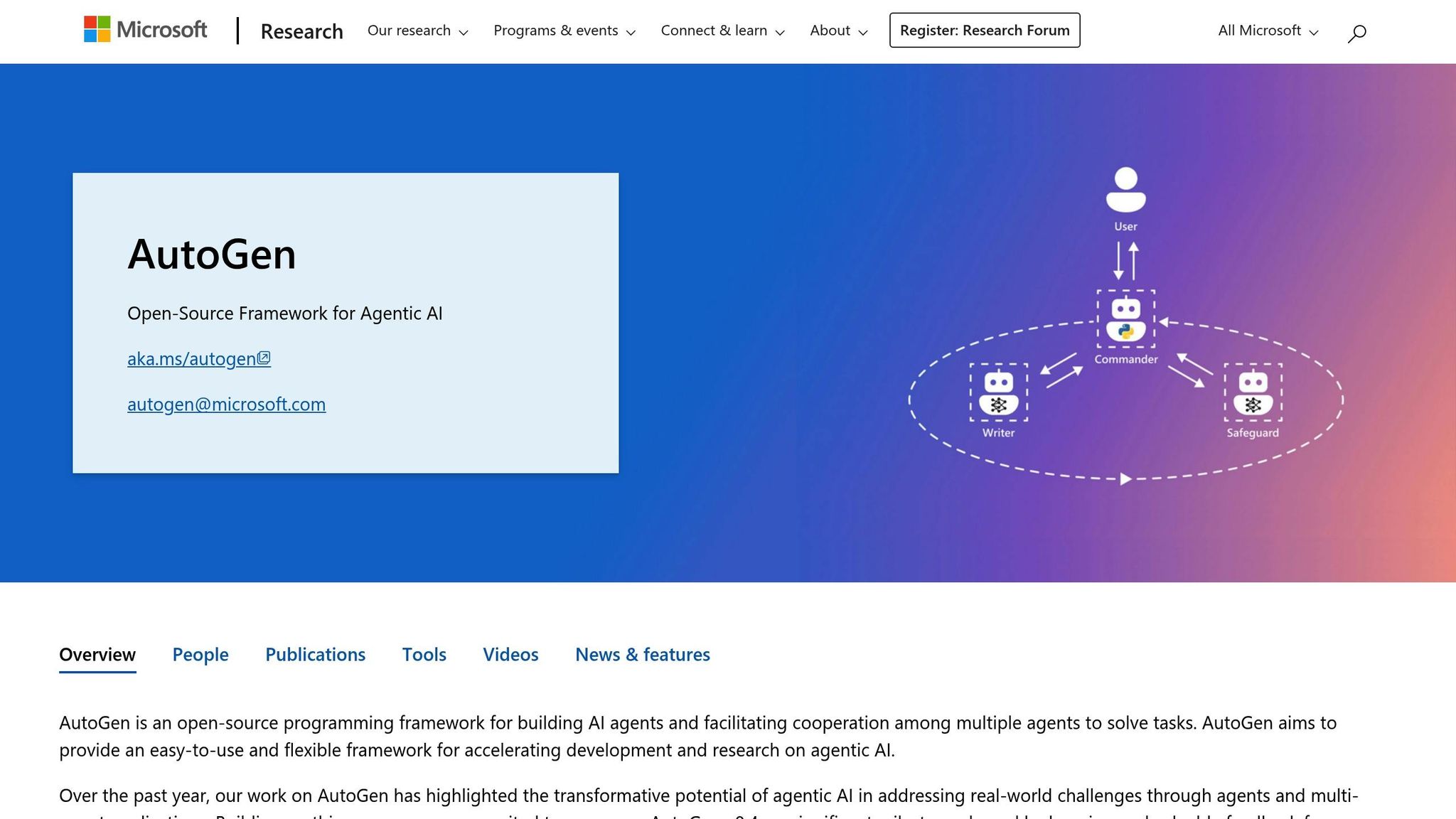
Microsoft's AutoGen framework takes autonomous AI tools to a new level by enabling collaboration between multiple AI agents to tackle complex tasks. This open-source platform divides intricate workflows among specialized agents, streamlining processes in ways that are hard to ignore. For example, in supply-chain optimization, AutoGen has reduced manual interactions by 3×–10× and cut coding efforts by 4×.
Doug Burger, Microsoft Technical Fellow, highlighted its potential:
"Capabilities like AutoGen are poised to fundamentally transform and extend what large language models are capable of. This is one of the most exciting developments I have seen in AI recently."
Impact on Productivity and Workflow Efficiency
AutoGen shines in scenarios requiring iterative problem-solving, multi-step workflows, or code execution. It features pre-built agents, such as the AssistantAgent for generating code and the User Proxy agent, which handles task execution or escalates to humans when necessary. These agents collaborate through a chat interface, troubleshooting and refining results automatically. The latest version, AutoGen v0.4, introduces an asynchronous, event-driven architecture that scales efficiently for enterprise needs. Teams using AutoGen Studio can pause agent conversations, adjust their configuration, and resume tasks without losing progress.
Industries and Use Cases Served
AutoGen is a natural fit for industries that rely on data-heavy or code-intensive workflows. Software development teams use it to automate coding, debugging, and execution. In supply chain management, the multi-agent collaboration optimizes logistics and solves operational challenges. Research and analytics teams benefit from its ability to handle multi-step reasoning, complex simulations, and detailed data analysis.
Ease of Integration into Existing Systems
AutoGen is available as a Python package (pip install pyautogen), making it easy to integrate into existing systems. It supports cross-language interoperability between Python and .NET, along with OpenTelemetry for observability and debugging. Businesses using Microsoft tools can integrate AutoGen with Copilot Studio for $200/month (25,000 Copilot Credits) or with Microsoft 365 Copilot for $30/user/month. While the framework itself is free, users will need to cover the costs of the underlying LLM APIs. AutoGen also includes features to help manage these costs by tuning inference parameters.
Standout Features
One of AutoGen's key components, the GroupChatManager, coordinates conversations between multiple agents by dynamically assigning roles and broadcasting messages to achieve shared goals. The framework also includes Magentic-One, a flexible multi-agent application for tackling open-ended tasks involving web or file-based data. Additionally, the User Proxy agent ensures human oversight by escalating tasks to a person when ambiguity or high-risk decisions arise.
4. CrewAI
CrewAI takes collaborative automation to the next level by structuring AI agents into specialized teams that mimic human workforce dynamics. These teams, with roles like Researcher, Writer, and Manager, are designed to tackle complex tasks seamlessly. Impressively, the platform powers over 450 million workflows every month and is utilized by 60% of Fortune 500 companies. This has translated into measurable productivity improvements across various industries.
Impact on Productivity and Workflow Efficiency
In 2025, General Assembly slashed its curriculum design time by a staggering 90%. Chris Giordano, Director of Learning and Program Development at General Assembly, remarked:
"We achieved a 90% reduction in development time for a critical phase of our process with CrewAI, motivating us to build agentic workflows for additional use cases."
Other companies have also experienced transformative results. DocuSign reduced its lead time-to-first-contact by 75%, while PwC boosted code generation accuracy from 10% to 70% - a sevenfold improvement - using CrewAI workflows. The platform achieves this through its dual architecture: "Flows" manage the overarching process logic, while "Crews" handle specific tasks. This setup ensures teams retain control while automating repetitive or time-consuming workflows.
Industries and Use Cases Served
CrewAI's versatility shines across a wide range of industries. For instance:
- Piracanjuba, a Brazilian dairy company, replaced outdated RPA tools with CrewAI's collaborative workflows, achieving 95% accuracy in customer support ticket responses.
- Gelato processes over 3,000 leads per month, automatically gathering key data like company size, revenue estimates, and printer infrastructure to improve lead prioritization.
- Software development teams see improved accuracy in function specifications.
- Education organizations streamline content creation processes, saving time and resources.
The platform also integrates seamlessly with enterprise tools such as Gmail, Slack, Salesforce, HubSpot, Microsoft Teams, and Notion, making it adaptable to existing workflows.
Ease of Integration into Existing Systems
CrewAI offers three deployment options to suit varied organizational needs:
- Open-source framework available via PyPI for maximum flexibility.
- Managed platform (CrewAI AMP Cloud) featuring a user-friendly visual editor.
- On-premises or private VPC solution (CrewAI AMP Factory) hosted on AWS, Azure, or GCP.
To ensure smooth operations, CrewAI includes safeguards like iteration limits and execution timeouts, preventing runaway costs or infinite loops during autonomous tasks.
Standout Features
CrewAI's role-based orchestration ensures tasks are clearly defined and executed with precision. Its built-in memory system - spanning short-term, long-term, and shared memory - allows agents to retain and use information across tasks, fostering effective collaboration. One standout feature, Reasoning, enables agents to reflect and draft detailed execution plans before acting, significantly reducing workflow errors.
Additionally, automatic context management prevents execution failures by summarizing conversation history when token limits are reached. With over 100,000 certified developers and 4,000 new sign-ups weekly, CrewAI has cultivated a thriving community around enterprise-ready AI automation.
5. LangChain Agents
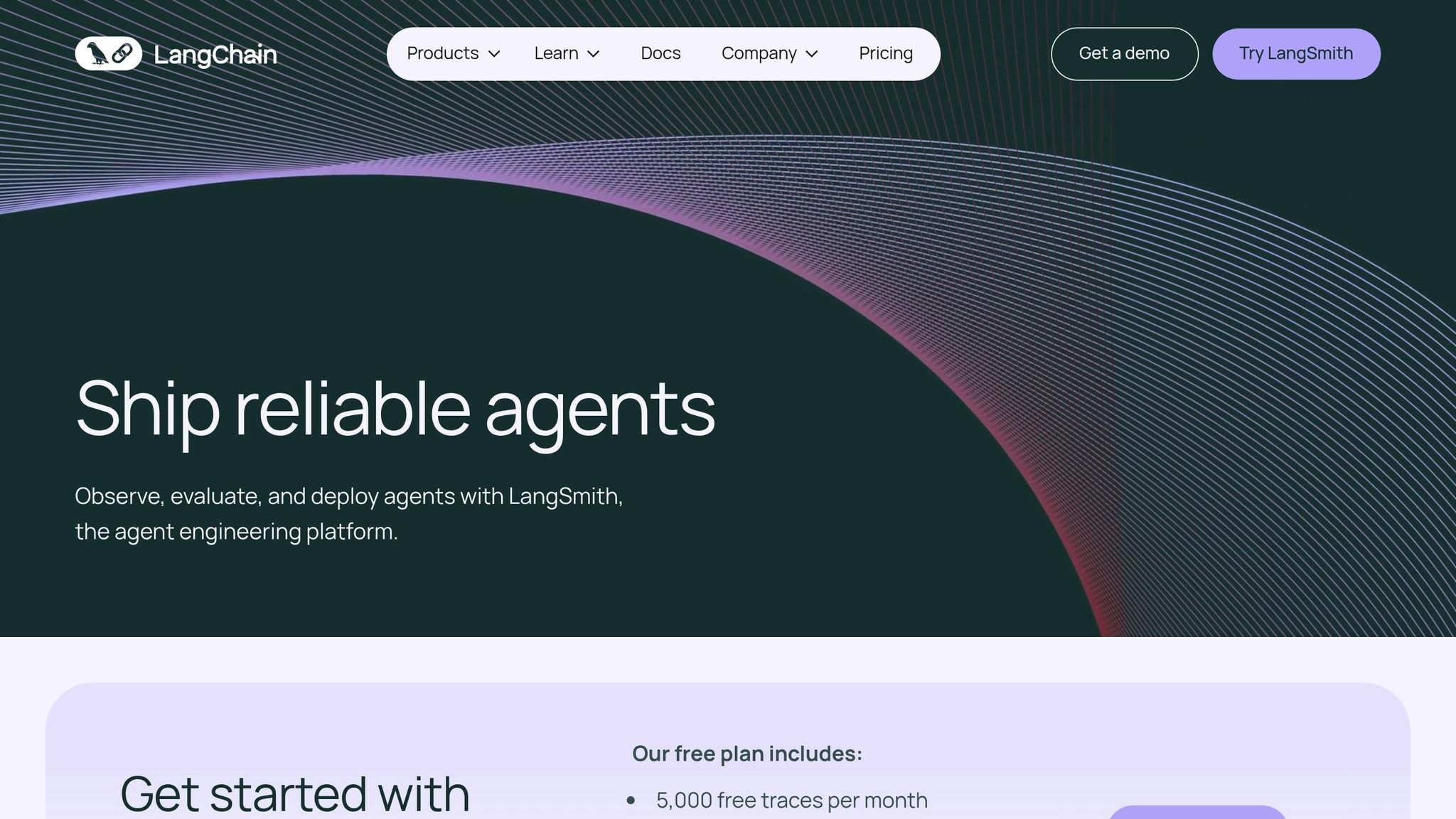
LangChain has grown into a leading platform for building autonomous AI systems. With over 90 million monthly downloads and more than 100,000 GitHub stars, it’s the most downloaded agent framework worldwide. Its popularity extends beyond tech companies, with 90% of non-tech organizations either using or planning to use LangChain agents - closely aligning with the 89% adoption rate in the tech sector. This widespread usage highlights its ability to boost productivity across industries.
Impact on Productivity and Workflow Efficiency
By 2026, 51% of organizations were already running LangChain-based systems in production, and 78% planned to deploy them soon. The platform is widely used for tasks like research (58%), personal productivity (53.5%), and customer service (45.8%), with other applications including code generation (35.5%) and data transformation (33.8%).
What sets LangChain apart is its flexibility in reasoning strategies. Developers can customize agent behavior using methods like Plan-and-execute, ReAct, and Self-ask. For more complex workflows, LangGraph coordinates multiple specialized agents - such as planners, executors, and validators - to handle multi-step processes. Additionally, the platform incorporates human-in-the-loop features, ensuring sensitive actions require manual approval, balancing efficiency with reliability.
Ease of Integration into Existing Systems
LangChain’s design makes it easy to integrate into existing systems. Its model-agnostic approach lets developers switch between LLMs, tools, and databases effortlessly. With integrations for over 1,000 platforms - including Slack, Salesforce, and Gmail - it supports both Python and TypeScript through remote MCP servers.
The LangSmith Agent Builder simplifies agent creation for non-technical users, enabling them to deploy agents for tasks like research or inbox management using natural language, without needing to write code. For workflows requiring high reliability, LangGraph offers features like persistent runtime, checkpointing, and "rewind" capabilities to prevent progress loss during system restarts. Companies like Replit, Clay, Rippling, Cloudflare, and Workday already leverage LangChain for their agent development needs.
Notable Features
LangSmith stands out with its full trace observability, helping users quickly identify and fix errors. It offers a free tier with 5,000 traces per month, while Enterprise plans include self-hosting options on Kubernetes across AWS, GCP, or Azure. Additional middleware hooks enhance security, meeting strict compliance requirements in industries like finance and healthcare. These features solidify LangChain’s reputation as a game-changer for workflow efficiency as of February 2026.
6. MultiOn
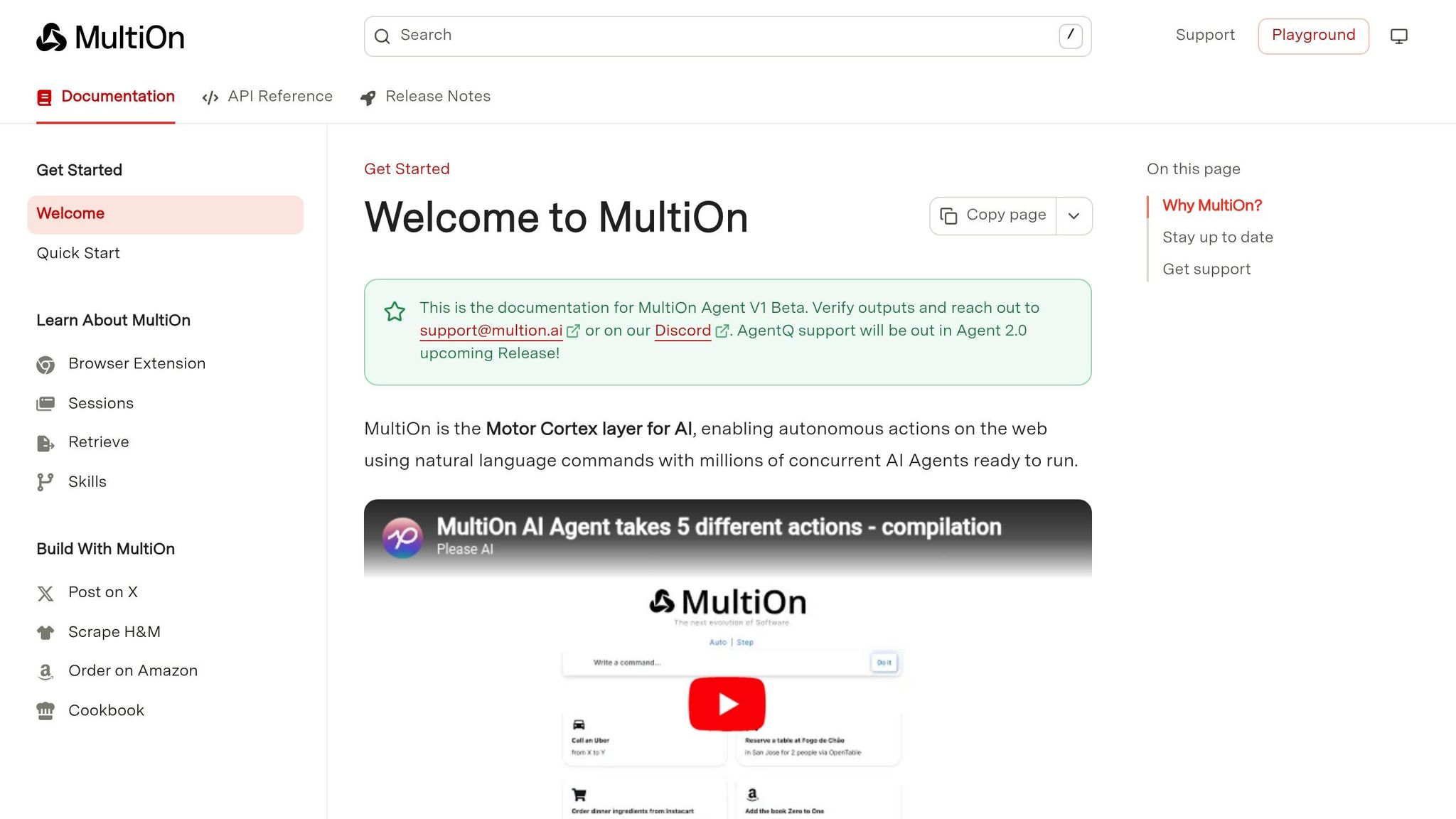
MultiOn is an autonomous web navigation agent designed to mimic how humans interact with websites. It can handle actions like clicking, typing, scrolling, and completing multi-step tasks - all without relying on official APIs. This makes it an excellent tool for automating workflows on platforms that don’t offer direct integrations, addressing a common challenge in workplace automation.
Impact on Productivity and Workflow Efficiency
By automating repetitive tasks like file searches, sending reminders, and updating trackers, MultiOn frees up time for professionals to tackle more meaningful work. Its reasoning engine breaks down complex goals into smaller, actionable steps and adjusts strategies when conditions change, making it a flexible tool for dynamic environments.
Ease of Integration into Existing Systems
MultiOn’s API-first approach makes it highly accessible for developers looking to create custom workflows. Since it operates at the interface level, it can seamlessly interact with almost any web-based tool without requiring backend access. This eliminates the need to wait for official API support, allowing for quicker implementation.
Notable Features
One standout feature of MultiOn is its specialized "Action" layer. This enables the platform to autonomously complete complex, multi-step tasks, such as booking appointments, managing social media, or making online purchases. Unlike basic task automation, this layer allows MultiOn to handle unexpected scenarios, like routing approvals or managing access, making it a more advanced solution for autonomous task execution.
7. Adept AI
Adept AI focuses on workplace automation by using its proprietary multimodal models and specialized actuation software to transform natural language instructions into actions. What makes this standout is its ability to bypass traditional API integrations. This means businesses can automate tasks on legacy systems or third-party platforms without needing direct connectivity, making it a game-changer for companies dealing with older systems or complex platforms.
Impact on Productivity and Workflow Efficiency
Adept AI is built to handle intricate enterprise workflows with remarkable precision. According to internal benchmarks, it achieved a planning score of 88 compared to GPT-4's score of 59. Its design is also "future-proof", meaning it adapts to changes in software interfaces, sparing IT teams from the constant maintenance headaches that come with traditional automation tools.
Industries and Use Cases Served
Adept's ability to enhance productivity makes it a valuable tool in industries that deal with high volumes of tasks. These include Supply Chain, Financial Services, Healthcare, HR, and Operations. For example:
- Supply Chain Management: Adept can check shipping availability across multiple vendor websites and generate detailed delivery plans instantly.
- Financial Services: It simplifies processes like extracting data from PDFs and contracts, updating internal systems, and automating follow-up communications.
- Healthcare: Organizations use Adept to handle license applications, navigating complex business logic efficiently.
Standout Features
Adept’s actuation layer uses a custom Domain Specific Language (DSL) to interact directly with software interfaces, including buttons, text fields, and links. Its performance is backed by impressive metrics: a score of 93 on "Adept Locate", which measures its accuracy in identifying UI elements, and 88.2 on Web Visual Question Answering, demonstrating its ability to interpret documents, charts, and tables. Trained on a vast dataset of web UIs and real-world software usage, Adept is equipped to handle a wide range of digital workflows.
8. ReAct Agents
ReAct Agents mark a shift in how AI systems tackle complex tasks. Unlike older automation methods that stick to rigid scripts, these agents blend internal reasoning with external actions and real-world feedback. In simpler terms, they can think through a problem, take action, observe the outcome, and adapt their approach in real time. This flexibility has made them a game-changer for improving business workflows.
Impact on Productivity and Workflow Efficiency
ReAct Agents excel at breaking down multi-step problems, analyzing objectives, and finding the best strategies using real-time data. Their ability to adapt has led to noticeable efficiency gains in various applications. For example, projections suggest that by 2026, 40% of enterprise applications will include task-specific AI agents. Companies that have integrated these agents into marketing operations have already reported an average 23% increase in lead conversion rates over a year.
"A common error enterprises make with AI is to treat it as a kind of 'bolt on' tool... the way to get much better results is to make AI an integral part of how you get work done - woven into the whole range of things workers do every day." - Dario Amodei, CEO and Co-founder, Anthropic
Industries and Use Cases Served
Thanks to their flexible problem-solving abilities, ReAct Agents have found applications in a wide range of industries:
- Finance: Automating market trend analysis, detecting fraud, and enhancing algorithmic trading.
- Customer Service: Resolving complex customer complaints using AI tools for customer service by analyzing CRM data and autonomously initiating actions like refunds or escalations.
- Healthcare: Assisting with medical diagnoses and providing real-time patient monitoring.
Unique Features That Stand Out
One of the standout qualities of ReAct Agents is their self-correction capability. During the "Observation" phase, the agent verifies its logic against real-world outcomes. If the data doesn’t align with expectations, the agent revises its plan rather than continuing with flawed assumptions. This approach not only improves accuracy but also creates a clear audit trail, allowing human supervisors to understand the reasoning behind the agent’s decisions - an especially important feature in regulated industries. Additionally, the framework ensures transparency by documenting the agent’s "Thought" process in plain language, making its steps easy to follow.
sbb-itb-212c9ea
9. BabyAGI
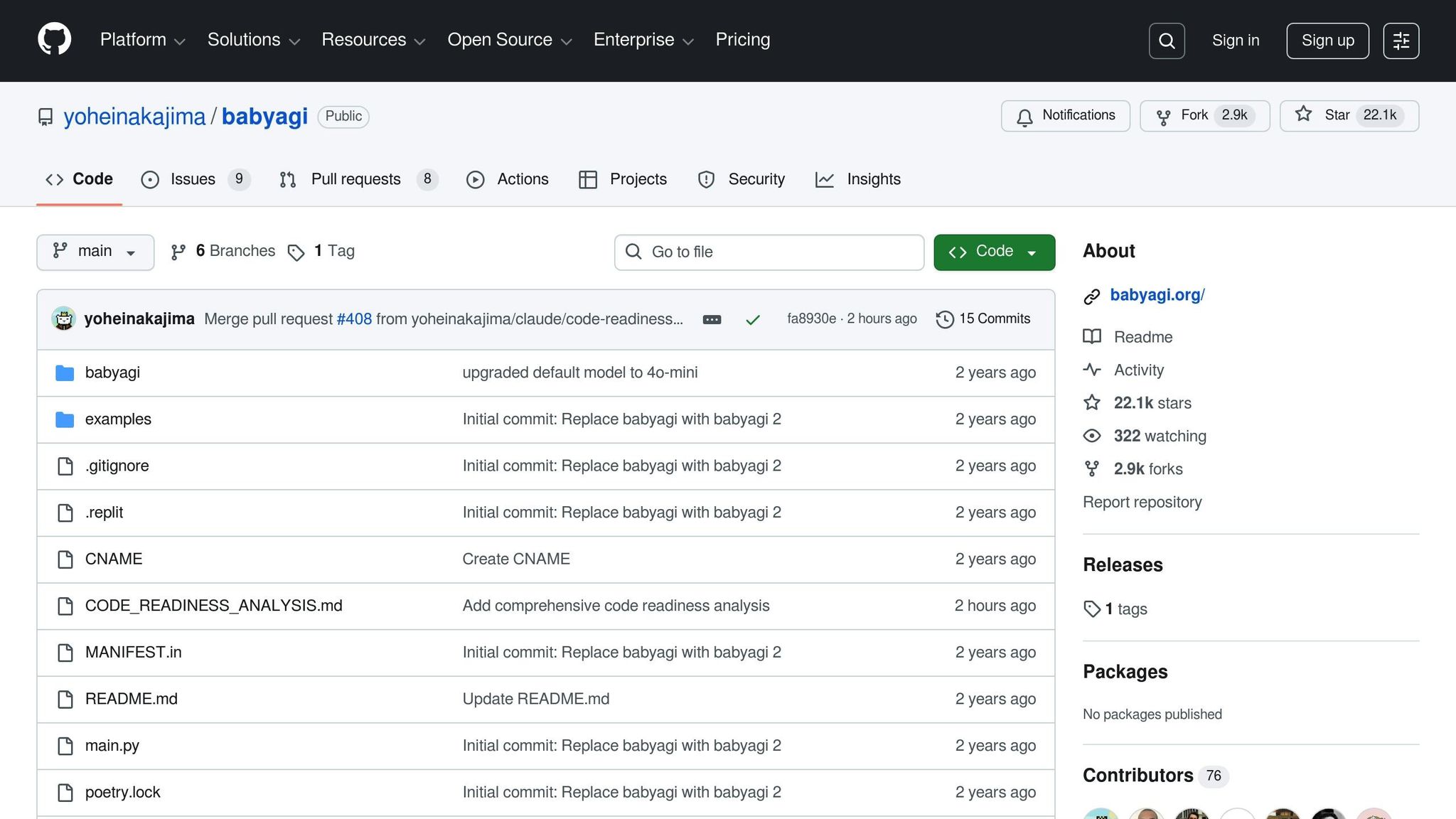
BabyAGI is a research tool designed to explore how complex goals can be autonomously managed. It operates through a continuous loop of task execution, creation, and reprioritization, enabling autonomous reasoning to drive progress. This iterative approach is reflected in advancements found in many enterprise applications today.
Key Features
One standout feature of BabyAGI is its vector memory integration. This system stores task results as embeddings in vector databases (like Pinecone, FAISS, or Chroma), allowing for semantic search to retrieve relevant context. Unlike traditional automation that relies on static scripts, BabyAGI adapts dynamically based on the outcomes of completed tasks. Additionally, its BabyAGI 2 "Functionz" framework supports dynamic function management, helping it evolve as it works toward high-level objectives.
Integration Requirements
To use BabyAGI, you'll need some technical know-how. It requires Python and Git, along with API keys for a large language model and a vector database. While the framework is available for free on GitHub, users will incur operational costs tied to API usage. This makes it an educational tool rather than an out-of-the-box enterprise solution.
Influence on Productivity
Although BabyAGI isn't yet enterprise-ready, it highlights how autonomous agents can transform productivity. Research indicates that 92% of business leaders anticipate a measurable ROI from agentic AI within two years. Furthermore, 66% already see these systems improving productivity by breaking down complex goals into manageable tasks and automating repetitive processes like data entry, reporting, and scheduling. This underscores the growing role of agentic systems in reshaping modern workflows.
10. SuperAGI
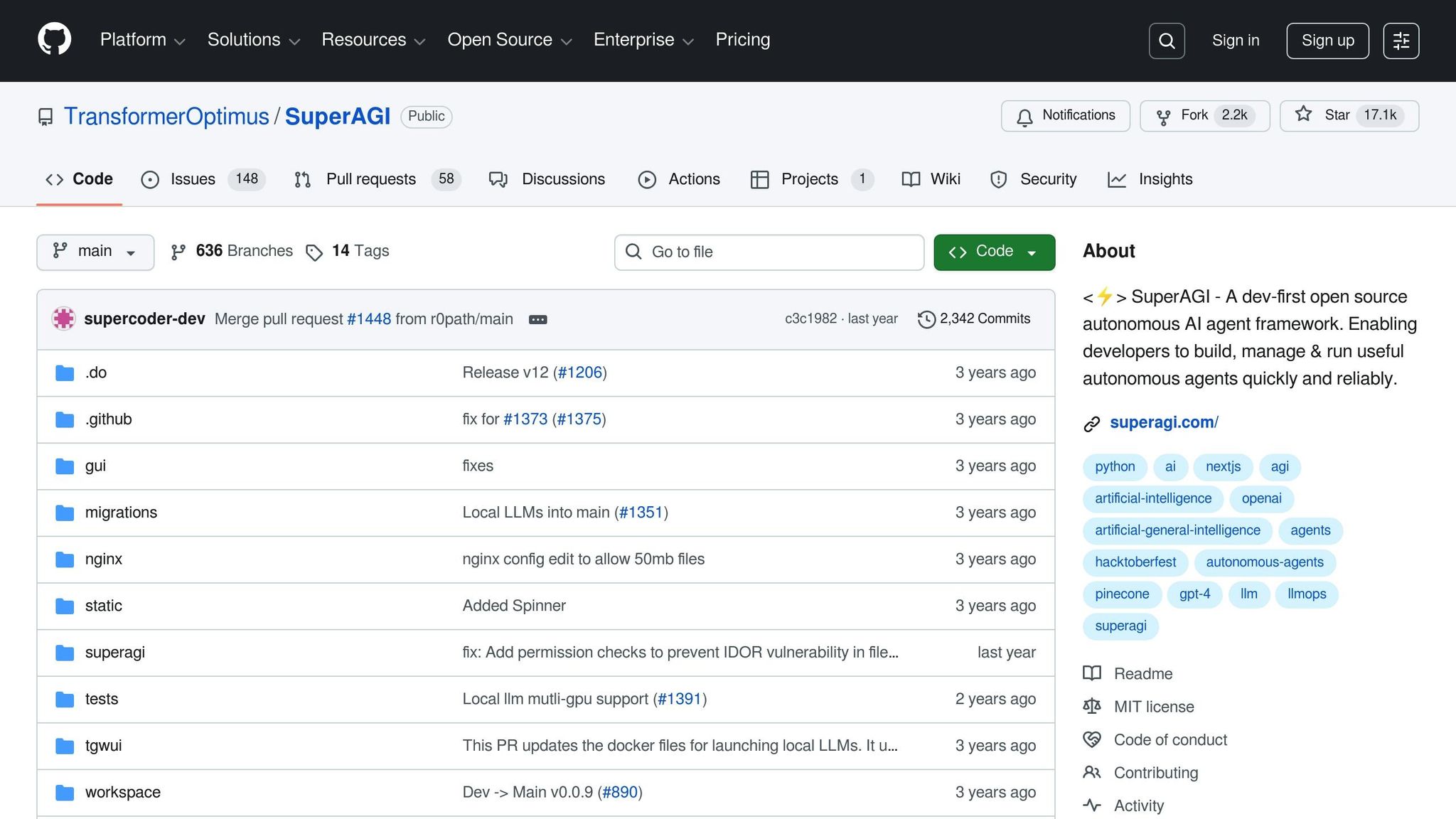
SuperAGI is making waves in modern workflows by breaking down information silos and streamlining task management. By automating processes like transcription and categorization, it saves employees up to 8 hours per week, reducing the time spent on repetitive tasks.
Key Features
SuperAGI operates on a Sense, Plan, Act, and Learn loop, which integrates flexible memory systems. It uses short-term memory for immediate actions and retrieval-augmented long-term memory for historical insights. This setup allows the system to continuously improve its efficiency and deliver better results over time.
Boosting Productivity and Workflow Efficiency
SuperAGI transforms rigid workflows into adaptable processes, handling complex tasks like access provisioning and approval routing. This shift allows professionals to dedicate their energy to strategic initiatives. According to reports, 78% of enterprises have seen significant improvements, and 92% of leaders anticipate measurable returns on investment within two years.
Industries and Applications
SuperAGI shines in industries that demand real-time, adaptive workflow management. It’s particularly effective for handling unpredictable, multi-step processes requiring dynamic decision-making and exception handling. This makes it a go-to solution for organizations managing intricate, real-time operations.
11. AgentGPT
AgentGPT, created by Reworkd, is a browser-based platform designed to deploy autonomous AI agents without requiring any coding or software installations. It’s particularly aimed at solopreneurs, marketing teams, and creators who want to automate tasks by simply defining a high-level goal. Once set, AgentGPT takes over, breaking the goal into manageable sub-tasks and completing them independently. This tool demonstrates how autonomous agents are reshaping workflows and task management in various fields.
Impact on Productivity and Workflow Efficiency
AgentGPT’s "set and forget" approach simplifies task management, allowing users to focus on bigger priorities while the platform handles the details. It automates tasks like research and planning, with a dedicated task window providing real-time updates on the AI’s progress. Thanks to its built-in web search functionality, it can pull current information to ensure tasks are completed with relevant data. This hands-off model can lead to noticeable productivity gains.
Industries and Use Cases Served
AgentGPT is versatile, making it a valuable tool for multiple scenarios. It shines in marketing and content strategy, enabling teams to create detailed campaign plans, analyze trends, and generate task lists. Beyond marketing, it’s also useful for building resumes, managing financial budgets, and converting broad objectives into step-by-step plans. These capabilities make it adaptable for a variety of professional and personal needs.
Ease of Integration into Existing Systems
AgentGPT offers flexibility with its pricing, starting with a free tier that allows up to 5 demo agents daily. Paid plans begin at $40 per month, supporting up to 30 agents per day. It has a 3.9/5 rating on G2, with users praising its extensive library of pre-built agents. However, some users find the interface less user-friendly, and the platform currently lacks integration with other AI systems, which could limit its appeal for those seeking seamless connectivity.
Innovative or Unique Features
What sets AgentGPT apart is its ability to operate as an autonomous manager, not just a chatbot like ChatGPT o1 responding to individual queries. It independently determines strategies and executes tasks, offering a variety of pre-built agents and a visual interface to track progress. This autonomy and transparency in task execution make it a standout tool for those looking to delegate complex workflows.
12. SmythOS
SmythOS employs a three-layer design to organize AI agent functions in a highly structured way. At its core are Components, which are single-purpose modules handling tasks like API calls or executing prompts. These components come together to create Skills, which are more comprehensive workflows, such as document summarization or CRM lead enrichment. At the top level, Agents act as smart containers, managing orchestration logic, memory, and access control. They determine which skills to use based on the request at hand. This layered approach drives its efficiency and seamless integration capabilities.
Impact on Productivity and Workflow Efficiency
SmythOS makes it easy for non-technical users to design, test, and refine agents through its drag-and-drop Visual Agent Studio. This tool provides dynamic model control, allowing users to switch between different LLMs or update prompts on the fly without needing to redeploy. Additionally, its observability tools, which include run logs and token usage tracking, help teams pinpoint inefficiencies and address potential cost or performance issues before they become problems.
Industries and Use Cases Served
Thanks to its flexible architecture, SmythOS supports a variety of industries and workflows:
- Customer Support: Agents handle complex queries, pull relevant documents, and draft suggested replies, speeding up response times.
- Marketing: Automates tasks like creating campaign copy, product descriptions, and blog drafts.
- Internal Operations: Agents can process tickets, update spreadsheets, and send automated Slack notifications.
- Data Science: Facilitates file analysis, code execution on raw data, and delivers visual charts or summaries.
- Sales Outreach: Personalizes and sends cold emails or lead nurture sequences in bulk.
Ease of Integration into Existing Systems
SmythOS simplifies integration with its REST and WebSocket APIs, enabling smooth connections to existing systems. Its embedded Web UI can be tailored to match branding and dropped directly into enterprise platforms, eliminating the need to build a custom front-end. The Smyth Runtime Environment (SRE) offers the ability to run agents locally or in private setups, meeting the strict data residency needs of regulated industries. A centralized Data Pool organizes structured knowledge retrieval, while its secure Vault manages API keys and secrets across agents. The Form Preview feature allows teams to visually test inputs and responses before full deployment.
Innovative or Unique Features
SmythOS sets itself apart by enabling agents to dynamically decide on the best actions to take, rather than following rigid, predefined workflows. It supports multi-agent collaboration, where specialized agents work together on complex tasks requiring multiple workflows. With over 40 pre-built tools in its integration library and multi-channel deployment options (including chat, voice, and batch processing), SmythOS provides enterprises with the flexibility to scale AI operations while maintaining centralized oversight of security and governance.
13. Lindy AI
Lindy AI is pushing the boundaries of workplace automation by introducing "AI employees" rather than just chatbots or simple automation tools. With its no-code, drag-and-drop interface and natural language commands, users can design AI agents capable of managing entire business processes without needing advanced coding skills. These agents go beyond basic if-then logic, using contextual intelligence to understand workflows and make informed decisions.
Impact on Productivity and Workflow Efficiency
Lindy AI can save teams up to 40 hours per week by automating repetitive tasks. By early 2026, the platform had earned the trust of over 5,000 customers, handling tasks like scheduling meetings, summarizing documents, updating CRMs, and completing forms. For businesses looking for a quick setup, the "Built for You" service delivers fully functional AI agents within just 48 hours.
"Lindy allowed us to scale the unscalable." – Scot Westwater, CEO, Pragmatic
Industries and Use Cases Served
Lindy AI has found applications across multiple industries, including sales, customer support, recruiting, marketing, and operations. Sales teams use it to automate lead research, qualify prospects, and send personalized outreach emails. In customer support, the platform provides 24/7 ticket resolution and contact center assistance. HR departments streamline recruiting processes, while finance teams use features like the sevDesk integration to manage invoices and other financial tasks.
Ease of Integration into Existing Systems
Lindy AI connects seamlessly with over 3,000 tools, including Gmail, Slack, HubSpot, Salesforce, and sevDesk, enabling automated workflows triggered by specific events. It supports operations in more than 50 languages and adheres to GDPR, SOC 2, HIPAA, and PIPEDA compliance standards. Users can start with a free plan offering 400 tasks and 400 credits, with paid plans starting at $49.99 per month for over 5,000 tasks.
Unique Features and Considerations
What sets Lindy AI apart is its ability to adapt proactively to workflow changes, unlike traditional automation tools that stick to predefined paths. Its natural language instruction system allows users to describe tasks conversationally, making it highly accessible for non-technical users. However, the credit-based pricing model may become costly for businesses with high automation demands, and some users have reported occasional technical hiccups or slower customer support. Lindy AI offers a fresh perspective in the rapidly evolving landscape of AI-powered workplace solutions.
14. Cloud Optimization Agents for Specific Tasks
Cloud optimization agents have come a long way, evolving from simple reactive tools into sophisticated systems that can autonomously plan, reason, and execute complex tasks with minimal human input. Unlike traditional "if-this-then-that" scripts, these advanced agents respond to natural language commands and adapt to dynamic situations seamlessly. By early 2026, 78% of enterprises reported that these agentic AI systems had transformed their operations, either significantly or entirely. Building on earlier frameworks, these agents are reshaping enterprise workflows.
Impact on Productivity and Workflow Efficiency
The proactive nature of these agents has led to tangible productivity improvements across industries. For instance, Thomson Reuters leveraged an AI-powered .NET modernization tool from AWS Transform in January 2026, cutting transformation costs by 30% and speeding up cloud migrations by a factor of four. Similarly, Rocket Companies saw dramatic results in early 2026, achieving 68% faster query resolution and tripling their loan closure rates by deploying agentic AI for complex workflows. Moreover, 66% of executives using these AI agents have already reported measurable productivity gains.
Industries and Use Cases Served
These agents are particularly effective in data-intensive industries like finance, healthcare, retail, manufacturing, and logistics. They take on tasks such as fraud detection, trend forecasting, and automated reconciliation. In supply chain management, they’re used for predictive maintenance, route optimization, and real-time inventory tracking. For example, Epsilon developed agents that fully automate marketing campaign creation and optimization, eliminating manual processes in high-volume tasks. Another notable case involves a global distributor that reduced order processing time by 60%, while a consulting firm cut document review times by 80% using these AI systems.
Ease of Integration into Existing Systems
Integration with existing systems is straightforward, thanks to low-code and no-code platforms like Microsoft Copilot Studio and AWS AgentCore. These tools work seamlessly with widely used software such as ServiceNow, Workday, Salesforce, and Microsoft Teams. Azure Copilot, for instance, includes chat-based language models and agentic features at no extra cost, while AWS offers new customers up to $200 in credits to explore its AI services. Additionally, many agents are bundled with Microsoft 365 Copilot licenses, simplifying adoption for organizations already using Microsoft’s ecosystem.
Innovative or Unique Features
These agents operate autonomously for extended periods, relying on "Reasoning Engines" to break down complex goals into actionable steps and adapt strategies based on real-time data. The AWS DevOps Agent exemplifies this by going beyond reactive monitoring to proactively prevent incidents and continuously enhance system reliability. Multi-agent orchestration allows specialized agents to collaborate across departments, mimicking human team structures to tackle cross-functional challenges.
"At AWS, we're committed to being the best place to build the world's most useful AI agents, empowering organizations to deploy reliable and secure agents at scale".
15. Multi-Agent Orchestration Systems
Multi-agent orchestration systems act as a central hub, coordinating specialized AI agents to manage tasks and execute complex workflows. This layer ties together the capabilities of individual agents, enabling seamless automation across different functions.
Impact on Productivity and Workflow Efficiency
By leveraging the combined strengths of specialized agents, orchestration systems significantly boost efficiency across enterprises. For example, IBM handled 94% of its 10 million+ annual HR requests instantly in 2025 using orchestrated AI agents, allowing employees to focus on strategic initiatives. Similarly, Ciena introduced "Navi", an AI assistant managing over 100 automated workflows in areas like IT, HR, and finance, cutting internal approval times from 3 days to just 30 minutes. In another instance, a financial services firm replaced a manual process involving 25 employees with a multi-agent system, reducing document processing time from 45 minutes to 3 minutes and dropping error rates from 5% to 0.5%. This change delivered a 300% ROI within the first year. In fact, 66% of organizations using orchestration systems report measurable productivity improvements.
Industries and Use Cases Served
These systems are reshaping operations across various industries. In HR and recruitment, they handle tasks like onboarding, time-off requests, and benefits management. IT and security teams use them for password resets, access provisioning, and threat detection, while sales and marketing teams benefit from automated lead qualification, CRM updates, and personalized outreach. For instance, Dun & Bradstreet reduced procurement task times by 20% with AI-powered supplier risk evaluations. In sports and entertainment, Scuderia Ferrari HP used IBM Granite models within an orchestration framework to analyze millions of data points in real time for automated race commentary. Similarly, UFC partnered with IBM to enhance insight generation for over 40 live events annually.
Ease of Integration into Existing Systems
Modern orchestration platforms are designed to integrate effortlessly with existing systems, avoiding the need to replace current setups. They connect to SaaS applications, on-premises ERPs like SAP and ServiceNow, mainframes, and databases through prebuilt connectors. Low-code and no-code tools make it easy for both technical and non-technical users to design and deploy agents using natural language or drag-and-drop interfaces. The Model Context Protocol (MCP) standardizes "skills" and toolsets, enabling agents to perform predictable business actions reliably.
Innovative or Unique Features
These systems support various task frameworks, such as ReAct for exploratory tasks, Plan-Act for structured workflows, and deterministic methods for critical processes. AI Gateways allow businesses to work with multiple large language model providers - like IBM Granite, OpenAI, Anthropic, and Google Gemini - without being tied to a single vendor. Built-in governance tools ensure compliance with regulations such as the EU AI Act by offering features like automated policy enforcement, audit trails, and "human-in-the-loop" checkpoints. Gartner predicts that by 2028, 15% of routine work decisions will be made autonomously by agentic AI, and by 2026, 40% of enterprise applications will incorporate AI agents. These features make orchestration systems the backbone of unified enterprise automation.
"AI agents, assistants and apps often work in silos, leaving complex tasks unfinished or routed incorrectly. Multi-agent orchestration... acts as a supervisor, router and planner across your agent landscape."
- IBM
Conclusion
From coding automation to enterprise-wide coordination, AI systems are reshaping how work gets done. These tools are shifting the focus from repetitive manual tasks to autonomous operations. Interestingly, while 77% of workers believe automation could enhance productivity, only 45% say their teams have adopted it yet. That gap presents a huge opportunity for businesses willing to act.
A practical way to start is by automating simple, routine tasks - like summarizing meetings or enriching lead data - within a single department. This allows you to fine-tune workflows before scaling up. For more critical decisions, maintain human oversight while automating lower-risk activities. Also, ensure your data is accurate and well-organized, as these systems rely on current information to perform effectively. This step-by-step approach aligns with the gradual strategies discussed earlier.
Early adopters are already seeing results. Companies like Salesforce, Vercel, and Plative have collectively saved hundreds of thousands of hours by implementing these systems, achieving measurable time and cost efficiencies. Their success stories highlight how a thoughtful rollout of agentic systems can deliver tangible ROI.
"The future of work isn't just about choosing between humans or AI. It's about teaming up to work smarter, not harder."
- Slack
As tools like GPT-5 integrate into enterprise platforms such as Slack, these "Agentic Operating Systems" are becoming vital for staying competitive. Businesses that embrace AI report 3× higher revenue growth per employee, and 96% of AI users say they’ve accomplished tasks that were previously impossible. The key is to identify agents that suit your needs, test them in real-world scenarios, and expand what works to stay ahead in this evolving era of automation.
FAQs
How do AI agents boost productivity across different industries?
AI agents are transforming productivity by taking over repetitive tasks, simplifying workflows, and supporting better decision-making. They handle activities like scheduling, managing emails, and generating reports, allowing employees to dedicate their time to more strategic, impactful work.
In fields like finance, legal, and insurance, AI agents are automating complex processes such as contract reviews, due diligence, and workflow coordination. This not only reduces manual labor but also speeds up operations. By improving precision, cutting expenses, and enabling businesses to scale more effectively, AI agents are reshaping how companies operate and evolve.
What makes Devin by Cognition Labs stand out as an AI agent for engineering tasks?
Devin, developed by Cognition Labs, is a cutting-edge AI agent built specifically for engineering tasks, with a strong focus on software development. It’s designed to tackle intricate coding problems, including managing large-scale pull requests, addressing vulnerabilities, conducting unit tests, and migrating code. Devin integrates smoothly into engineering teams, delivering precise and efficient results.
What truly sets Devin apart is its speed and reliability. Tasks that might take a junior engineer 4–8 hours can be completed by Devin in a fraction of the time - and it doesn’t get tired. It can handle multiple tasks at once, maintaining consistent quality across the board. This makes Devin a game-changer for engineering teams looking to enhance productivity and streamline their workflows.
How can businesses effectively integrate AI agents into their workflows?
To bring AI agents into workflows, businesses should begin by identifying tasks that are repetitive or consume a lot of time - think scheduling, analyzing data, or handling customer support. These are the areas where automation can make a real difference. Once these tasks are identified, the next step is to choose AI tools specifically designed to meet those needs.
It’s important to ensure that these AI agents are set up to match the company’s objectives, work smoothly with existing systems, and meet security requirements. Training employees to collaborate effectively with these tools is equally important. Starting with small pilot projects is a smart way to test how well the tools work, troubleshoot any issues, and fine-tune the process before rolling them out on a larger scale.
By having a clear plan, consistently monitoring progress, and staying flexible, companies can get the most out of AI agents and bring fresh ideas and efficiency to their operations.