Digital Transformation
Top AI News for June 2026: Breakthroughs, Launches & Trends You Can’t Miss
June 2026 AI roundup: model and hardware breakthroughs, agentic platforms, cheaper training, healthcare advances, and governance concerns.

Top AI News for June 2026: Breakthroughs, Launches & Trends You Can’t Miss
AI is transforming industries faster than ever this June 2026. From cutting-edge model updates to hardware innovations, the month has seen major players like OpenAI, Google, and NVIDIA redefine how businesses and developers use AI. Here’s what stands out:
- New AI Models: OpenAI’s GPT-5.5 Instant, Google’s Gemini 3.5 Flash, and Anthropic’s Claude Opus 4.8 are setting new performance benchmarks.
- Hardware Upgrades: NVIDIA Cosmos 3 and Intel Xeon 6+ deliver faster, cost-efficient AI processing.
- AI in Action: Tools like ZoomMate ($20/user/month) and Itential FlowAI are automating workflows and IT operations.
- Cost Efficiency: Orion-100B trained a 100-billion-parameter model for just $1.25/hour - revolutionizing affordability in AI training.
- Healthcare & Science: AI is advancing oncology research and surgical training with autonomous platforms and simulations.
Stay ahead by understanding how these updates are driving AI’s integration into workflows, reducing costs, and scaling production. Let’s dive deeper into the tools, trends, and challenges shaping the AI landscape this month.
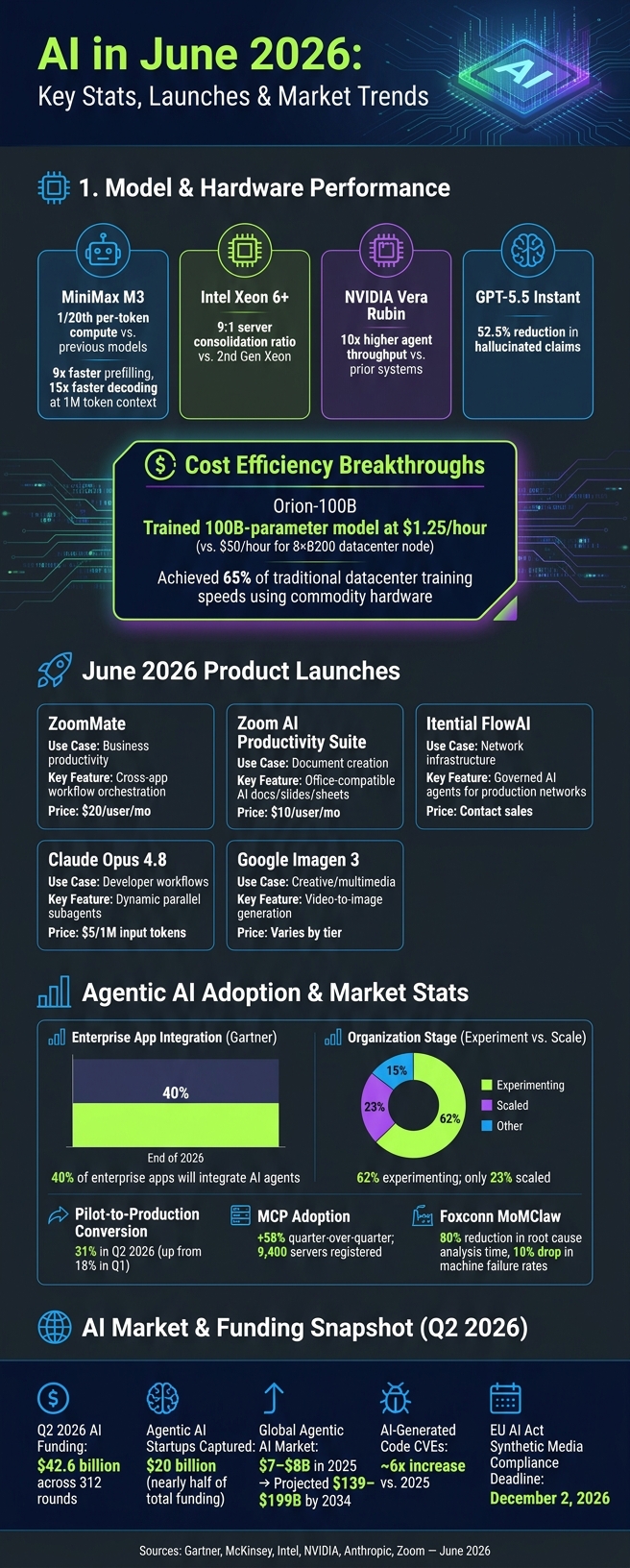
AI in June 2026: Key Stats, Launches & Market Trends
Major AI Advances in June 2026
Updates in Transformer and Multimodal Models
The MiniMax M3 model has taken multimodal AI to new heights. Built on the MiniMax Sparse Attention (MSA) architecture, it slashes per-token compute requirements to just 1/20th of previous models. With support for up to 1 million tokens, it delivers impressive speed gains - 9x faster prefilling and 15x faster decoding for 1M token contexts. This makes it a game-changer for processing massive datasets, codebases, or documents while keeping compute costs in check.
On the hardware front, NVIDIA Cosmos 3 unveiled what it calls the first fully open "omnimodel" for physical AI. By integrating vision reasoning, world simulation, and action generation into a single mixture-of-transformers architecture, this development represents a significant leap forward in AI's ability to interact with and understand the physical world.
Together, these advancements are paving the way for groundbreaking applications, particularly in science and healthcare.
AI in Science and Healthcare
These technical strides are already making waves in healthcare and scientific research. For instance, Tempus, a clinical AI firm based in Chicago, has upgraded its Lens platform to leverage agentic AI in oncology drug development. This shift allows the platform to go beyond simple data retrieval, enabling autonomous, multi-step workflows that streamline research.
In surgical training, NVIDIA Cosmos 3’s simulation capabilities are being used to create synthetic videos of rare medical scenarios, offering surgical robots access to training data that would be almost impossible to gather in real-world clinical environments. At the same time, enhanced hardware platforms like NVIDIA's Vera Rubin and Intel's Xeon 6+ are ushering in new possibilities for secure healthcare data processing. These platforms now feature Confidential Computing at rack scale, which allows U.S. healthcare providers to handle sensitive patient data securely without compromising performance. The Vera Rubin platform, in particular, achieves 10x higher agent throughput compared to earlier systems.
Infrastructure and Cost Improvements
June 2026 also brought significant cost reductions in AI training and operations. Intel's Xeon 6+, launched on June 1, offers a 9:1 server consolidation ratio compared to 2nd Gen Xeon processors. This means businesses can accomplish more with fewer servers, translating into major savings. Summing up this shift, Intel's EVP Kevork Kechichian explained:
"As AI becomes more agentic, the constraints shift to orchestration, concurrency, and data movement. That shift reinforces a core reality: the CPU remains the control plane for the modern AI infrastructure."
For smaller players, the Orion-100B project has proven that cutting-edge AI training doesn’t have to break the bank. By training a 100-billion-parameter model across 16 pipeline-parallel stages using commodity hardware and the open internet, the project achieved 65% of traditional datacenter training speeds. Even more impressive? It did so at a cost of just $1.25 per hour, compared to the $50 per hour typical of an 8×B200 datacenter node.
sbb-itb-212c9ea
AI Product Launches and Updates from June 2026
Agentic AI Platforms for Business
June 2026 saw a noticeable shift in AI tools toward active, workflow-driven solutions. Two standout products highlight this trend.
Zoom introduced ZoomMate on June 1, 2026, priced at $20 per user per month. This tool integrates directly into live meetings, connecting decisions made during discussions with platforms like Salesforce, Jira, ServiceNow, and Slack. Its standout "Complete" feature transforms meeting notes into polished documents or presentations automatically. As Russell Dicker, Zoom's Chief Product Officer, explained:
"Before, during, and after the meeting, ZoomMate connects what was decided to what needs to happen next across every system where your work lives."
Also launching on June 1 was Itential FlowAI, designed for IT and infrastructure teams. This platform allows users to deploy AI agents, known as FlowAgents, capable of reasoning and acting on live production networks. Built-in governance ensures that no irreversible changes occur without oversight. Greg Freeman, VP of Network and Customer Transformation at Lumen, shared his experience:
"When you're operating infrastructure at Lumen's scale, the question was never whether AI could help – it was whether we could trust it in production and Itential's FlowAI answered that."
Melody Brue, VP and Principal Analyst at Moor Insights & Strategy, summarized the broader trend:
"The market is moving away from isolated AI helpers and toward tools that can better connect decisions, data, and workflows across an organization."
These developments signal a growing focus on tailored, workflow-integrated AI solutions for various professional domains.
Developer and Coding Tools
AI tools for developers are advancing automation capabilities in groundbreaking ways. For instance, Anthropic's Claude Opus 4.8, updated on May 28, 2026, introduced dynamic workflows. These workflows automatically generate orchestration scripts and deploy multiple subagents for complex tasks. By activating the ultracode setting, developers can tackle large-scale projects like codebase migrations or security audits with ease.
Developer Jarred Sumner demonstrated the power of this update by using dynamic workflows to migrate the Bun runtime from Zig to Rust, covering 750,000 lines of code in just 11 days, with a 99.8% test suite pass rate. Ken Takao, Lead Systems Engineer, highlighted the practical benefits:
"Dynamic workflows fill the gap between firing off a single subagent and building out a full agent team. Plan to implementation just flows, so we can trust longer runs without losing visibility."
Claude Opus 4.8 also improves reliability, being 4 times less likely than its predecessor to miss flawed code during automated reviews. This makes it a valuable upgrade for teams prioritizing code quality.
Creative and Multimedia Tools
On the creative front, Google's Imagen 3 Nano and Pro models became widely available in June 2026. These tools use video files as prompts to create context-aware images, such as thumbnails and infographics. This feature streamlines workflows for content teams looking to extract visual assets directly from video materials.
WPP integrated Imagen 3 into its "WPP Open" marketing platform, enabling global clients like Verizon, L'Oreal, and Unilever to scale content production. Similarly, Shopify introduced the technology to its merchants, helping them expand product photography and generate high-quality lifestyle imagery for their catalogs. These updates highlight how AI is reshaping content creation for marketing and retail.
Business Productivity and Support Tools
Zoom expanded its offerings with two new solutions: ZoomMate and the AI Productivity Suite, priced at $10 per user per month (bundled with ZoomMate). The suite includes Zoom Canvas, Zoom Slides, Zoom Sheets, and Zoom Paper, all of which are compatible with standard Microsoft Office formats (.docx, .pptx, .xlsx). For U.S.-based enterprise teams, this compatibility eases the transition to new tools while maintaining existing workflows.
Here's a snapshot of the key June 2026 launches:
| Tool | Primary Use Case | Key Feature | Starting Price |
|---|---|---|---|
| ZoomMate | Business productivity | Cross-app workflow orchestration | $20/user/mo |
| Zoom AI Productivity Suite | Document creation | Office-compatible AI docs/slides/sheets | $10/user/mo |
| Itential FlowAI | Network infrastructure | Governed AI agents for production networks | Contact sales |
| Claude Opus 4.8 | Developer workflows | Dynamic parallel subagents | $5/1M input tokens |
| Google Imagen 3 | Creative/multimedia | Video-to-image generation | Varies by tier |
Together, these launches showcase how AI tools are evolving to meet the diverse needs of businesses across industries.
AI Trends to Watch for the Rest of 2026
The Shift Toward Agentic AI and Autonomous Workflows
AI has evolved from being a passive tool to becoming an active participant in workflows. Recent developments highlight this shift, with autonomous agents now capable of managing and executing multi-step tasks without human intervention. This year, the focus has shifted from single-task tools to systems that operate independently, completing complex workflows end-to-end.
According to Gartner, 40% of enterprise applications will integrate AI agents by the end of 2026, while McKinsey reports that although 62% of organizations are experimenting with agents, only 23% have scaled them. This gap between testing and scaling is where much of the action is expected in the coming months.
A standout example of agentic AI in action is Foxconn's "MoMClaw", launched in June 2026. Built on Nvidia's FOX blueprint, this multi-agent manufacturing system links machine sensors to hundreds of coordinating agents. The results? An 80% reduction in root cause analysis time and a 10% drop in machine failure rates.
As one CTO from a SaaS company observed:
"We thought 2025 was the agentic year. It was the rehearsal. Q2 2026 is when the curtain went up."
While these advancements are exciting, they also bring challenges in governance and security.
AI Governance, Security, and Trust
As AI systems become more autonomous, the risks associated with them grow. In May 2026, prompt injection attacks were officially classified as a CVE (Common Vulnerabilities and Exposures) category, with examples like CVE-2026-25592 demonstrating the potential for Remote Code Execution on agent hosts. By mid-year, the number of CVEs linked to AI-generated code had increased nearly sixfold compared to 2025.
On the regulatory front, the EU AI Act Omnibus reached a key milestone on May 7, 2026. While audits for high-risk systems were postponed to December 2027, synthetic media transparency requirements were accelerated to December 2, 2026. U.S. companies producing AI-generated images, voice, or video for European audiences must ensure compliance with C2PA watermarking standards before this deadline.
Roey Eliyahu, CEO of Salt Security, addressed the issue succinctly:
"AI is writing code faster than organizations can govern it... Salt Code changes the equation. For the first time, security policy travels with the code itself."
For teams using agents that combine data retrieval with tool integration, immediate action is necessary. Audit these systems now, and implement measures like argument allowlists and sandboxed environments before moving to production.
Scaling AI in Production Environments
The push to scale AI systems from pilot projects to full production is accelerating. In Q2 2026, the pilot-to-production conversion rate reached 31%, almost doubling the 18% recorded in Q1. This rapid scaling is supported by increasingly standardized infrastructure.
The Model Context Protocol (MCP) has emerged as a key standard for connecting AI agents with external tools and data. MCP adoption grew 58% quarter-over-quarter, with 9,400 servers now registered. For engineering teams, MCP significantly reduces integration time and avoids vendor lock-in, making it easier to manage growing tool stacks.
On the hardware side, CPUs are reclaiming their role as the central control hub for agentic systems, handling orchestration and data movement. Meanwhile, GPUs remain essential for heavy inference workloads. Kevork Kechichian of Intel summed it up well:
"AI doesn't scale as a collection of parts - it scales as a coordinated system."
Market and Economic Signals
The financial landscape reflects this shift toward autonomous systems. In Q2 2026, AI funding hit $42.6 billion across 312 rounds, with startups focused on agentic systems capturing $20 billion - nearly half of the total. Investors are clearly betting on the infrastructure that supports autonomous workflows as the next big thing in enterprise software.
The global market for agentic AI is expected to grow from $7–$8 billion in 2025 to between $139–$199 billion by 2034. For startups and investors, the opportunity to establish a foothold in this space is now. But as an internal memo from April 2026 warned:
"The model layer is approaching commodity faster than anyone's pricing model assumed. The differentiation has moved up the stack."
For U.S. businesses, the focus must shift to integrating workflows, data, and agents to move quickly from experimentation to full-scale production.
How AI Apps Helps You Keep Up with AI Trends
Keeping up with the pace of AI development in June 2026 can feel like a full-time job. New models, agent-driven platforms, and developer tools are rolling out every week, making it tough to figure out what's worth your time. AI Apps simplifies this process by offering a centralized directory where you can discover and evaluate tools that actually matter. Here's how it helps streamline everything from discovery to confident decision-making.
Discover AI Tools in One Place
With AI evolving so quickly, having a single, organized directory is a game-changer. AI Apps compiles 2,058+ AI tools - all neatly categorized into 9 main areas and 17 industries. Whether you're a software developer searching for coding assistants, a marketer exploring creative solutions, or a financial advisor looking into automation platforms, the directory lets you filter tools by your profession and use case. This targeted approach saves you from endlessly scrolling through generic lists and helps you act on trends faster.
Stay Updated on New and Popular Tools
AI Apps keeps you in the loop with its "Just Landed" section, which is updated weekly to showcase the latest arrivals. The "Trending" section highlights tools gaining momentum based on community saves and upvotes. Want to know what’s genuinely catching on? The "Most Popular" list ranks tools based on their Google search traffic over the past three months, providing a clear picture of what users are actively adopting - not just what's being hyped.
Evaluate Tools with Confidence
Not every shiny new tool is production-ready. To help you avoid wasting time, AI Apps uses a AI tool selection checklist. Tools that pass this credibility check earn a "Verified" badge, so you can quickly identify reliable options for critical workflows. When stakes are high, that badge can save you from unnecessary headaches.
Connect Trends to the Right Tools
AI Apps doesn’t just list tools - it organizes them by emerging trends. Whether it’s agent-driven AI (with 751+ business tools) or multimodal content creators, you can easily find solutions that match the latest industry shifts. The platform bridges the gap between reading about trends and actually applying them, making it easier to stay ahead in a fast-moving field.
Key Takeaways from June 2026 AI Developments
June 2026 marked a major shift in how AI is perceived and utilized, transforming it from a passive tool into an active, integrated system. One standout example is ZoomMate, which debuted at $20 per user per month. This service goes beyond simple communication by converting live conversations into actionable deliverables, such as presentations and spreadsheets. This reflects a broader market trend favoring integrated AI solutions over standalone tools.
Beyond these product advancements, significant improvements in AI models and infrastructure have pushed the boundaries of performance and affordability. For instance, MiniMax M3 introduced a sparse attention architecture, while GPT-5.5 Instant achieved a 52.5% reduction in hallucinated claims. Meanwhile, Intel Xeon 6+ delivered a 9:1 server consolidation ratio, underscoring gains in efficiency and reliability. On the business side, Anthropic's confidential S-1 filing with the SEC signals growing financial stakes in the AI sector. Together, these developments are shaping how businesses will operate with AI in the future.
The message is clear: teams that fail to adapt to these advancements risk falling behind. Understanding which tools are best suited for specific tasks is now essential, especially with older models like GPT-4.5 scheduled for retirement on June 27, 2026. These rapid changes demand that leaders stay proactive, aligning their workflows with the evolving AI landscape to remain competitive.
FAQs
Which June 2026 AI update matters most for my business?
The most relevant AI update will hinge on your specific business goals:
- Looking to streamline workflows? ZoomMate connects meeting insights with tools like Salesforce and Jira for seamless integration.
- Need a budget-friendly AI solution? Google's Gemini 3.5 Flash delivers high performance at just $0.10 per million tokens.
- Want around-the-clock task automation? Gemini Spark operates as a virtual team member within Google Workspace, handling tasks autonomously.
How can I adopt AI agents without new security risks?
To integrate AI agents securely, consider using a Zero Trust approach, which involves verifying every interaction and command. Regularly audit your tools to ensure they include explicit argument allowlists and operate within sandbox environments that enforce strict privilege limits. Implement the least privilege principle by restricting agents' access to sensitive data whenever possible. For critical actions, incorporate out-of-band verification to add an extra layer of security. Additionally, thoroughly scan all components - such as models and plugins - for vulnerabilities before deploying them.
What does the EU synthetic media deadline mean for U.S. teams?
The EU AI Act introduces new rules that U.S. teams offering products or services in Europe need to prepare for. Starting August 2, 2026, anyone deploying AI-generated content or deepfakes must clearly inform users about their synthetic nature. This means transparency will be key for compliance.
Additionally, by December 2, 2026, providers of AI systems must embed machine-readable watermarks into pre-existing models. For U.S. deployers, focusing on human-readable labels and disclaimers will be essential to align with the Act’s transparency standards. These steps ensure users are fully aware when interacting with AI-generated content.