Digital Transformation
Claude Fable 5: What to Know About the Powerful New AI
Multimodal AI with a 1M-token context window, advanced reasoning, autonomy, and enterprise integrations for coding and knowledge work.

Claude Fable 5: What to Know About the Powerful New AI
Claude Fable 5 is Anthropic's most advanced AI model, designed for tackling complex knowledge work and coding tasks. It introduces a 1 million token context window (handling 750,000 words at once), NVIDIA GB200 Blackwell Ultra GPUs for better training efficiency, and features like autonomous task execution and multimodal input support. Key improvements include:
- Long-context understanding: Processes entire codebases, extensive documents, or months of data in one prompt.
- Advanced reasoning: Handles intricate tasks with self-correcting capabilities and long-term autonomy.
- Multimodal capabilities: Supports text, images, and even interacts with on-screen elements.
- Enhanced safety: Operates with a 23,000-word ethical framework to ensure responsible use.
It’s ideal for entrepreneurs, developers, writers, and researchers managing large-scale or precision-demanding tasks. Available via claude.ai, desktop apps, or API, pricing starts at $20/month for Pro plans. Claude Fable 5 integrates seamlessly with tools like Slack, Google Drive, and GitHub, making it a powerful tool for automating workflows and improving productivity. You can also explore other AI automation tools to further optimize your operations.
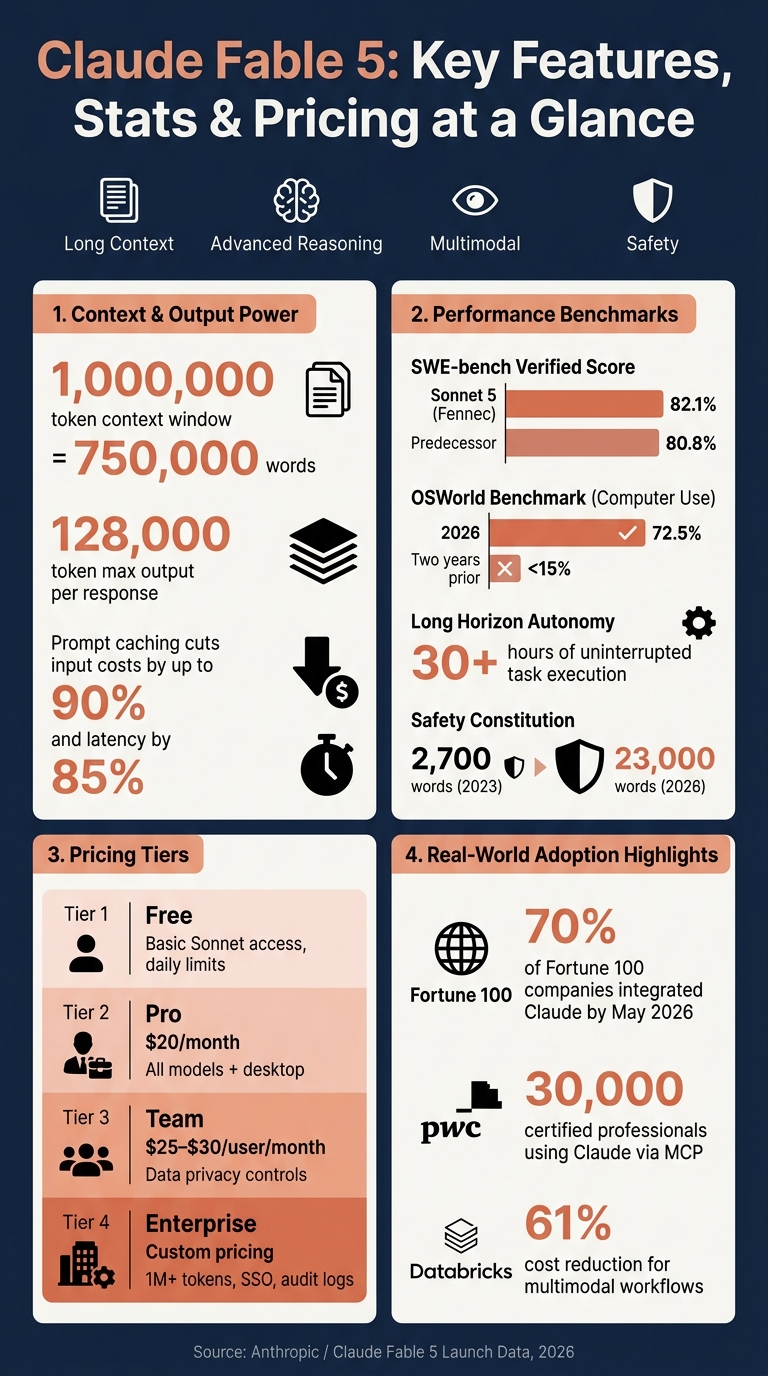
Claude Fable 5: Key Features, Stats & Pricing at a Glance
Key Features and Improvements
Long-Context Understanding
Fable 5 introduces a game-changing 1 million token context window, enabling it to handle entire mid-sized projects in a single prompt. To put this into perspective, that's about 750,000 words - enough to process a mid-sized codebase, a quarter's worth of customer interviews, or 18 months of business data in one go.
"The 1M-token context window means full-codebase audits, full-book editorial passes, and full-deal-room due diligence in one prompt." - Sid Saladi, The Product Channel
The model also supports a 128,000-token output limit per response, making it capable of generating lengthy documents like a 50,000-word strategy report or a complete code module without cutting off mid-task. Additionally, prompt caching can slash input costs by up to 90%, making it more economical when reusing large document contexts repeatedly.
Advanced Reasoning and Autonomous Task Handling
Fable 5 takes task execution to the next level with enhanced reasoning capabilities. Its Adaptive Thinking feature gauges the complexity of a problem and adjusts its reasoning speed accordingly. Simple lookups are handled swiftly, while more intricate tasks like debugging are approached with deeper focus. Developers can activate this feature using the thinking: {type: 'adaptive'} API parameter.
The model’s Long Horizon Autonomy allows it to stay focused on a single, complex task for over 30 hours without needing human intervention. Meanwhile, Progressive Context Compaction ensures it doesn’t lose track of earlier decisions in long-term projects by summarizing older parts of the conversation. On the technical side, Fable 5 has achieved an 82.1% score on SWE-bench Verified, outperforming the Claude 3.5 Sonnet score of 80.8%.
Multimodal Capabilities
Fable 5 goes beyond text by incorporating multimodal inputs, broadening its range of applications. It can analyze images up to 2,576 pixels, making it effective for tasks like interpreting financial dashboards, annotated wireframes, and scanned documents. Its Computer Use feature is another leap forward, allowing the model to interact with on-screen elements like moving cursors, clicking buttons, and typing. This improvement is reflected in its 72.5% OSWorld benchmark score as of 2026, a significant jump from under 15% just two years earlier. This functionality is especially handy for automating workflows in older software systems that lack modern APIs.
For non-technical users, the Claude Cowork desktop agent simplifies tasks. By describing a task in plain English - like extracting data from PDFs into a spreadsheet - users can let Fable 5 handle the work autonomously.
Built-In Safety and Guardrails
Anthropic has expanded Fable 5's ethical framework significantly. The model’s internal "Constitution", which governs its approach to safety and ethics, has grown from 2,700 words in 2023 to a robust 23,000 words in 2026. This ensures the model operates responsibly, particularly in sensitive fields like finance and healthcare. It’s designed to flag uncertainties rather than proceed with potentially incorrect answers, adding an extra layer of reliability.
For businesses using Fable 5 in sensitive environments, Anthropic advises running the AI in a sandboxed, isolated browser profile to keep its workspace separate from personal or confidential accounts. The expanded guardrails also enable the model to recognize tasks that fall outside safe boundaries, escalating them for human review instead of proceeding unchecked. These measures make it a dependable choice for both business and creative applications in the US.
sbb-itb-212c9ea
How US Businesses and Creators Can Use Claude Fable 5
Enterprise Knowledge Work
The introduction of a 1-million-token context window isn't just a technical feat - it’s a game-changer for teams dealing with complex, knowledge-heavy tasks. Imagine legal teams uploading an entire room's worth of contracts into one prompt. They can then ask Claude to identify contradictions, highlight missing clauses, or break down obligations by party. Similarly, financial analysts can seamlessly cross-reference annual reports with earnings call transcripts, saving time and improving accuracy.
Take PwC, for example. By May 2026, they had 30,000 certified professionals leveraging Claude through the Model Context Protocol (MCP) to handle intricate deals and streamline professional service workflows. Meanwhile, Bridgewater Associates relied on Claude Opus 4.8 for high-stakes financial analysis. What stood out most? Its self-awareness.
"Opus 4.8's tendency to proactively flag issues with the inputs and outputs of an analysis was the key differentiator. When one of the world's largest hedge funds says a reasoning model's most valuable feature is that it tells you when it doesn't know something, you pay attention." - Priya Sundaram, AI Platform Analyst, TechSifted
For US enterprises managing sensitive data, this kind of transparency - where the model openly admits uncertainty rather than guessing - acts as a safeguard. It also shines in technical workflows, equipping enterprise teams to tackle coding and automation challenges with confidence.
Software Development and Automation
Claude Fable 5 takes software development and automation to the next level. For engineering teams, it’s like having a seasoned developer who can juggle an entire codebase without dropping context. Its 82.1% SWE-bench Verified score for Sonnet 5 "Fennec" demonstrates its ability to handle large-scale tasks like codebase migrations, multi-file refactoring, and security audits with ease.
Cursor, an AI-powered code editor, tested Claude Opus 4.8 on its internal "CursorBench" benchmark in May 2026. They found that the model completed end-to-end coding tasks faster and with better tool usage. Similarly, Databricks reported a 61% cost reduction for multimodal workflows after integrating Opus 4.8, compared to its predecessor Opus 4.7. For DevOps teams managing high-frequency tasks, a cost-effective strategy involves routing simpler jobs to Haiku 4.5 at $1 per million tokens, while reserving Opus for more complex reasoning.
Customer Support and Back-Office Operations
Fable 5 simplifies the repetitive tasks that often bog down operations. Its Claude Dispatch feature automates recurring browser-based workflows like weekly invoice extraction, expense tracking, or pulling data from vendor portals - no custom scripts required.
Beyond its strengths in knowledge work and software development, Fable 5 also boosts efficiency in customer support and back-office functions. Block (formerly Square) implemented Claude in early 2026 to power AI-driven checkout flows and sales intelligence. For support teams, MCP integrations with tools like Slack, Jira, and GitHub allow Claude to triage tickets, pull up relevant histories, draft responses, and log resolutions - all within the platforms teams already know. By May 2026, 70% of Fortune 100 companies had integrated Claude into their workflows.
How to Get Started with Claude Fable 5
Accessing the Platform
You can access Claude Fable 5 through claude.ai or via console.anthropic.com if you need API access. For the full experience, including advanced features, download the desktop app, which is available for both macOS and Windows users.
The pricing model is simple:
- The Free tier provides basic access to Sonnet models with daily usage limits.
- The Pro plan, priced at $20/month, unlocks all models and desktop functionality.
- Team plans cost $25–$30 per user, per month, and include features like keeping your data out of model training.
- For larger needs, Enterprise plans come with custom pricing and perks like a 1 million+ token context window, SSO, and audit logs.
Once you're set up, make sure to enable Memory and Tool Access under Settings → Capabilities. This allows Claude to retain your preferences across sessions.
"Memory is how Claude improves over time without you re-explaining your context in every session." - Reid Johnston, CITO and Teal Cofounder
Next, create a Project, which acts as a dedicated workspace for storing resources like brand guidelines, style documents, or codebase files. Any conversation within that Project automatically inherits these instructions, making it a great tool for teams aiming for consistency.
After setting up, the next step is learning how to write effective prompts to make the most of Claude Fable 5.
Writing Effective Prompts
To get better results, focus on structuring your prompts clearly. Use XML tags (like <context>, <task>, <format>) to separate instructions from data. This approach helps Claude handle complex inputs more effectively, especially when working with lengthy documents or mixed data types.
For tasks you perform regularly, try few-shot prompting by including 2–3 examples. If you're tackling problems that require deeper reasoning, enable Extended Thinking mode and ask Claude to "think step-by-step" before providing a response.
Another tip: Ask Claude to challenge your assumptions. This transforms the model into a more interactive collaborator rather than just an agreeable assistant. For users handling high-volume API tasks, prompt caching can significantly reduce costs - by up to 90% - and cut latency by 85% for repeated prompts or large documents.
These strategies not only improve your interactions with Claude but also make it easier to integrate the tool into your business systems.
Connecting Claude Fable 5 to Business Systems
Claude Fable 5 integrates seamlessly with your existing tools using the Model Context Protocol (MCP). This protocol acts as a universal adapter, allowing you to connect Claude to platforms like Slack, GitHub, Google Drive, HubSpot, and even internal databases.
"MCP is quickly becoming the backbone of serious enterprise AI deployment." - Sanjeev Patel, Tech Analyst
For developers, Claude Code works with VS Code and JetBrains, enabling the model to edit files, run tests, and even commit changes to Git autonomously. If you're working on non-technical tasks, the Cowork desktop interface links directly to local folders, including OneDrive and Google Drive, so Claude can access files without requiring manual uploads.
Enterprise users gain access to native connectors for platforms like Microsoft 365, Salesforce, Asana, and monday.com, all of which can be managed directly in the settings menu. For large-scale operations, the Batch API offers a 50% discount on processing costs, making it a budget-friendly option for automating high-volume tasks.
Conclusion and Key Takeaways
Final Insights
Claude Fable 5 is making waves in how US enterprises and creators approach AI. With the ability to handle up to 5 million tokens of context, operate autonomously for over 30 hours, and integrate seamlessly with various applications through the Model Context Protocol (MCP), it’s proving to be a game-changer. Early users have reported reduced costs and improved operational efficiency, signaling a clear shift toward AI-powered processes.
What sets Claude Fable 5 apart is its thoughtful balance of scale, safety, and integration. Features like self-correcting loops, strong AI guardrails, and transparent reasoning make it suitable even for industries with strict regulations, such as finance and law. These capabilities empower businesses to achieve higher productivity while maintaining secure and scalable operations.
This foundation paves the way for exploring how Claude Fable 5 can fit into your own workflows.
Next Steps
If you’re ready to tap into the potential of Claude Fable 5, start with a specific, high-impact use case. It could be automating routine reports, refining code reviews, or simplifying customer support processes. Build a project tailored to this workflow, using your relevant documents and guidelines as a foundation. Then, take advantage of MCP connectors to integrate Claude with tools your team already uses - like Google Drive, Slack, or internal databases. With these connections in place, you’ll be well-positioned to begin transforming your chosen workflow.
Claude Opus 4.8 Review: New Demos You Need to See
FAQs
What should I include in a 1M-token prompt for the best results?
With a context window of 1 million tokens, you can handle massive datasets like entire codebases, whole books, or large-scale customer data without needing to break them into smaller pieces. To maximize its potential, give detailed, context-rich instructions and target broad tasks like cross-file audits, thorough editing, or spotting inconsistencies across extensive datasets. This expansive attention span allows for seamless synthesis, auditing, or refactoring across all the content you provide.
How do I safely use autonomous “Computer Use” in my business workflows?
To ensure safe use of autonomous computer systems, prioritize agent reliability by implementing an iterative reflection process. This involves having the agent pause periodically to review its progress and make step-by-step adjustments to its plans.
For handling more complex tasks, consider using dynamic workflows that incorporate parallel subagents. These subagents can cross-check outputs against test suites, ensuring accuracy and consistency.
Risk management is also crucial. You can achieve this by calibrating the agent's reasoning depth using Effort Control. Additionally, permissions or context can be updated mid-task through the Messages API system prompts, allowing for greater flexibility and control during operations.
What’s the easiest way to connect Claude Fable 5 to Slack, Google Drive, or GitHub?
Using the built-in Connectors feature is straightforward. Start by opening the settings in the Claude interface. From there, navigate to Connectors and pick the service you want to link. Click Connect and follow the secure OAuth authentication process to authorize access. Once that's done, you can activate these connectors during your conversations, allowing you to fetch data or take actions directly within the chat - no need to switch between apps!