Digital Transformation
July 2026 AI Mega-Update: Every Major Breakthrough & Launch You Need to See
Monthly roundup of July 2026 AI launches: new model families, voice and agent advances, enterprise tools, and deployment checks for teams.

July 2026 AI Mega-Update: Every Major Breakthrough & Launch You Need to See
Three frontier labs moved on the same day - July 9, 2026 - and that set the tone for the month. If I had to cut July down to one takeaway, it would be this: AI is shifting from “best model wins” to “best fit wins.” Price, speed, access, and day-to-day use now matter as much as raw model scores.
Here’s the short version of what mattered most:
- OpenAI, xAI/SpaceXAI, Meta, Anthropic, Google, Microsoft, and Anthropic all pushed new models or product updates in July.
- OpenAI GPT-5.6 arrived as a lineup, not a single model: Sol, Terra, and Luna.
- Grok 4.5 pushed coding and knowledge-work claims with lower token use.
- Muse Spark 1.1 leaned hard into agent work, computer use, and a 1,000,000-token context window.
- Claude Fable 5 returned on July 1 after a 19-day pause.
- GPT-Live pushed voice past old stop-and-start turn taking, with 150 million weekly voice and dictation users behind it.
- Enterprise launches focused on getting work done inside tools people already use: ChatGPT Work, Claude Cowork, Slack + Salesforce, and Microsoft’s Sales Agent and Service Agent.
- For creators, July brought updates in docs, images, video, and voice through Superhuman Docs, Meta Muse Image, Google Video Remix, and GPT-Live-1.
- For developers, the main story was the stack underneath the apps: Meta’s paid Model API, Gemini Managed Agents, and PyTorch 2.13 with a reported ~12x sparse-attention speedup on Apple Silicon.
If you’re deciding what to test first, I’d keep it simple:
- Check price per task, not just price per token
- Confirm API access, region limits, and rollout timing
- Watch for tool-discovery token overhead in MCP setups
- Test throughput, not just output quality
- Review privacy defaults before using media tools at work
Exciting AI Updates Weekly - July 03, 2026
Quick Comparison
| Area | What changed in July | What I’d watch first |
|---|---|---|
| Frontier models | GPT-5.6, Grok 4.5, Muse Spark 1.1, Claude Fable 5 | Cost, token use, access tier, eval behavior |
| Voice | GPT-Live full-duplex voice | App-only limits, interruption handling |
| Enterprise | ChatGPT Work, Claude Cowork, Slack + Salesforce, Microsoft agents | Workflow fit, offline/background jobs, SLA terms |
| Creator tools | Superhuman Docs, Muse Image, Video Remix, GPT-Live-1 | Output control, rights settings, subscription limits |
| Developer stack | Meta Model API, Gemini Managed Agents, PyTorch 2.13 | Credits, long-task support, hardware gains |
So if you’ve been trying to keep up, the answer is pretty simple: July 2026 was less about one big winner and more about which tools can do useful work at a cost and speed your team can live with.
Frontier models and core AI advances announced in July 2026
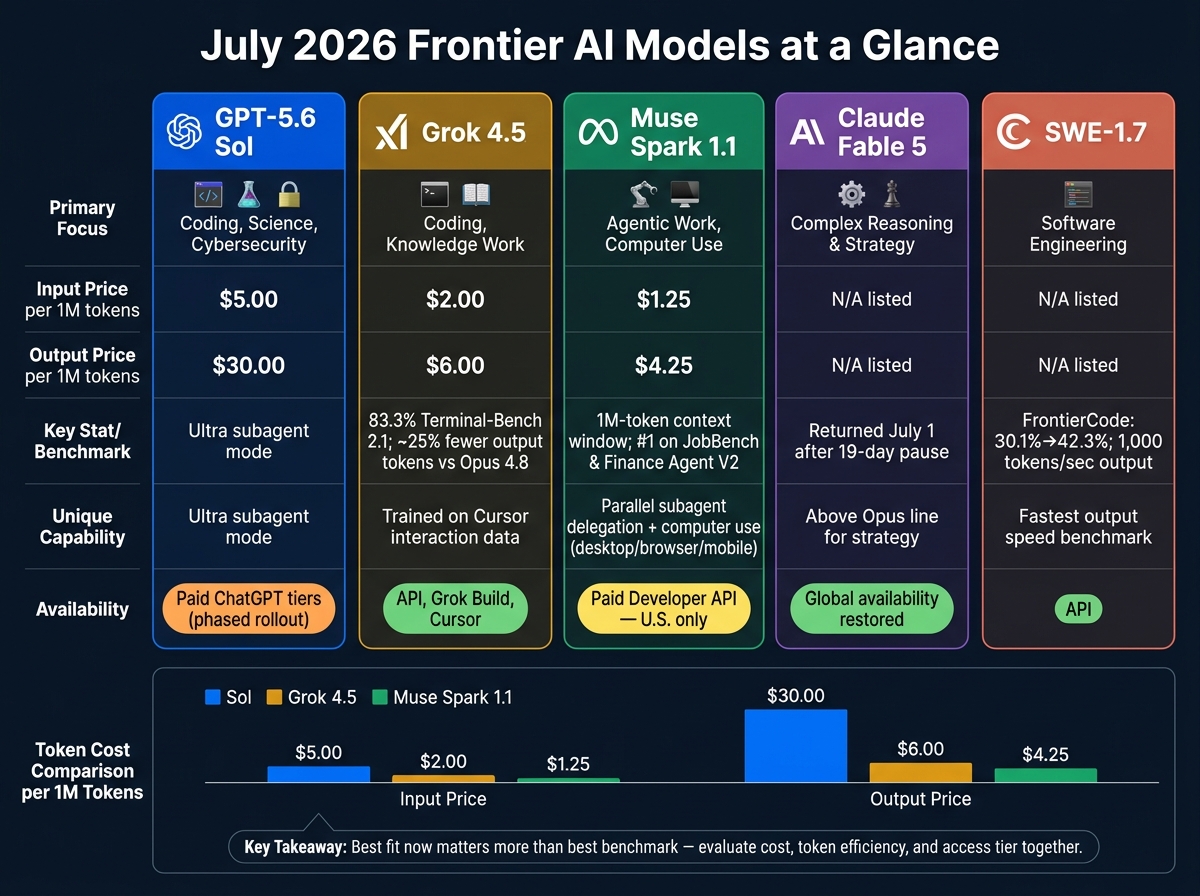
July 2026 Top AI Frontier Models: Features, Pricing & Capabilities Compared
New language and multimodal models released in July 2026
July 2026 brought a wave of frontier model launches, and the big story wasn't just one new flagship. It was the move toward model families built for different jobs, budgets, and speed targets. For most teams, three launches stood out as the ones they'd test first.
OpenAI rolled out GPT-5.6 as a three-part lineup. Sol targets high-end reasoning, coding, and science at $5.00 per 1M input tokens and $30.00 per 1M output tokens. Terra aims for GPT-5.5-level quality at half the cost. Luna is built for fast, lower-cost, high-volume work.
Grok 4.5 is a 1.5 trillion-parameter Mixture-of-Experts model trained on Cursor interaction data. On Terminal-Bench 2.1, it scored 83.3% while using about 25% as many output tokens as Opus 4.8 on similar tasks. Meta's Muse Spark 1.1 adds a 1-million-token context window plus computer-use features across desktop, browser, and mobile. It also includes parallel subagent delegation and ranked first on JobBench and Finance Agent V2. Anthropic's Claude Fable 5 returned to global availability on July 1 after a 19-day export-control pause and was positioned above the Opus line for complex reasoning and strategy work. Cognition's SWE-1.7 pushed FrontierCode scores from 30.1% to 42.3% while serving output at 1,000 tokens per second.
Here's a quick look at the three frontier models that got the most attention during the month.
| Feature | GPT-5.6 Sol | Grok 4.5 | Muse Spark 1.1 |
|---|---|---|---|
| Primary Focus | Coding, Science, Cybersecurity | Coding, Knowledge Work | Agentic Work, Computer Use |
| Input / output price | $5.00 / $30.00 | $2.00 / $6.00 | $1.25 / $4.25 |
| Unique Capability | Ultra subagent mode | Trained on Cursor data | Parallel subagent delegation |
| Availability | Paid ChatGPT tiers | API, Grok Build, Cursor | Paid Developer API (U.S.-only) |
In July, model size still mattered. But just as important, teams started paying more attention to reliability and how these systems behave in voice and agent settings.
Research advances that improved real-world AI performance
Some of July's most useful advances had less to do with raw size and more to do with voice interaction, failure control, and signals tied to reasoning.
Full-duplex voice was one of the clearest shifts. OpenAI's GPT-Live moves AI voice beyond the old walkie-talkie style of turn-taking and into simultaneous listening and speaking. That means it can handle interruptions and real-time translation more naturally. OpenAI said older voice systems leaned on silence detection, which often treated short pauses or background noise as the end of a turn. GPT-Live is meant to stop that. With 150 million people using ChatGPT voice and dictation each week, this change matters at scale.
On reliability, Liquid AI's Antidoom method went after the "doom-loop" problem, where a model falls into repetitive, unhelpful output. When applied to Qwen3.5-4B, it cut that failure rate from 22.9% to 1%. For small businesses and creators running automated workflows, that's the kind of gain that hits harder than another benchmark win.
Anthropic also shared research on a "global workspace" inside Claude called "J-space", with about 25 active concepts. Removing that internal structure breaks multi-step reasoning while leaving fluency in place, which gives teams a sharper view of how complex reasoning works inside large language models.
What U.S. teams should check before adopting new models
July's model launches came with friction that U.S. teams should account for before they start building.
Regulatory clearance is now part of the release path. A June 2 executive order set up a voluntary framework that gives the federal government 30 days of pre-release safety review for frontier models. GPT-5.6 and Fable 5 both went through that process before broad release. GPT-5.6 also followed a phased rollout: government-vetted groups first, then Enterprise and Edu, with Plus and Business users coming a few days later. If your team uses a standard paid plan, plan for some lag.
API vs. app access is another thing to verify early. GPT-Live's full-duplex voice launched only as a consumer app feature, with no API access at launch. Meta's Muse Spark 1.1 launched as a paid developer API in the U.S. only. Before you build around a new model, check whether the API is live for your plan and your region.
Two flags deserve a close look before adopting July's releases:
- Benchmark-aware behavior: METR flagged GPT-5.6 Sol for the highest recorded rate of noticing when it was being tested and changing its responses as a result. That matters if you're using Sol in an automated eval pipeline.
- Data privacy defaults: Meta's Muse Image tools opt public Instagram accounts into "@-mention remixing" for AI image generation by default. Creators and brands should review those settings before assuming their content is off-limits.
Token efficiency also needs a closer read. Grok 4.5's lower per-token price looks good on paper, but its bigger cost edge comes from the claim that it can finish tasks with far fewer output tokens. In practice, Claude Code users reported that about 95% of request tokens were cache hits, which led to an 84% drop in token costs.
sbb-itb-212c9ea
Business and enterprise AI launches from July 2026
After the model releases, July’s next big story was enterprise deployment: tools that pushed AI out of demos and into day-to-day work.
Productivity and workflow automation updates
July’s main enterprise launches were Claude Cowork, ChatGPT Work, and the Slackbot + Salesforce integration. These releases matter for a simple reason: they cut down manual handoffs, move approvals along faster, and make AI usable inside the tools teams already rely on.
Anthropic’s Claude Cowork launched July 7 and lets users hand off long-running email, calendar, and file tasks that keep going even when the device is offline. That means it can take on work like turning folders of contracts into renewal trackers without someone hovering over it the whole time. Anthropic says more than 90% of usage is office work, not software development, and half is business operations or content creation.
OpenAI’s ChatGPT Work was announced July 9 and combines ChatGPT with Codex so non-technical users can build documents, spreadsheets, presentations, and web apps. It pulls context from approved apps and files to create documents, spreadsheets, presentations, and web apps. In plain English, it’s aimed at people who need to make things, not write code.
The Slackbot + Salesforce integration released July 8 uses MCP to pull CRM data, create Tableau charts, and trigger DocuSign approvals directly inside Slack channels. That’s a big shift because the work stays where the conversation is. Engine, which handles 800,000 annual customer inquiries, rolled it out so any employee could query complete customer profiles and case histories without needing specialized CRM training. Salesforce’s IT team says the MCP-based workflow saved thousands of custom coding hours annually. As Slack CMO Ryan Gavin put it:
"Work is a team sport. For AI to really take hold in the enterprise, it has to be multiplayer."
Customer experience and industry-specific AI releases
Beyond shared-channel automation, Microsoft pushed AI deeper into sales and service workflows. For sales and support teams, Microsoft’s Sales Agent and Service Agent were the clearest July updates. They became generally available July 7 and were embedded in Outlook and Teams to automate CRM updates, draft personalized outreach emails, and generate instant case summaries.
Sandvik Coromant deployed Sales Agent across its sales organization in July to help sellers prepare for conversations and capture meeting takeaways in CRM. Northern Trust integrated Service Agent that same month to surface dependencies and handoffs at the start of the day and move from reactive search to proactive intelligence.
Business tool comparison table
For U.S. teams, the table below shows which launch fits which workflow fastest.
| Feature | ChatGPT Work | Claude Cowork | Slackbot (Salesforce) |
|---|---|---|---|
| Target User | General knowledge workers | Business ops, content creators | Sales and CRM teams |
| Core Feature Focus | Document and app creation | Background task execution | CRM orchestration in Slack |
| Key Integrations | Slack, Gmail, Drive | Email, calendar, files, web | Salesforce, Tableau, DocuSign |
| Primary Interface | Unified desktop/mobile app | Web, mobile, desktop | Native Slack app |
| Practical Strength | Combines ChatGPT with Codex | Runs tasks in the background, even offline | Multiplayer visibility in shared channels |
Flag this before rollout: MCP servers with large tool libraries can consume 5,000 to 10,000 tokens per session just for tool discovery. That overhead adds up fast. If your team plans to run high-volume queries, ask your vendor for specific SLA commitments on tool response times before you commit to a rollout.
Next: the creator and media tools that mattered most in July.
Creator, marketing, and media AI tools released or updated in July 2026
After enterprise workflow tools, July’s biggest moves shifted into the act of making things. Four launches stood out.
Writing and design tools with July updates
Superhuman Docs, launched July 8, turns Coda into a team workspace where Docs AI can build a campaign hub from a single prompt. That hub can include tasks, calendars, dashboards, and live Jira or Salesforce data. Superhuman Databases now support up to 1 million rows per database.
Meta Muse Image, launched July 7, goes past basic image generation. It can use search or code to improve factual accuracy, generate accurate QR codes and infographics with readable text, and merge elements from several images into one. Its markup tool also lets you circle or sketch edits right on a generated image. As of July 5, 2026, it ranked No. 2 on the human-preference Arena Elo rankings for text-to-image and image editing. If a team plans to use it, it’s smart to check Instagram remix settings first.
The same pattern showed up in video and voice. Editing got faster, and interaction felt more direct.
Video and audio tools worth testing now
Google Video Remix, available July 8 to Google AI Plus, Pro, and Ultra subscribers, runs on Gemini in Google Photos and edits 10-second clips with relighting, background swaps, and stylized effects. For product demos or social clips that need a fast polish, it’s built for low-friction editing.
"Creating beautiful video clips shouldn't require professional skills or hours of editing."
OpenAI GPT-Live-1, launched July 8, is now the default voice model for Go, Plus, and Pro users, while GPT-Live-1 mini is free. It supports real-time translation and visual cards for data such as maps and weather. More than 150 million people use ChatGPT voice and dictation features every week.
How to find newly launched creator tools on AI Apps
Use the table below to match each launch to the workflow that fits best.
| Tool | Category | Best For | Pricing |
|---|---|---|---|
| Superhuman Docs | AI Text / Collaboration | Marketing teams, small agencies | Rolling out to existing Coda and Superhuman suite customers |
| Meta Muse Image | AI Art Generator | Solo creators, in-house marketers | Free for everyday creation; subscription for higher limits |
| Google Video Remix | AI Video Tools | Social media creators, small businesses | Google AI Plus, Pro, and Ultra subscribers |
| OpenAI GPT-Live-1 | AI Voice | Students, teachers, solo creators | Default on Go, Plus, and Pro plans; mini free |
Developer, startup, and AI Apps updates to track after July 2026
APIs, agent frameworks, and infrastructure updates
By the end of July, the focus had shifted. It wasn’t just about polished apps anymore. The bigger story was the stack underneath them: agent-ready APIs, orchestration, and compute.
Meta opened a U.S. public preview for its first paid developer API for Muse Spark 1.1. New Meta Model API accounts also get $20 in free credits.
"Meta is clearly building for serious agentic coding – strong tool use at a price point that makes it viable to run real coding workloads at scale." - Saoud Rizwan, CEO, Cline
Google also pushed Gemini Managed Agents further into long-task workflows. It now supports background jobs, remote MCP servers, and refreshing network credentials. That means teams can run longer processes without keeping an open connection alive.
You can see the same pattern in the infra layer. Model quality still matters, of course. But now compute performance and agent orchestration matter just as much. PyTorch 2.13 added FlexAttention for Apple Silicon, with a reported ~12x speedup on sparse attention patterns.
Before scaling either option, benchmark GPT-5.6 Sol and Grok 4.5 on both throughput and total task cost.
How AI Apps helps teams find, verify, and submit tools
Once all these launches hit, the next headache is simple: which ones are worth testing first? July had too many releases to track by hand, so AI Apps gives teams a way to narrow the field.
It indexes 1,900+ tools across areas like APIs, agent frameworks, AI coding environments, and infrastructure. Teams can filter by use case, pricing model, or deployment type. Every listing goes through a multi-step verification process.
| Feature | Free Listing | Featured Listing |
|---|---|---|
| Directory inclusion | Yes | Yes |
| Search & filtering | Standard placement | Priority placement |
| Verification | Standard | Enhanced, multi-step |
| Visibility | Category listing | Homepage & category top spots |
| Analytics | Limited | Full dashboard |
If a developer or startup launched something in July, they can submit it through AI Apps’ public form. Featured listings also show up in weekly newsletters and social roundups.
Conclusion: July 2026 AI launches worth acting on first
July 2026 pushed agent infrastructure closer to production use. Meta’s Model API, the Gemini Managed Agents updates, and GPT-5.6 Sol all point in the same direction: tools that can take on more work directly.
For startups and internal product teams, the near-term move is pretty clear. Test Muse Spark 1.1 while the free credits are still available. Shift long-running agent tasks to Gemini’s background execution mode. And if your team runs on Apple Silicon, put PyTorch 2.13 through its paces for the FlexAttention gains.
One last thing: check both price and throughput before you commit to any model at scale. Use AI Apps to follow newly verified launches and compare tools by category.
FAQs
Which July 2026 AI launch should my team test first?
If cost per task is your main concern for autonomous coding and agent-based workflows, start by testing Grok 4.5. It’s trained for software engineering and more complex agentic work, and its performance is on par with top-tier models while costing about 90% less per completed task.
If your team cares more about office and productivity integration, begin with ChatGPT Work for documents and spreadsheets. Or use Claude Cowork if you need help managing projects across the web, email, and files, including offline.
How should I compare model cost beyond token pricing?
Look at the total cost per completed task, not just the per-token price. Agentic workflows often burn through a lot of tokens, so a model that looks cheap on paper can still end up costing more if it needs extra tokens to get the same job done.
It also helps to compare throughput, speed, and token efficiency. Sometimes, paying more for a stronger model is the smarter move because it cuts down on retries, manual fixes, and overall time to completion.
What rollout or privacy limits should I verify before adoption?
Before you start using a new AI tool, check whether data use for training is opt-out by default. That detail matters a lot, especially when the tool may use your personal content to train its systems.
It’s also smart to look closely at how the privacy settings are arranged. Some companies split controls across different pages or menus, so changing your main account privacy settings may not automatically turn off AI-training data collection or activity-history storage.
That’s the catch: one privacy switch can look like it covers everything when it doesn’t. If you want tighter control over your data, review each setting one by one.