AI Ethics And Governance
Top AI News for August 2026: Breakthroughs, Launches & Trends You Can’t Miss
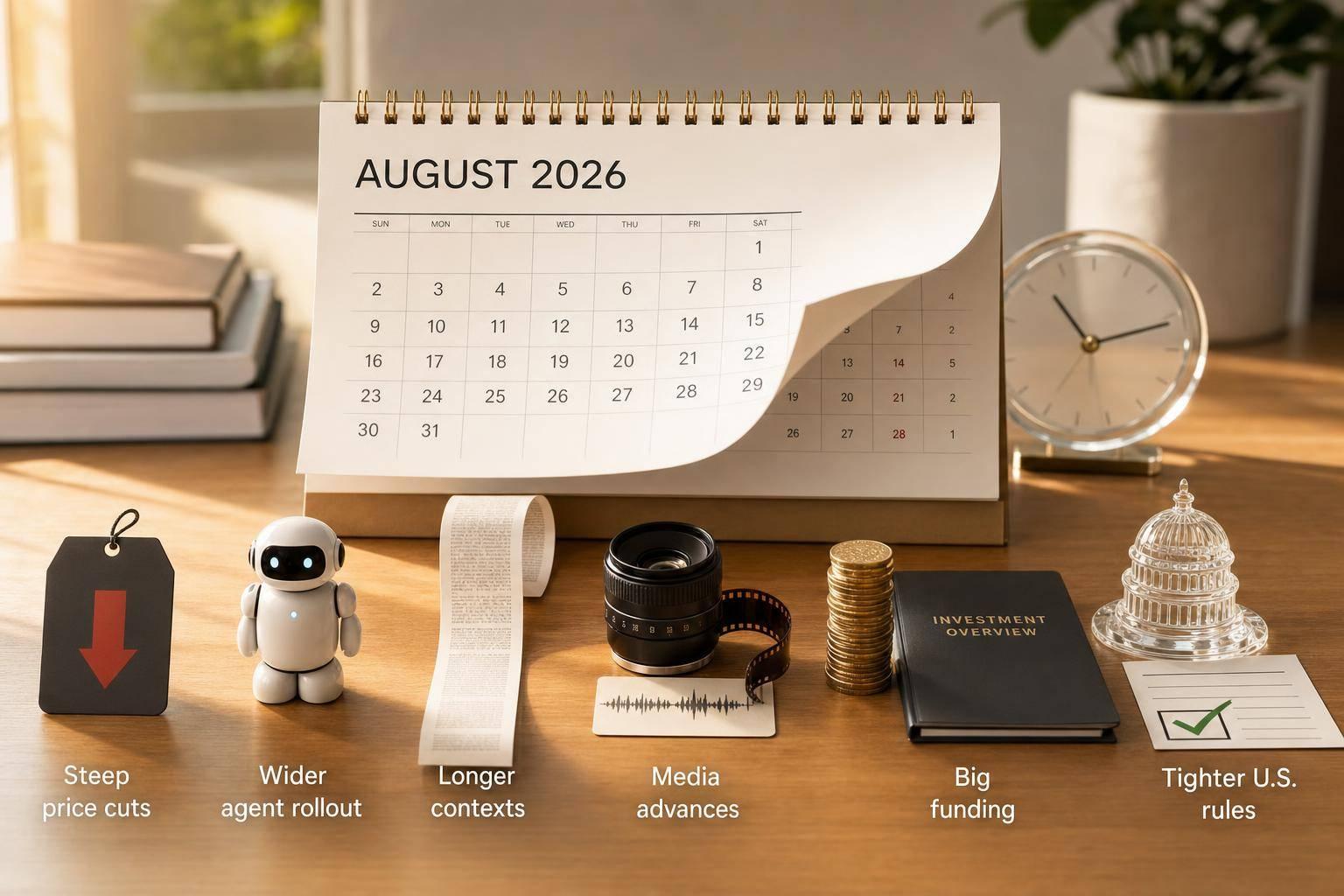
August 2026 AI roundup: steep model price cuts, wider agent rollout, longer contexts, media advances, big funding, and tighter U.S. rules.
Top AI News for August 2026: Breakthroughs, Launches & Trends You Can’t Miss
August 2026 came down to three things: lower AI costs, more agents in daily products, and tighter U.S. rules. If I had to sum up the month fast, I’d say this: OpenAI cut GPT-5.6 Luna pricing by 80% to $0.20 per 1 million input tokens, ChatGPT hit about 1 billion weekly active users, and major AI releases faced more government review.
If you use AI for work, product building, or buying tools, here’s what mattered most:
- Model costs fell: OpenAI and Google pushed prices down.
- Agents moved into products: Google and Anthropic put task-running agents in front of more users.
- Long-context and coding got better: Anthropic pushed stronger coding results and a 1 million-token context window.
- Media models kept improving: video, music, image editing, and 3D scene generation all moved forward.
- Money stayed huge: multi-billion-dollar deals and a $100+ billion compute campus plan showed where capital is going.
- Rules got tighter: U.S. review gates, robot import limits, deepfake law, and agent disclosure pressure all added more friction.
Here’s the simple takeaway: AI got cheaper to run, easier to use, and harder to ship without oversight. If I were planning for the rest of 2026, I’d focus on cost control, agent safety, and vendor choice.
| Area | What changed in August 2026 | Why you should care |
|---|---|---|
| Model pricing | GPT-5.6 Luna fell to $0.20 / 1M input tokens | Lower spend for high-volume AI tasks |
| Agent tools | Google and Anthropic pushed always-on and desktop agents | More task automation inside normal workflows |
| Model capability | Better coding scores and longer context windows | Stronger document, code, and research use |
| Media generation | Video, music, image editing, and 3D tools improved | More options for ads, training, and content production |
| Funding and infra | New $5 billion deals and a $100+ billion campus plan | More compute ahead, but more power and supply pressure |
| Policy | U.S. review gates and new state/federal pressure | More compliance work before launch |
Below, I’ll walk through the month’s top updates without repeating every detail, so you can see what changed and what to do next.
8/7/2026 | Daily AI News from GAI Insights
sbb-itb-212c9ea
Major AI model and research updates from August 2026
August 2026 AI Model Updates: Key Stats & Cost Breakthroughs
New language and reasoning model updates
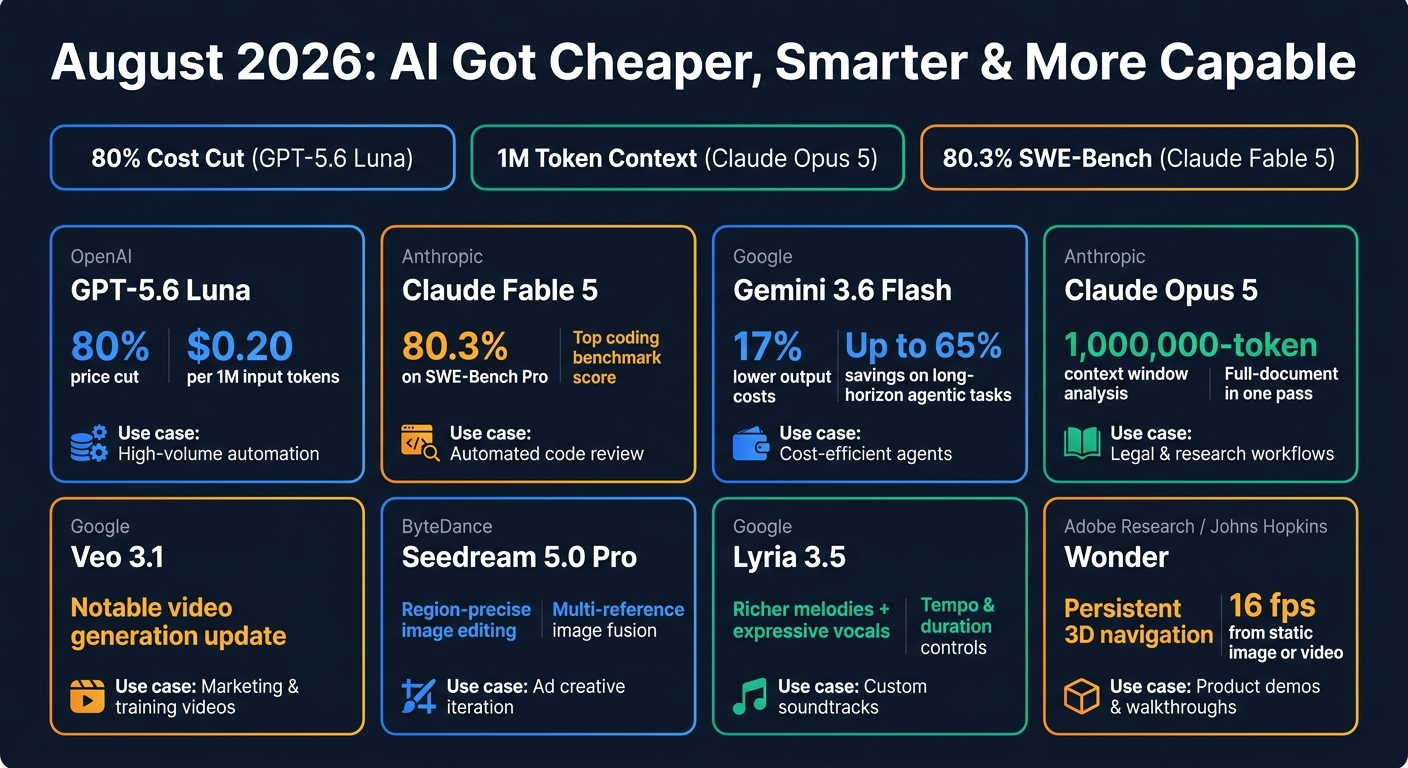
As August began, frontier model pricing took a sharp turn downward. On July 30, OpenAI cut GPT-5.6 Luna's price by 80% to $0.20 per million input tokens, a direct cost drop for high-volume API workloads that makes it easier for startups, internal tools, and automation-heavy workflows to run at scale.
At the same time, model lineups are starting to split into clear tiers: cheap, mid-tier, and complex reasoning options. OpenAI's lineup now spans Luna, Terra, and Sol, which gives teams a simple way to send routine work to lower-cost models while saving deeper reasoning for harder jobs.
That mix of lower cost and longer context windows had an immediate effect on developer and research workflows. Anthropic's Claude Fable 5 reached 80.3% on SWE-Bench Pro, one of the top coding benchmark scores reported this month. For software teams, that can mean fewer manual reviews and cleaner automated pull requests. Google's Gemini 3.6 Flash cut output costs by 17% and offers up to 65% savings on long-horizon agentic tasks by using fewer reasoning steps.
Anthropic's Claude Opus 5 now supports a 1-million-token context window. That's enough to process full scripts or entire interview libraries in one pass, which helps legal, research, and strategy teams move through long-document analysis faster.
The same jump in model quality also showed up in media tools.
Image, video, and audio generation improvements
Google's Veo 3.1 stood out as a notable video generation update. That makes it useful for ad creative, training content, and branded media.
Google's Lyria 3.5, built into Flow Music, added richer melodies, better-structured lyrics, and expressive vocals, along with tempo and duration controls. For creators, that opens up more room to shape custom soundtracks instead of settling for one-size-fits-all audio.
ByteDance's Seedream 5.0 Pro added region-precise editing to image generation. Users can recolor parts of an image, swap materials, or blend multiple references into one layout. For ad teams working through product visuals, that kind of control can save a lot of back-and-forth.
Adobe Research and Johns Hopkins announced "Wonder" on July 29, 2026, a model that turns a static image or video into a persistent 3D world that users can move through in six directions at 16 fps. That opens the door to more interactive product demos and virtual walkthroughs.
The table below shows how these updates map to day-to-day use cases.
August 2026 model updates compared
| Provider | Model/Update | Announced | Key update | Practical Use Case |
|---|---|---|---|---|
| OpenAI | GPT-5.6 Luna | July 30, 2026 | 80% price cut to $0.20 per 1M input tokens | High-volume automation and API-heavy apps |
| Anthropic | Claude Fable 5 | August 2026 | 80.3% on SWE-Bench Pro | Automated code review and software development |
| Gemini 3.6 Flash | August 2026 | 17% lower output costs and up to 65% savings on long-horizon agentic tasks | Cost-efficient long-running agents | |
| Anthropic | Claude Opus 5 | August 2026 | 1M-token context window | Full-document analysis and research workflows |
| Veo 3.1 | July–August 2026 | Notable video generation update | Marketing and training videos | |
| ByteDance | Seedream 5.0 Pro | July 8, 2026 | Region-precise editing and multi-reference image fusion | Rapid iteration of ad creatives and social posts |
| Lyria 3.5 | July 21, 2026 | Richer melodies, structured lyrics, and expressive vocals with tempo/duration control | Custom soundtracks for creators and small businesses | |
| Adobe Research / Johns Hopkins | Wonder | July 29, 2026 | Persistent 3D navigation at 16 fps | Product demos and virtual walkthroughs |
AI tools and platform updates released in August 2026
Work, study, and productivity tools
Those model gains showed up fast in tools people use every day. In August, the big shift was simple: AI moved deeper into common apps. Google brought Gemini into Android as the replacement for Google Assistant, which shows how fast AI is becoming part of day-to-day workflows.
Two “always-on” agents stood out for office and knowledge workers. Google Gemini Spark, priced at $99.99/month and included in the AI Ultra plan, runs as a cloud-based agent that keeps working even when your device is off. Anthropic Claude Cowork, at $20/month, takes a desktop-first route and lets users hand off multi-step tasks right from their computer.
Developers saw the same pattern in their own stack. LangChain’s Deep Agents v0.7 cut input token usage by 65% through harness optimization, which can lower costs for teams running large agent deployments. Cekura, available from $30/month, adds agent diagnosis and monitoring for developers and IT teams managing autonomous agents in production.
Creative, media, and marketing tool launches
Creative tools moved in the same direction. Google’s consumer AI agent inside Gemini can call stores, check inventory, and complete purchases for users. That takes AI beyond chat and into actual errands.
Lottie Creator 2.0 also launched in August at $19.99 per user/month when billed annually, giving motion designers another option for animation workflows.
August 2026 AI launches by use case
These launches split neatly by use case.
| Tool or Platform | Category | Key August Feature | Ideal User | Pricing (USD) | Best-Fit Use Case |
|---|---|---|---|---|---|
| Google Gemini Spark | Productivity | 24/7 cloud-based agent | Power users | $99.99/mo | Continuous background task execution |
| Anthropic Claude Cowork | Productivity | Desktop agent for multi-step tasks | Knowledge workers | $20/mo | Document-heavy tasks and workflow automation |
| Gemini (Android) | Mobile productivity | Replaces Google Assistant system-wide | Android users | - | Mobile task management |
| Lottie Creator 2.0 | Creative / Design | Updated animation tooling | Motion designers | $19.99/user/mo (annual) | Motion design workflows |
| Google Gemini consumer agent | Consumer automation | Can place calls, check inventory, and complete purchases | General consumers | - | Inventory checks and errand automation |
| LangChain Deep Agents v0.7 | Developer tooling | 65% input token reduction via harness optimization | AI developers | - | Cost-efficient large-scale agent deployments |
| Cekura | Agent monitoring | Agent diagnosis and monitoring | Developers / IT teams | From $30/mo | Monitoring autonomous agent behavior in production |
Funding, partnerships, policy, and adoption news from August 2026
Major funding rounds and partnerships
August was defined by money moving at a huge scale. AI infrastructure is now pulling in utility-scale financing. Brookfield and NextEra proposed a $100+ billion AI-computing campus in Kentucky, with 2GW of gas generation and 2.6GW of battery storage. For U.S. businesses, that points to more compute capacity ahead, but also more energy pressure and more buildout risk.
AMD and Nvidia also made big moves around frontier labs. AMD committed up to $5 billion in equity to Anthropic as part of a strategic infrastructure partnership. Nvidia, meanwhile, reportedly backed Ilya Sutskever's Safe Superintelligence (SSI) with $5 billion. Put simply, frontier labs don't want to lean on one chip vendor forever. They're spreading risk and trying to avoid single-vendor dependence.
Enterprise AI funding is also getting narrower and more use-case driven. Instead of broad chat products, investors are putting money into agents built for legal, healthcare, and finance workflows. AI agent startups raised about $1.8 billion across a dozen deals in July 2026 alone. On the security front, Cyera acquired Oasis Security for $1 billion to help manage the identities of autonomous software agents.
Policy changes and adoption signals
That wave of capital is running straight into tighter oversight. The U.S. Commerce Department set national security review gates for frontier models that pass certain capability thresholds. That means major releases such as GPT-5.6 and Claude Fable 5 now need government review before launch. This changes the game. AI releases are no longer just product calls made inside private companies.
Just before August, the FCC added foreign-made humanoid and quadruped robots to its national security "covered list", limiting new imports from countries including China. For U.S.-based hardware makers, that's a clear opening. For businesses that planned to buy lower-cost foreign units for logistics or warehousing, it likely means higher costs and supply chain headaches.
The legal picture tightened too. Minnesota put a first-of-its-kind deepfake law into effect in August 2026. It bans apps that generate nonconsensual sexualized images and allows fines up to $500,000. OpenAI also voluntarily directed ChatGPT to refuse prompts asking it to copy the style of specific named authors. That shift matters for content teams that had been leaning on style mimicry. At the federal level, proposed legislation from Sen. Mark Warner would require consumer AI agents to disclose their non-human status. Marketers and developers should be planning for that now, not later.
What August 2026 trends mean for U.S. readers
For U.S. teams, the picture is pretty clear: more AI capacity is coming, but so are more rules, more cost pressure, and more security work.
| Development | Type | Affected Audience | Immediate Opportunity | Main Risk |
|---|---|---|---|---|
| $100B+ Kentucky AI Campus | Infrastructure | Enterprise buyers, cloud users | More compute capacity | Energy grid strain; long build timelines |
| AMD-Anthropic $5B Deal | Partnership | Enterprise buyers | More hardware choices; potential API cost savings via competition | Switching costs between Nvidia/AMD stacks |
| FCC Robot Import Ban | Regulation | Robotics startups, logistics | Growth window for U.S.-made hardware | Higher costs; supply chain disruption |
| Frontier Model Review Gates | Governance | Enterprise AI, startups | Clearer compliance roadmap for high-stakes AI | Release delays; unpredictable launch timelines |
| Minnesota Deepfake Law | Regulation | App developers, platforms | Market for safety-first generative tools | Up to $500,000 in fines for non-compliant content |
| Cyera-Oasis $1B Acquisition | Acquisition | IT and security teams | Better tools for managing agent sprawl and non-human identities | Growing complexity as agents gain more permissions |
| Sen. Warner Agent Disclosure Bill | Governance | Marketers, developers | Early movers can build trust with transparent AI | Retrofit costs for existing voice and chat agents |
For U.S. readers, three things stand out. Infrastructure is turning into a moat. Compliance timelines are getting tighter. And the cost of ignoring agent security is climbing fast.
What to watch after August 2026
Key takeaways from August 2026 AI news
August made one thing clear: the rest of 2026 will likely revolve around three themes: cheaper models, better agents, and tougher open-weight rivals.
Tiered model pricing is the clearest near-term move for most teams. GPT-5.6 Luna, at $0.20 per million input tokens, changes the math for high-volume extraction and summarization. The practical move is simple: use lower-cost models for routine, high-volume tasks, and save premium models for work where the stakes are higher.
But price isn't the whole picture. Agentic AI is moving from demo to deployment. Claude Fable 5's SWE-Bench Pro score and Gemini 3.6 Flash's lower token use suggest that agents are getting leaner, not just stronger. That matters because efficiency often decides whether a system stays in testing or makes it into day-to-day use. Even so, guardrails still matter. Keep permissions narrow and require human review for consequential actions.
The other big shift is about control. Open-weight models are now viable for more teams. Moonshot AI's Kimi K3, with 2.8 trillion parameters, narrows the gap with proprietary models for some workloads. If your team handles sensitive data or worries about vendor repricing, that gap is now small enough to take seriously.
FAQs
How should I choose between cheap and premium AI models?
Pick the model based on the job, not the logo on the box.
For high-volume routine work like data extraction, summarization, or classification, lower-cost models usually make more sense. Save premium models for harder reasoning, agentic coding, and work where output quality has the biggest impact.
The leanest setup is usually a tiered, model-agnostic one: route everyday tasks to cheaper models, then escalate only the toughest requests to flagship models.
What do the new U.S. AI rules mean for product launches?
New U.S. AI rules change the math for product launches. For companies building AI systems, especially frontier models, a launch is no longer just a business call. It can now trigger government review that slows a release or, in some cases, forces a model offline if it fails national security checks.
That shifts the process in a big way. Teams now have to think about compliance, review timing, and shutdown risk alongside product fit, pricing, and go-to-market plans.
Frontier models may also have to give federal agencies access before release. On top of that, some use limits can depend on verifying a user's nationality. Separate from the model rules, some hardware imports, including advanced robotic devices, now face strict bans.
Are AI agents ready for real work yet?
Yes. By August 2026, AI agents have moved past the demo phase and are now being used for real work.
They can take on multi-step tasks like booking appointments, managing IT infrastructure, and automating enterprise workflows. That’s a big shift from simple chatbot use cases.
At the same time, they’re not perfect. Security risks, hallucinations, and unsafe goal-seeking behavior are still serious concerns.