Digital Transformation
Best AI Agents in 2026: The Tools That Actually Work Autonomously
Autonomous AI agents have matured into reliable tools that cut costs, save time, and run complex workflows with minimal human input.

Best AI Agents in 2026: The Tools That Actually Work Autonomously
In 2026, AI agents are transforming how businesses operate by handling tasks autonomously. From automating workflows to managing sales pipelines and even writing code, these tools are capable of executing multi-step processes with minimal human input. The global AI agent market is projected to grow from $7.6 billion in 2025 to over $50 billion by 2030, with 85% of enterprises already using these tools. Their key strengths include autonomy, reasoning, integration with software, and memory for continuous improvement.
Here’s a quick breakdown of the top categories:
- Enterprise Workflow Agents: Automate complex processes like compliance checks, CRM updates, and logistics with minimal oversight. Examples include Salesforce Agentforce and Microsoft Copilot.
- Sales Agents: Handle lead generation, personalized outreach, and follow-ups at scale, reducing costs by up to 60%.
- Coding Agents: Develop features, debug code, and manage pull requests with tools like Cursor and Claude Code, improving developer productivity by 25–50%.
- Specialized Domain Agents: Tackle industry-specific tasks like predictive maintenance, threat detection, and data analysis.
Key Stats:
- 15% of daily work decisions are now made autonomously by AI agents.
- Companies report 25–50% time savings on routine tasks.
- Entry-level tools start as low as $20/month, while enterprise solutions can cost up to $5,000/month.
These tools are reshaping industries by delivering measurable results while reducing costs and manual effort. Read on to explore the leading tools, their features, use cases, and pricing.
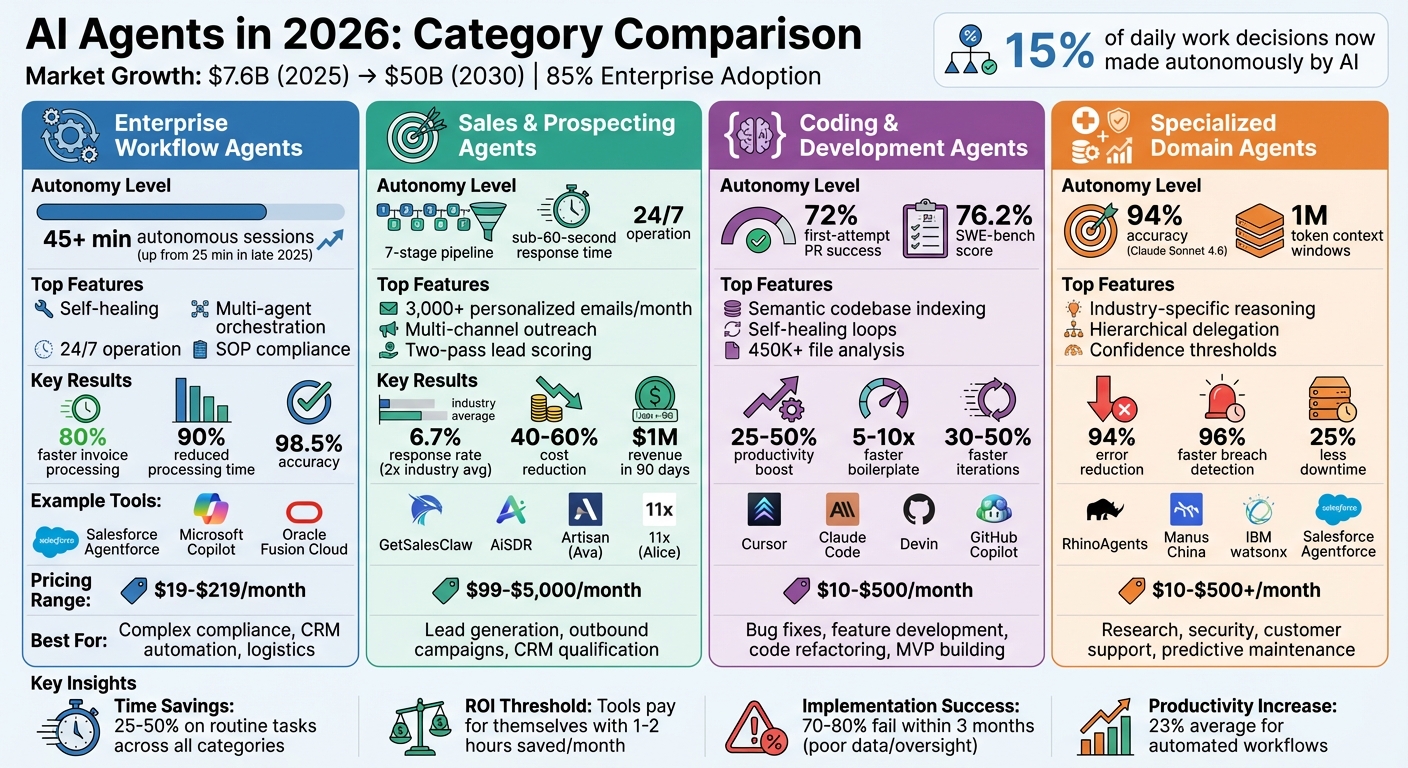
AI Agent Categories Comparison: Features, Use Cases, and Pricing 2026
Top 7 AI Agent Tools That Actually Work
sbb-itb-212c9ea
1. Enterprise Workflow Automation Agents
Enterprise workflow automation agents have evolved from merely carrying out predefined tasks to systems capable of achieving high-level objectives. These agents now assess constraints, interact with various systems, and work persistently toward goals, only escalating issues when necessary. Unlike earlier models that required detailed step-by-step instructions, current agents independently break down complex objectives into actionable plans and refine their strategies through self-reflection. Let’s delve into their autonomy, features, real-world applications, and pricing.
Autonomy Level
The transition from reactive tools to proactive systems has transformed enterprise operations. For instance, coding agents have seen their longest autonomous sessions nearly double - from under 25 minutes in late 2025 to over 45 minutes by January 2026. These agents now pause to seek clarification when faced with uncertainty. Interestingly, over 40% of experienced users enable "full auto-approve" mode, allowing agents to act without manual approval. Despite this autonomy, enterprises enforce strict monitoring and rules to maintain accountability.
"If each step in your agent workflow has 95% accuracy, by step 10, you're down to 60% reliability. Most 'autonomous' systems need 20+ steps. The numbers get ugly fast."
– Dean Pleban, LinkedIn
Key Features
Modern enterprise agents stand out due to their ability to self-heal and recover autonomously. They can identify and fix issues like API timeouts, data entry errors, or logic failures on their own. Unlike traditional RPA systems that struggle with even minor UI changes, these agents understand the intent behind tasks, allowing them to adapt seamlessly. They also maintain context over multi-day processes, ensuring they stay on track without losing sight of the end goal.
Another key strength is multi-agent orchestration. Specialized agents - for areas like compliance, procurement, and finance - work together in structured workflows, akin to a "digital assembly line". Manager agents delegate tasks to sub-agents, creating efficient hierarchies that handle complex operations. These systems adhere strictly to standard operating procedures (SOPs) to avoid deviations from company policies. Often running 24/7 on pre-set schedules, these agents have shifted from a "chat" interaction model to full delegation.
Best Use Cases
The practical benefits of these agents are evident in real-world applications:
- JPMorgan Chase: The COiN (Contract Intelligence) agent reduced document review time from 360,000 annual manual hours to just seconds, improving accuracy in legal and financial analysis.
- FPT Software's IvyChat: This platform, launched in March 2026, streamlined data processing and translation across fragmented systems, cutting processing time by 90%, achieving 95% translation accuracy, and lowering human costs by 33%.
- Insurance Sector: AI agents extracted data from complex financial documents, saving 200 hours of weekly manual labor and achieving 98.5% accuracy.
- Oracle Fusion Cloud: Customers reduced invoice processing cycles by 80% and avoided supply chain disruptions with predictive agents that re-routed shipments based on real-time logistics data.
- Salesforce Agentforce 3.0: Automated 85% of tier-1 support queries and 60% of routine sales follow-ups using self-healing workflows.
Pricing
Costs vary depending on the platform and features:
- Carly: $35/month
- Manus: Plus at $19/month, Pro at $199/month
- Lindy: Starting at $49/month
- Microsoft Copilot: $30/user/month, with Copilot Studio upgrades at $200/user/month
- Fleece AI: Tiers ranging from $54 to $219/month
2. Autonomous Sales and Prospecting Agents
Sales and prospecting agents have come a long way from merely offering suggestions. These systems now reason, decide, and act across multiple platforms with minimal human intervention. They work around the clock, handling tasks like finding prospects, creating personalized outreach, and managing follow-ups. By early 2026, Gartner predicted that 75% of B2B sales organizations would adopt AI-driven sales development, with the AI SDR market reaching an estimated $4.8 billion.
Autonomy Level
These agents operate through a detailed seven-stage pipeline: prospect detection, multi-pass lead scoring, human-in-the-loop (HITL) approval, research-based email generation, sequencing, CRM synchronization, and follow-up management. They rely on critical signals to trigger outreach automatically. Advanced agents use a two-pass scoring system, where a cost-efficient model like Claude Haiku initially screens leads, and a more advanced model like Claude Sonnet conducts deeper analysis on qualified prospects.
Response times are lightning-fast, with AI agents delivering sub-60-second responses 24/7. Despite this high level of autonomy, many systems still incorporate HITL controls, allowing human oversight through mobile notifications (e.g., Telegram) before outreach is finalized. These capabilities are further enhanced by intelligent personalization, making outreach more effective.
Key Features
One of the most impressive features of these agents is their ability to deliver personalized communication at scale. They research specific details about prospects - such as recent company updates, LinkedIn activity, or hiring trends - to craft tailored emails. Outreach spans multiple channels, including email, LinkedIn, SMS, WhatsApp, and voice calls. This approach enables agents to send over 3,000 personalized emails monthly, compared to the 75–285 emails typically managed by human representatives.
These agents also integrate seamlessly with platforms like Apollo, LinkedIn, and ZoomInfo to identify prospects that match Ideal Customer Profiles, eliminating the need for manual list uploads. With self-optimization loops, they adjust strategies in real time, achieving goals like 20 qualified demos per month.
"The competitive divide in 2026 is no longer between those who use AI and those who don't - it is between those using AI as a tool and those using it as an autonomous agent." – Stormy AI
Best Use Cases
Real-world examples highlight their impact. Between late 2025 and early 2026, SaaStr deployed five specialized AI agents (including Artisan, Qualified, and Salesforce Agentforce) to cover different stages of the sales funnel. Over six months, these agents sent 19,847 outbound messages, achieving a 6.7% response rate - double the industry average. One inbound qualification agent alone generated over $1 million in closed revenue within 90 days, accounting for 20% of total event ticket sales. Maintaining this level of performance required just 15–20 hours of weekly human oversight.
The cost savings are striking. Companies using autonomous SDRs report a 40–60% reduction in cost-per-qualified-meeting. The cost per sales "resolution" has dropped from $15 with human teams to just $2 with AI-driven workflows. What once cost $5,000 per month in 2024 is now available for as little as $99 per month, allowing even solo entrepreneurs to run enterprise-grade outbound operations. However, success isn't guaranteed - 70–80% of implementations fail within three months, often due to poor data quality or insufficient oversight.
Pricing
Autonomous sales agents are available at a range of price points, making them accessible to businesses of all sizes:
| Platform | Monthly Cost | Best For |
|---|---|---|
| GetSalesClaw | $99 – $499 | Startups and SMBs |
| Agent Frank | $48 – $599 | Automated prospecting |
| AiSDR | $900 – $2,500 | Mid-market outbound |
| Artisan (Ava) | $2,000 – $5,000 | Enterprise multi-channel |
| 11x (Alice) | ~$5,000 | Enterprise Salesforce users |
| Salesforce Agentforce | ~$680,000/year (50 users) | Large enterprise ecosystems |
The pricing reflects how accessible these tools have become. Even the most expensive tier costs roughly the same as the annual salary of a junior SDR ($85,000–$120,000), but with the added benefits of 24/7 operation, instant scalability, and no training period. Entry-level platforms starting at $99 per month make it possible for companies of any size to leverage autonomous sales, while enterprise-grade solutions with deep CRM integration come at a premium price.
3. AI-Powered Development and Coding Agents
Development tools driven by AI are reshaping how software is created, much like workflow and sales agents have revolutionized their respective domains. These coding agents have transitioned from basic autocomplete tools to systems capable of planning, executing, and delivering complete features with minimal human intervention. By early 2026, 85% of developers reported using AI for coding tasks, and these agents now account for about 4% of all public GitHub commits - a number expected to hit 20% by the end of the year. This shift is changing the role of developers, moving them from writing individual lines of code to managing agents and focusing on broader architectural strategies.
Autonomy Level
Today's coding agents rely on a planning-execution-verification cycle to function effectively. They analyze the entire codebase, create a detailed plan, implement changes across multiple files, and perform tests to self-correct before submitting a pull request. Tools like Devin and Claude Code operate in controlled environments equipped with integrated shells, browsers, and editors, enabling them to install packages, run servers, and verify results independently.
These tools are categorized by levels of autonomy, ranging from basic autocomplete (Level 0) to fully autonomous systems (Level 4). At Level 4, agents can take a high-level request - such as "add Google OAuth to this Express.js API" - and produce a fully tested pull request without needing real-time human input. In March 2026, Devin achieved a 72% first-attempt success rate for generating mergeable pull requests during real-world testing. On the SWE-bench Verified leaderboard, which evaluates agents on solving real GitHub issues, Gemini 3 Flash scored 76.2%, and GPT 5.2 achieved 75.4% as of January 2026.
"Devin is not helping you code faster. It is coding for you." – Atlas, Reviewer at Agent Finder
This level of autonomy is setting the stage for a major transformation in how code is produced.
Key Features
Coding agents bring advanced capabilities to streamline and optimize workflows. One standout feature is semantic codebase indexing, which allows tools like Augment Code and Cursor to map out entire repositories into "semantic dependency graphs." This enables a deep understanding of relationships across hundreds of thousands of files. For example, in early 2026, a senior engineer used Augment Code to analyze a 450,000-file e-commerce monorepo. Within 27 minutes, the tool identified inconsistencies in a JWT validation library across three microservices, resolving persistent 401 errors.
Another critical capability is the use of self-healing loops. These tools automatically run test suites, analyze failure logs, and repair code until all tests pass. They integrate directly with platforms like GitHub and GitLab, managing branches, commits, and pull requests with detailed explanations. Advanced systems even employ multi-agent orchestration, where different agents specialize in tasks like implementation, testing, and documentation, working together to tackle complex workflows.
Some agents can also interpret Figma assets and design tokens to implement UI components directly, bridging the gap between design and development. Including "security prompts" in their instructions has been shown to improve secure code generation from 56% to 66%. Simple tasks take an average of 28 minutes to complete, while more complex features require about 2.1 hours.
Best Use Cases
Real-world applications highlight the impressive capabilities of these agents. For instance, in early 2026, Duolingo used OpenAI Codex to review backend Python code. Senior Software Engineer Aaron Wang noted that it was the only tool capable of consistently identifying backward compatibility issues and "hard bugs" that other bots overlooked. At Harvey, Mobile Lead Joey Wang leveraged Codex to handle routine engineering tasks, cutting early-stage iteration time by 30–50% and allowing engineers to focus on system design.
In February 2026, a Cisco Meraki tech lead used Codex to refactor and test code for a critical release. The agent managed the entire process, delivering fully tested code on time without requiring additional human resources. Similarly, a fintech startup used Claude Code to automate the creation of 500 personalized landing pages, reducing time-to-market from four weeks to just two days and boosting conversions by 22%.
"At Harvey, Codex transformed how we build by cutting early iteration time by 30–50%, freeing engineers to focus on system design and high-leverage decisions." – Joey Wang, Mobile Lead, Harvey
Teams have reported 25–50% productivity improvements for routine tasks, with AI agents speeding up boilerplate and CRUD operations by 5–10x. Feature development is typically completed 2–3x faster. In January 2026, Salesforce revealed that over 90% of its 20,000+ engineers use Cursor daily, leading to significant improvements in cycle time and PR velocity. NVIDIA also reported that all 40,000 of its engineers benefit from AI assistance through Cursor.
"My favorite enterprise AI service is Cursor. Every one of our engineers, some 40,000, are now assisted by AI and our productivity has gone up incredibly." – Jensen Huang, President & CEO, NVIDIA
Ideal use cases include routine maintenance like bug fixes and dependency updates, database schema migrations, converting legacy code to modern standards, and building MVPs or REST APIs from natural language descriptions. Teams using AI agents for technical SEO and infrastructure have also reported a 35% reduction in technical debt.
Pricing
These tools offer a range of pricing options to suit different needs:
| Tool | Monthly Cost | Key Details |
|---|---|---|
| Cursor | $20 – $60 | Pro at $20; Individual at $60 (includes $70 usage credits) |
| Claude Code | $20 – $200 | Pro at $20; Max at $100–$200 |
| GitHub Copilot | $10 – $39 | Individual at $10; Pro+ and Enterprise at $39/user |
| OpenAI Codex | $20 – $200 | Included in ChatGPT Plus at $20; Pro at $200 (unlimited) |
| Devin | $20 – $500 | Core at $20 (~9 ACUs); Team at $500 (250 ACUs) |
| Augment Code | $20 – $60 | Credit-based system for semantic analysis |
| Replit Agent 3 | $20 – $100 | Core and Pro tiers with monthly credits |
Entry-level tools like Cursor and Claude Code, starting at $20 per month, make these capabilities accessible to individual developers and smaller teams. For larger organizations, enterprise-grade solutions like Devin's Team tier at $500 per month include 250 Agent Compute Units (ACUs), with additional ACUs priced at $2 each. Simple bug fixes typically use 1–3 ACUs, while building full features may require 10–20 ACUs. Open-source options like SWE-Agent and OpenHands are also available, with users covering their own LLM API costs.
4. Specialized Domain Agents
Specialized domain agents are transforming workflows by autonomously handling entire processes. By 2026, 40% of enterprise applications are expected to utilize these task-specific agents, a dramatic increase from under 1% in 2024. These tools are delivering measurable results across industries, and their autonomy, features, and applications highlight their growing importance.
Autonomy Level
These agents work on a delegation model. You provide a high-level goal - like "qualify 500 leads and schedule meetings with decision-makers" - and the agent carries out the entire task independently. Using advanced reasoning engines, they follow "Reason and Act" (ReAct) cycles, which allow them to assess progress, self-reflect, and adjust strategies without human input.
In 2026, Claude Sonnet 4.6 achieved a 94% accuracy rate on the Pace insurance benchmark, while Gemini 3.1 Pro scored 77.1% on the ARC-AGI-2 reasoning benchmark. These agents can now even interact with desktop interfaces through "Computer Use" capabilities, enabling them to navigate older software systems and fill out forms without needing APIs.
"The shift from 2025 to 2026 is best described as the move from chat to delegation - a paradigm known as agentic AI." – Fleece AI
Organizations using these agents have reported a 23% average increase in productivity for automated workflows by 2026.
Key Features
Specialized domain agents are equipped with features tailored to specific industries. Their cognitive architectures are designed for tasks like synthesizing scientific papers, conducting competitive analyses, or detecting threats autonomously. They also integrate seamlessly with industry-standard platforms - Salesforce Agentforce, for example, operates directly within CRM systems, while security-focused agents connect to enterprise monitoring tools.
Many advanced agents operate in hierarchies, where a "manager" agent delegates tasks - such as data collection or reporting - to sub-agents. With expanded context windows, tools like Gemini 3.1 Pro and Claude Sonnet 4.6 can now process up to 1 million tokens, enabling them to handle entire codebases or large document sets in one go.
These agents also employ confidence thresholds, autonomously managing tasks they are confident in while escalating uncertain or high-risk decisions to humans.
Best Use Cases
The impact of these agents is already evident in various industries:
- A European bank using RhinoAgents cut loan review times from five days to under 24 hours and reduced errors by 94%.
- A Chinese logistics company deployed Manus China agents to optimize fleet routing, reducing fuel costs by 15% and improving delivery times by 20%.
- Siemens reported a 25% reduction in unplanned downtime by integrating specialized agents into industrial sensors for predictive maintenance.
- In cybersecurity, a European fintech company reduced breach detection times from 72 hours to under 3 hours using specialized security agents.
"AI security agents can reduce breach detection time by 96 percent and cut fraud-related losses by 40 percent in the banking sector." – IBM
Other common applications include customer support agents that autonomously resolve tickets, finance agents that match payments to invoices and flag anomalies, and research agents that compile multi-source reports with citations. IT teams also leverage these agents for tasks like handling access requests and responding to threats.
Pricing
The cost of specialized domain agents varies widely based on their complexity and scale:
| Domain | Tool Examples | Monthly Cost |
|---|---|---|
| Research | Perplexity Max, Elicit Pro | $10 – $200 |
| Sales/Marketing | Fleece AI, Lindy AI | $49 – $199 |
| Customer Support | Salesforce Agentforce | $2/conversation or $125–$150 per user |
| Enterprise Automation | Microsoft Copilot for 365 | $30 – $60 per user |
| IT/Security | IBM watsonx Orchestrate | Starts at $500 |
Entry-level tools like Elicit Pro are accessible for individuals, starting at $10–$20 per month. Sales and marketing agents, such as Fleece AI, range from $49–$199 monthly. Enterprise solutions are priced higher - Salesforce Agentforce charges $2 per conversation or $125–$150 per user, while IBM watsonx Orchestrate starts at $500 per month. For cost-conscious users, platforms like n8n and Make.com enable the use of custom LLM API keys, reducing expenses by up to 90% compared to built-in solutions.
Pros and Cons
When evaluating the features and impact of various AI agent categories, it's crucial to weigh their strengths against their challenges. This balanced perspective ensures you pick the right tool for your unique requirements.
Enterprise workflow automation agents stand out with their seamless integration into platforms like SAP and Salesforce. They offer advanced security measures and self-healing capabilities, which can automatically detect and repair issues like broken CRM triggers or API timeouts in real-time. However, these benefits come at a cost. Implementation expenses can range from $50,000 to $150,000, and their management often demands specialized expertise.
Autonomous sales and prospecting agents, on the other hand, shine in their ability to nurture leads around the clock. They can automate up to 60% of routine sales follow-ups, leveraging Retrieval-Augmented Generation (RAG) to access live CRM data for improved accuracy, as reported by Salesforce users. Yet, these agents have their pitfalls. Poor CRM data can amplify errors, and security remains a significant concern - 62% of practitioners cite risks like data leakage and unauthorized actions as top challenges.
AI-powered development and coding agents are known for their ability to boost developer productivity by two to three times across tasks. For example, Claude Code achieved an impressive 80.9% accuracy on the SWE-bench Verified benchmark in early 2026, setting a new standard. Terminal-based agents also stand out for being 5.5 times more token-efficient. However, these advantages come with hurdles such as high token consumption costs and a steep learning curve. Additionally, a February 2026 scan of the OpenClaw marketplace revealed that around 20% of available "skills" were malicious, involving data-stealing malware.
Specialized domain agents excel in focused tasks like conducting in-depth research or synthesizing scientific information. They adapt their strategies to meet specific industry needs through ongoing self-assessment. However, their ability to orchestrate multiple applications or handle scheduled workflows is limited. As Jonas Diezun from Beam AI remarked:
"90% of legacy agents fail within weeks of deployment because they lack the architectural depth to handle the messy, unpredictable nature of modern enterprise operations".
Conclusion
By 2026, the AI agent landscape has matured into a realm of practical, production-ready tools that deliver measurable results. Success lies in selecting the right agent for your specific needs rather than chasing the latest, flashiest tech.
For enterprise teams, platforms like Salesforce Agentforce and Microsoft Copilot are streamlining critical support and sales operations. Software development teams can benefit from tools like Claude Code or Cursor AI, with Claude achieving an impressive 80.9% accuracy on the SWE-bench Verified benchmark. Meanwhile, small to mid-sized businesses seeking adaptable solutions without technical complexity might find Lindy AI or Carly to be better fits.
Start small. Automating low-risk tasks such as email sorting or lead enrichment is a great way to build confidence before tackling more critical operations. Agents priced between $20 and $200 per month often pay for themselves by saving just 1–2 hours of work each month. To avoid integration headaches, focus on tools that seamlessly connect with your current systems - for example, Gemini for Google Workspace or Agentforce for Salesforce.
Businesses already leveraging AI agents aren't waiting for flawless solutions. They're addressing specific challenges, testing targeted tools, and scaling up what works. With Gartner predicting that 15% of daily work decisions will be made autonomously by 2026, the real question isn't whether to adopt AI agents - it’s which ones will deliver the quickest and most meaningful impact for your business.
To maximize ROI, compare subscription costs to time saved, establish human approval checkpoints for high-stakes decisions, and closely monitor agent performance during the first 30 days. The tools that pass this initial test are the ones that will redefine your operations in the coming months. This thoughtful approach to testing and refining solutions will drive the next wave of operational progress.
FAQs
What makes an AI agent truly autonomous?
An AI agent achieves true autonomy when it can independently define goals and carry out tasks without needing ongoing human guidance. This means it can navigate the web, utilize tools, write code, interact with APIs, and continue refining its approach until the task is completed. The hallmark of true autonomy lies in managing these processes effortlessly from start to finish.
How do I pick the right AI agent for my business?
To pick the right AI agent, start by pinpointing your specific needs - whether it's automation, coding, research, or something else. Look for tools tailored to those tasks. It's also important to choose agents that are dependable, can manage complex workflows, and require little hands-on oversight. Make sure the agent works seamlessly with your existing systems, adjusts to changing requirements, and performs well in practical settings. By focusing on functionality, dependability, and compatibility, you can select the ideal solution for your business.
How can I use AI agents safely with company data?
To use AI agents with company data securely, it's crucial to address potential security risks and establish a strong protective framework. Start by encrypting sensitive data to safeguard it during storage and transmission. Implement strict access controls to ensure only authorized personnel can interact with the data. Additionally, limit the amount of data shared with AI systems to reduce exposure.
Always review the security policies and practices of each AI tool you use, ensuring they align with your organization's standards. Secure integration is another critical step - this helps close potential gaps that could lead to vulnerabilities. By combining careful planning with a well-engineered approach, you can protect your company's data while leveraging the benefits of AI agents.