AI Ethics And Governance
Top AI News for July 2026: Breakthroughs, Launches & Trends You Can’t Miss
AI became more useful and more controlled in July: practical agent tools, tighter access rules, and massive compute deals.

Top AI News for July 2026: Breakthroughs, Launches & Trends You Can’t Miss
July 2026 boils down to three things: better AI tools for daily work, tighter access rules, and much bigger compute spending.
If I had to sum up the month in plain English, it would be this: AI got more useful and more controlled at the same time. Claude Sonnet 5 pushed agent-style coding and workflow use into day-to-day business work, Google shipped new video and image tools, and GitHub Copilot added its first open-weight coding model. At the same time, access to top systems got more restricted through ID checks, vetted previews, and credits-based billing.
Here’s the short version:
- Claude Sonnet 5 stood out for coding, debugging, and multi-step work, with intro pricing at $2 per 1 million input tokens and $10 per 1 million output tokens until August 31, 2026
- Gemini Omni Flash and Nano Banana 2 Lite made video editing and image generation more usable for teams right now
- Kimi K2.7 Code became the first open-weight model inside GitHub Copilot
- Reflection AI locked in $6.3 billion in compute through 2029
- Federal agencies hit a July 2 deadline tied to the June 2 AI executive order
- Frontier access is getting more controlled with ID verification, limited previews, watermarking, and metered use
What this means for you: if you build, buy, or manage AI tools, the main question is no longer just “Which model is best?” It’s also “Can I get access, what will it cost, and will my team meet the new rules?”
A few points stand above the rest. First, agentic AI is moving from test mode into paid work. Second, pricing and access now matter almost as much as model quality. Third, infrastructure and policy are starting to shape who can ship fast and who gets slowed down.
That’s the lens I’d use to read the month: useful models are arriving fast, but access is getting tighter just as demand grows.
Meta to Build Cloud Business to Sell Excess AI Compute | Bloomberg Tech 7/01/2026
sbb-itb-212c9ea
Major Model Releases and Product Launches
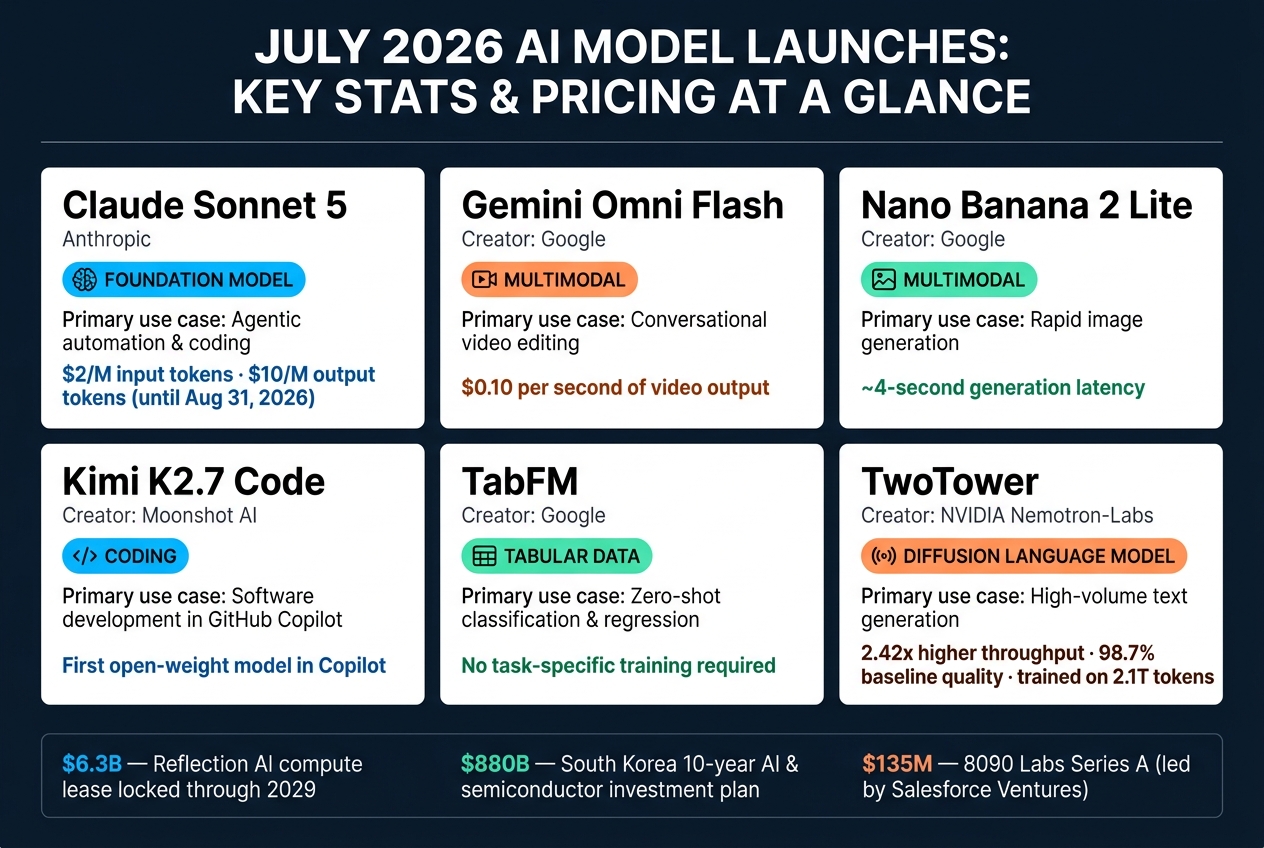
July 2026 AI Model Launches: Key Stats & Pricing at a Glance
Foundation Models That Changed How Work Gets Done
The biggest foundation-model release this month is Claude Sonnet 5 from Anthropic. It brings stronger long-run coding, tool use, and debugging at a lower price, which makes it a solid pick for agentic coding and debugging workflows. Pricing is $2 per million input tokens and $10 per million output tokens, then moves to $3/$15 after August 31, 2026.
Another launch to watch is NVIDIA's Nemotron-Labs-TwoTower. This open-weight diffusion language model generates text in parallel, which helps it deliver 2.42x higher throughput while keeping 98.7% of baseline quality. It was trained on about 2.1 trillion tokens.
Google's TabFM also stands out among this month's model releases. It's a zero-shot model for tabular data that can handle classification and regression without task-specific training or manual feature engineering.
New AI Tools and Features Available Right Now
Those releases are already making their way into tools people can use today. Kimi K2.7 Code from Moonshot AI became the first open-weight model available in GitHub Copilot's model picker. It uses provider list rates under Copilot's usage-based billing, and enterprise admins need to turn it on before developers can access it.
Google also rolled out Gemini Omni Flash and Nano Banana 2 Lite on the Gemini Enterprise Agent Platform. Omni Flash is built for conversational video editing and costs $0.10 per second of video output, while Nano Banana 2 Lite can generate images in about 4 seconds. Both ship with C2PA credentials and SynthID watermarks turned on by default.
July Launches at a Glance
| Name | Category | Primary Use Case | Main Advantage |
|---|---|---|---|
| Claude Sonnet 5 | Foundation Model | Agentic automation & coding | Opus-level reasoning at a lower price point |
| Gemini Omni Flash | Multimodal | Video generation & editing | Conversational video editing at $0.10/sec |
| Nano Banana 2 Lite | Multimodal | Rapid image generation | ~4-second generation latency |
| Kimi K2.7 Code | Coding | Software development | First open-weight option in Copilot |
| TabFM | Tabular Data | Classification & regression | Zero-shot prediction without training |
| TwoTower | Diffusion Language Model | High-volume text generation | 2.42x higher throughput than standard AR models |
These launches tee up the next issue: which enterprise moves and policy shifts are most likely to shape adoption?
Research Advances, Deals, and Policy Shifts
Research and Technical Advances Worth Knowing
Two technical stories stand out because they could affect deployment in the near term.
First, OpenAI and Broadcom's "Jalapeño" chip reached tape-out in just 9 months from the initial design phase. It's an inference chip built for LLM workloads, with the goal of better performance per watt.
Second, Meta's Brain2Qwerty v2 hit 61% average word accuracy when converting non-invasive MEG brain signals into text. That's up from 8% in earlier models. This is still early research, but that jump is hard to ignore. Non-invasive brain-computer interfaces may be moving faster than many people expected.
Also on the technical side, JetSpec posted a 9.64x speedup on MATH-500 benchmarks by using a method that predicts tokens ahead of time.
Put together, Jalapeño, Brain2Qwerty v2, and JetSpec point to faster movement in chip design, brain-signal decoding, and speculative decoding. Those gains are also feeding much bigger compute bets.
Funding, Partnerships, and Enterprise Moves
Reflection AI activated a $6.3 billion compute lease at SpaceX's Colossus 2 facility in Memphis on July 1. The deal locks in Nvidia GB300 chips through 2029 to train American open-weight frontier models. That move makes one thing clear: compute is now treated like a strategic asset in the push to build domestically controlled AI infrastructure. And that push is now running into tighter access controls.
On the enterprise side, 8090 Labs closed a $135 million Series A led by Salesforce Ventures. The funding will help scale its "Software Factory" platform, an agentic coding system built for regulated sectors like healthcare and aerospace. EY's rollout of the platform across tens of thousands of U.S. consultants reportedly lifted software development productivity by 70%.
Media and marketing also saw big moves. Google's $75 million partnership with A24 brought AI into filmmaking workflows, while WPP added Gemini Omni Flash to its WPP Open platform. That gave teams conversational video editing for asset localization and dynamic style transfers.
U.S. and Global Policy Updates That Affect Deployment
Beyond model launches, July's AI story is increasingly about who gets to deploy frontier systems and under what rules. Policy changes this month focused on identity checks, restricted previews, and watermarking requirements.
Fable 5 returned with mandatory identity verification through Persona, starting July 8, and shifted to usage credits instead of flat-rate subscriptions. Mythos 5 is still limited to vetted U.S. critical infrastructure defenders through Project Glasswing, Anthropic's controlled-access program. GPT-5.6 Sol is limited to about 20 approved organizations in a government-gated preview.
The pattern is pretty clear: frontier AI is becoming verified, metered, and restricted.
The Five Eyes intelligence alliance issued a blunt warning in July that frontier AI models will "fundamentally transform" offensive and defensive cyber capabilities, and that the timeline is "not years, it is months". For businesses, that means planning for identity checks, safety audits, and default watermarking on AI media.
Globally, South Korea announced an $880 billion 10-year investment plan covering semiconductors, AI infrastructure, and robotics. Samsung and SK Hynix alone are set to commit $518 billion toward new chip fabrication sites.
What July 2026 Means for Businesses, Creators, Startups, and Everyday Users
Which July Updates Are Worth Testing Now
The most useful July test for a lot of teams is Claude Sonnet 5. It offers strong agentic coding at a lower intro price through Aug. 31, 2026. That makes it a solid pick for teams trying out autonomous coding and workflow automation without spending top-tier money.
In July, insurance tech firm Pace used it on live systems for multi-step insurance work, including intake and claims setup. That matters because it moves the model out of the demo phase and into day-to-day business use.
Software developers should watch for one gotcha: Sonnet 5 removes temperature and top_p parameters. If those calls are still sitting in your code, the API will throw errors. So before migrating, audit your integrations.
For content and marketing teams, Nano Banana 2 Lite is now inside Adobe Firefly for fast ad testing. That could make early campaign iteration much less of a slog.
Support teams got a practical update too. The xAI Voice Agent Builder can create production-ready voice agents in under two minutes with no code required. Pricing is $0.05 per minute of audio plus $0.01 per minute for telephony. If your team wants hard pricing data, July is a good time to run a pilot before Aug. 31, 2026.
Market Signals for Brands and Builders
Zoom out a bit, and July’s releases show a clear pattern. The market is splitting into tiers.
- Frontier models are being gated more tightly.
- Mid-tier models like Claude Sonnet 5 and GPT-5.6 Sol are getting close to flagship-level performance at lower prices.
- Open-weight options like Kimi K2.7 Code, now available directly inside GitHub Copilot, give cost-aware teams a cheaper route with usage-based billing.
That short-term pricing pressure points to a bigger shift in how AI products are being sold. It’s not just about raw model power anymore. More labs are turning AI into job-specific workbenches.
You can see that in tools like Claude Science for drug discovery and 8090 Labs' Software Factory for regulated industries. Instead of handing users a general model and saying “good luck,” these products wrap the model inside a setup built for a specific kind of work.
Notion tested this idea in July through a memory partnership with Engram. It used prebuilt workspace context to cut token use by up to 10x. That’s the kind of move brands and builders should pay attention to: less waste, lower cost, and tools that fit the job more closely.
These patterns set up the key July takeaways that follow.
Key AI News to Remember From July 2026
July's biggest signals came down to three things: easier access, faster workflows, and tighter deployment rules.
Claude Sonnet 5 was the clearest sign that agentic coding is moving into mainstream use. At the same time, Google's Nano Banana 2 Lite and Gemini Omni Flash pushed image-to-video workflows from "interesting demo" territory into something teams can actually use day to day. Put together, these launches made multimodal and coding workflows more usable for everyday teams.
The other major July shift was access risk. Fable 5's pause showed that frontier access can change overnight for policy reasons. That's a big deal. Access controls are now a real deployment risk that businesses need to plan for, not just a background compliance detail.
Infrastructure told the same story. Etched launched with a $5B valuation and $1B in signed contracts for specialized AI inference chips. That points to a market where demand for dedicated inference capacity is already large enough to support a new wave of hardware companies.
August now matters for pricing, access, and compliance.
FAQs
Which July AI launch is best to test first?
Claude Sonnet 5 is the most practical model to test first if you want something you can use right away across a lot of tasks. It became the default model for all Claude plans on June 30, 2026, so it's easy to access for day-to-day reasoning, coding, and tool use.
If your focus is fast image iteration, Nano Banana 2 Lite is also a smart choice. It stands out for speed and lower cost.
How do new access rules affect AI adoption?
New access rules are changing how AI gets released. For frontier models, the path to launch may get tighter and more closely reviewed by the government.
That means developers may have to give federal evaluators early pre-release access, report malicious activity, and meet strict security rules. In practice, this can lead to staggered rollouts and tighter access for more powerful models.
Who gets access first? In many cases, vetted critical infrastructure organizations may move to the front of the line, while the public gets access later. So instead of a broad launch on day one, companies may release high-end models in phases and under tighter controls.
What should teams budget for AI in August 2026?
For August 2026, teams should plan around Claude Sonnet 5’s intro pricing: $2.00 per million input tokens and $10.00 per million output tokens through August 31, 2026. After that date, pricing moves up to $3.00 per million input tokens and $15.00 per million output tokens.
There’s another cost factor to watch: the updated tokenizer may produce 1.0 to 1.35 times more tokens for the same text. That means a prompt that used to fit one budget range could now cost more without any change in the content itself.
Because of that, it’s smart to benchmark your workloads and double-check budget enforcement settings. Teams should also review production code, since the removal of temperature and sampling parameters may call for updates in how requests are handled.